APAC Enterprises Commit $1M+ to Agentic AI: The End of Conceptual AI and the Rise of Autonomous Operations
Key Takeaways
Major APAC enterprises are shifting spending from generative AI proof-of-concept projects to highly autonomous, goal-oriented Agentic AI systems, signaling a fundamental move toward operationalizing complex, multi-step business workflows.
The global enterprise technology landscape is undergoing a profound structural metamorphosis, moving beyond the initial fascination with Generative AI (GenAI) to a massive, concerted deployment of Agentic AI. This shift, evidenced by reports showing nearly half of APAC enterprises committing substantial capital—some surpassing $1 million—to autonomous systems, signals a pivotal moment: businesses are finally transitioning from conceptual AI demonstrations to mission-critical, operational intelligence. This is not merely an incremental software upgrade; it represents a fundamental architectural overhaul of how complex commercial workflows are planned, executed, and managed.
For years, the industry debated the capabilities of large language models (LLMs), often focusing on text generation and query answering. However, real-world commercial complexity—like optimizing a quarterly cross-border payment cycle or processing complex insurance claims—cannot be solved by a single prompt or a single model output. The new investment wave into Agentic AI recognizes this limitation, channeling capital into systems capable of genuine autonomy. These agents are designed not just to generate information, but to act on it, bridging the critical gap between artificial intelligence potential and measurable, end-to-end operational results.
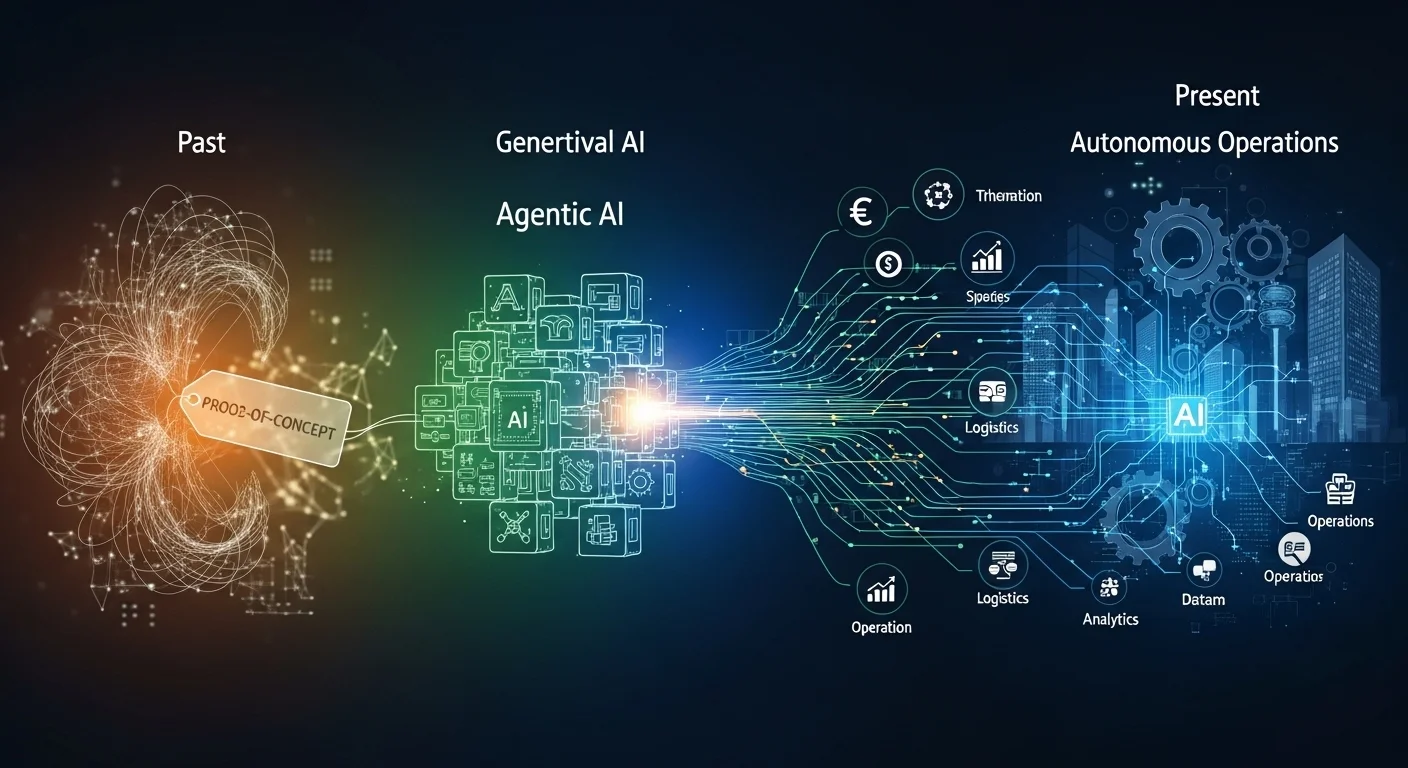
How Does Agentic AI Differ from Standard GenAI Models?
To understand the magnitude of the capital expenditure, one must first understand the functional distinction between its predecessor and its successor. Standard GenAI, while revolutionary in its ability to understand natural language and generate highly coherent content, is fundamentally a sophisticated predictive engine. It answers "what" or "what if."
Agentic AI, conversely, is designed as an orchestrator. It is given a high-level, strategic objective—a goal—and possesses the ability to break that goal down into a sequence of executable steps. It functions with a planning layer, memory, and external tool access (APIs). If a bank needs to reconcile a failed cross-border transfer involving three different jurisdictions, a GenAI model might draft a summary of the necessary steps; an Agentic AI agent will autonomously execute those steps: logging into the external API, querying the ledger, cross-referencing risk databases, making a decision on the next action, and generating a compliant report—all without human intervention at the execution level.
This capability—the autonomous, multi-step execution loop—is the defining technological leap that justifies the aggressive spending patterns observed across the Asia-Pacific region. The market confidence is reflected in the projected exponential growth: from an estimated $1.5 billion in 2025 to a massive $41.8 billion by 2030 for the enterprise agentic AI software market.
Key Implications for the FinTech Back-Office Ecosystem
For the Financial Technology sector, the impact of Agentic AI is transformative, particularly in areas previously characterized by technological silos and manual, compliance-heavy processes. The back-office—the engine room of global finance—is ripe for this degree of automation.
Payment Processing Automation and Risk Mitigation
Traditional payment cycles often involve multiple handoffs between disparate systems (core banking, fraud detection, compliance checks, ledger updates). This introduces latency and vulnerability. An autonomous agent can manage this entire workflow in real-time. For example, when a payment transaction occurs, an advanced agent doesn't just check for sufficient funds; it simultaneously analyzes global geopolitical risk indices, checks the recipient’s KYC status across multiple jurisdictions, flags unusual behavioral patterns, and executes multi-factor authorization protocols—all within milliseconds. This capability moves the industry from reactive risk management to predictive, preemptive operational flow control.
Compliance and Regulatory FinTech: Regulatory compliance (RegTech) is notoriously labor-intensive and prone to human error. AI agents excel at pattern recognition across massive datasets. They can continuously monitor transaction flows against dozens of evolving global regulations (AML, KYC, sanctions screening). By automating the ingestion of new regulatory mandates and mapping them instantly to existing operational code, Agentic AI significantly reduces the operational risk inherent in international finance.
The AI Agent Framework: A New Enterprise Standard
The market shift represents a move from "AI assisted workflows" to "Autonomous AI agents." These agents are not simple chatbots; they are sophisticated digital workers designed with the ability to perceive their environment, form complex goals, break those goals into actionable sub-tasks, execute those sub-tasks using external tools (APIs, databases, legacy systems), and learn from the resulting outcomes.
This capability fundamentally changes how enterprises interact with their technology stack. Instead of needing custom integration for every single business process improvement, the agent framework allows businesses to "plug in" the necessary logic and tools, maximizing the lifespan and adaptability of their IT investments.
Key Trends Shaping the Future of Enterprise AI
- Hyper-Personalization of Services: Agents will move beyond mere customer service to become financial advisors, proactively adjusting complex product portfolios based not just on stated risk tolerance, but on inferred life goals and market volatility signals.
- De-centralized Autonomous Operations: We are seeing the rise of decentralized finance (DeFi) systems managed by intelligent agents, removing the need for centralized intermediaries in certain transactional workflows, increasing efficiency, and cutting out counterparty risk.
- The Semantic Layer: Future enterprise systems will use agents that operate on a semantic layer—meaning they understand the meaning and intent behind data, rather than just the structure. This unlocks insights previously trapped in disparate, non-communicating departmental databases.
Conclusion: Operationalizing Intelligence
The shift underway is not merely about adopting new software; it is about operationalizing intelligence. By deploying autonomous agents, enterprises can compress decision cycles from days to seconds, managing complexity and risk at a scale previously unimaginable. The investment today is not in the algorithm itself, but in the orchestration framework that allows that algorithm to act autonomously, connecting the disparate elements of the modern global enterprise.
(End of Article)
Google Search Preference
Add Fintech Monster to your preferred sources
Never miss deep, analytical fintech insights. Prioritize our stories in your Google Search, Discover feed, and AI Overviews with one click.
About the Author
Fintech Monster
Fintech Monster is run by a solo editor with over 20 years of experience in the IT industry. A long-time tech blogger and active trader, the editor brings a combination of deep technical expertise and extended trading experience to analyze the latest fintech startups, market moves, and crypto trends.