Beyond Digitization: How AI Protocols are Reshaping India's Fragmented Healthcare Infrastructure
Key Takeaways
India's Ayushman Bharat Digital Mission (ABDM) combined with open healthcare AI protocols is transforming fragmented medical records into interoperable, verifiable diagnostic and claims settlement infrastructure.
Table of Contents
India’s healthcare landscape is undergoing an unprecedented digital and architectural transformation. At the intersection of the Ayushman Bharat Digital Mission (ABDM) and decentralized open protocols, a new generation of artificial intelligence startups is moving beyond simple electronic medical record (EMR) digitization. By building verifiable AI diagnostic and claims adjudication infrastructure directly atop India Stack’s digital public infrastructure (DPI), these innovators are solving the severe fragmentation that has historically crippled healthcare access, insurance penetration, and clinical outcomes for over 1.4 billion citizens.
Historically, India’s healthcare ecosystem has operated as an archipelago of disconnected, siloed data repositories. A patient visiting a primary healthcare center in a rural district possessed zero portable clinical history when transferring to a tertiary hospital in a metropolitan hub. Furthermore, the health insurance claims settlement process has been plagued by manual paperwork, rampant billing fraud, and agonizing 30-day reimbursement cycles that routinely push middle-class families into medical debt. The convergence of unified health identifiers and open AI protocols is dismantling these structural barriers at population scale.
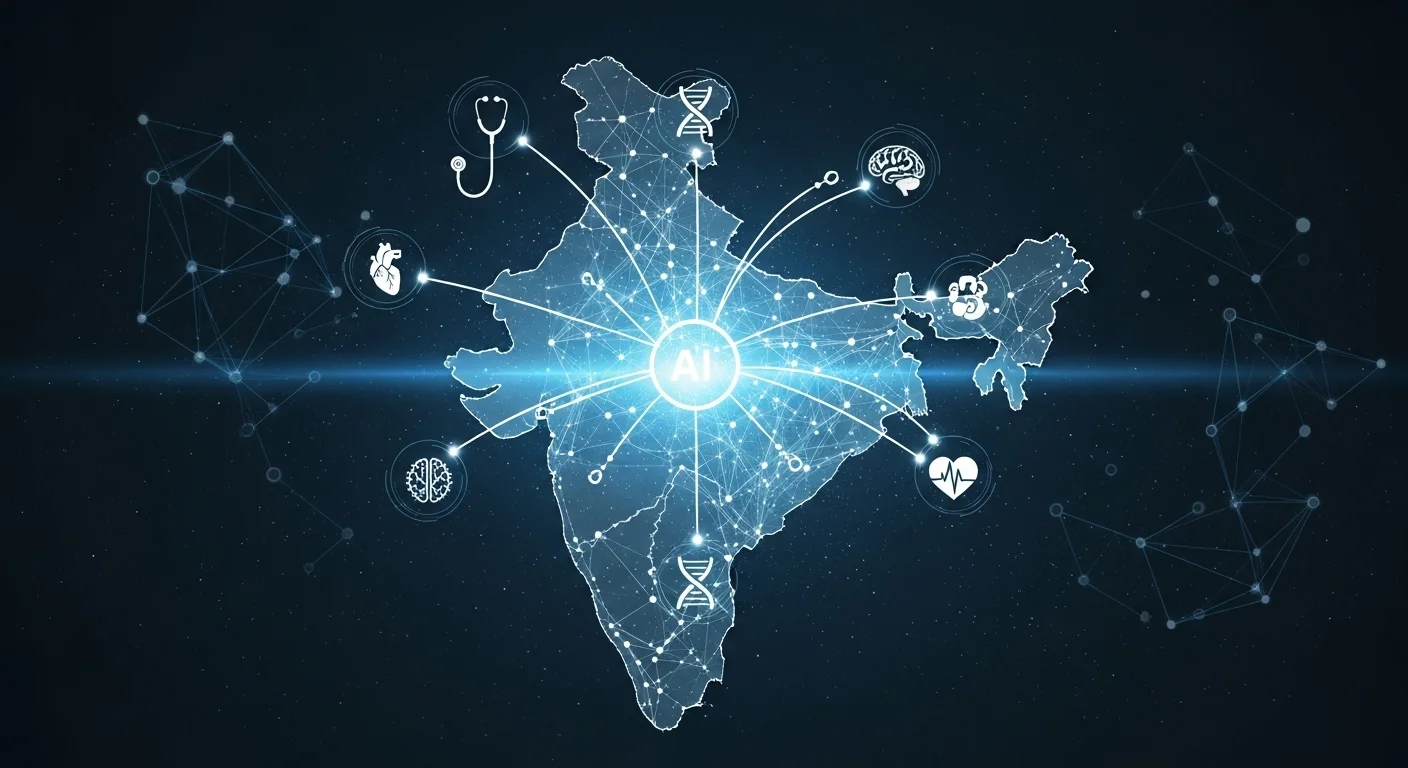
How do open AI protocols and the Ayushman Bharat Digital Mission achieve medical interoperability?
The structural breakthrough enabling this healthcare revolution is the architecture of the Ayushman Bharat Health Account (ABHA) coupled with the Unified Health Interface (UHI). ABHA establishes a 14-digit unique cryptographic identifier that securely binds a citizen’s diagnostic lab reports, clinical prescriptions, and longitudinal health records into a consent-driven, decentralized data mesh.
Building on this foundational layer, healthcare AI startups are deploying edge-based neural diagnostic networks and automated optical character recognition (OCR) engines. These models ingest unstructured handwritten doctor notes, vernacular voice memos, and radiographic imagery, instantly structuring them into standardized Fast Healthcare Interoperability Resources (FHIR) protocols. This automated structuring allows AI diagnostic triage models to run locally at rural clinics, accurately detecting early-stage diabetic retinopathy, tuberculosis, and oncology biomarkers months before symptoms become clinically debilitating.
Key Facts
- Digital Public Infrastructure: Over 500 million ABHA health accounts generated under the Ayushman Bharat Digital Mission framework.
- Open Protocol Standard: Unified Health Interface (UHI) allows open-network interoperability between diagnostic labs, telemedicine providers, and hospital networks.
- Fintech Integration: Automated AI claim adjudication engines compress health insurance settlement times from 30 days to under 15 minutes.
What are the fintech and insurance settlement ramifications of automated health protocols?
The economic ripple effects of this technological infrastructure are transforming the Indian insurtech and health financing sector. By standardizing and cryptographically verifying clinical data at the point of origin, insurance providers can eliminate fraudulent claims and implement real-time, cashless adjudication.
AI agents integrated with hospital management information systems (HMIS) can cross-reference patient diagnosis codes with policy terms, hospital tariff schedules, and clinical treatment pathways, validating coverage in real time and executing automated micro-disbursements directly via the Unified Payments Interface (UPI). This enables insurance underwriters to launch ultra-low-cost, sachet-sized outpatient insurance policies tailored to rural and low-income demographics—a market segment that was previously economically unviable to service under high-friction manual underwriting models.
Expert Commentary
Having analyzed digital public infrastructure, fintech scaling models, and institutional capital deployments across emerging markets for more than twenty years, India’s approach to healthcare modernization is nothing short of breathtaking. While Western healthcare systems remain hopelessly trapped in proprietary, multi-billion-dollar vendor lock-ins with legacy EMR monopolies, India is leapfrogging directly to open, interoperable, consent-driven digital public rails.
The brilliance of the India Stack model—demonstrated first with Aadhaar and UPI, and now with ABDM and UHI—lies in separating the open public protocol layer from the competitive private innovation layer. By building open rails, the government enables agile AI and fintech startups to compete on diagnostic accuracy and settlement efficiency rather than proprietary data hoarding.
Looking toward the end of the decade, India’s health-AI architecture will become the export standard for developing nations across the Global South. The institutions and venture funds investing in the infrastructure layers that bridge healthcare data with instant programmatic payments are building the foundational pillars of the 21st-century social safety net.
Google Search Preference
Add Fintech Monster to your preferred sources
Never miss deep, analytical fintech insights. Prioritize our stories in your Google Search, Discover feed, and AI Overviews with one click.
About the Author
Fintech Monster
Fintech Monster is run by a solo editor with over 20 years of experience in the IT industry. A long-time tech blogger and active trader, the editor brings a combination of deep technical expertise and extended trading experience to analyze the latest fintech startups, market moves, and crypto trends.
Related Articles
Recommended
APAC Enterprises Commit $1M+ to Agentic AI: The End of Conceptual AI and the Rise of Autonomous Operations
Major APAC enterprises are shifting spending from generative AI proof-of-concept projects to highly autonomous, goal-oriented Agentic AI systems, signaling a fundamental move toward operationalizing complex, multi-step business workflows.

Lexroom's Vertical Leap: How Strategic M&A Is Redefining Pan-European Legal AI Infrastructure
Lexroom’s acquisitions of Query Juriste and Praven Intelekt consolidate its pan-European legal intelligence platform, enhancing its technical moat while tackling complex cross-border regulatory hurdles inherent in global legal tech deployment.

How Does Mistral's €3 Billion Raise Reshape the Geopolitics of Foundational AI Infrastructure?
Mistral's €3 billion Series D funding, led by Samsung and valuing the company over €21 billion, signals a major institutional bet on European deep tech to challenge US AI dominance through robust, compliant infrastructure.

Mistral's €3B Bet on Sovereign AI: How Data Localization is Reshaping Financial Infrastructure
Mistral’s €3B funding round signals a major shift from general AI development to "Sovereign AI," positioning localized LLMs as critical infrastructure hedges against geopolitical risk for European financial institutions and governments.

Veridue's $4M Pre-Seed: How AI is De-Risking Mega-Cap Energy M&A
Veridue leverages AI and structured data to automate complex due diligence for high-CAPEX energy infrastructure deals, solving major bottlenecks in the renewable M&A cycle.