Beyond Inclusion: How Rylo is Scaling Accessibility with an $85M Funding Boost
Key Takeaways
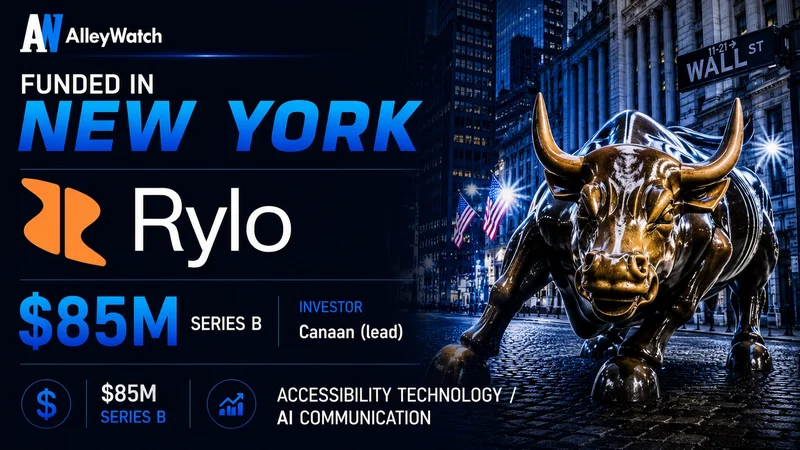
Rylo has secured an $85 million funding round to provide autonomous, high-fidelity captioning for the 48 million Americans living with hearing loss or who are deaf.
The recent announcement that Rylo has secured an $85 million funding round marks a pivotal moment in the intersection of artificial intelligence and social infrastructure. By pushing their total capital raised past the $100 million milestone, the company is positioning itself not just as a niche accessibility tool, but as a cornerstone of "inclusion technology." This investment targets a massive, underserved demographic: the approximately 48 million Americans living with hearing loss or who are deaf, for whom real-time communication remains a significant logistical and technological hurdle.
Getting to this point took significant effort. Originally known as Nagish, the company’s transition to Rylo signaled a strategic pivot from basic telephony support toward comprehensive video conferencing and real-time interactive environments. The grit required to build this platform is evidenced by the fact that the team faced 77 investor rejections before securing their first "yes." This high barrier to entry reflects the extreme technical difficulty of creating an AI system capable of functioning in critical scenarios—such as medical consultations or legal proceedings—where accuracy isn't just a luxury, but a necessity.
Why is the $85 million investment a game changer for accessibility?
The primary differentiator for Rylo lies in its regulatory and technical "moat." While several platforms offer transcription services, Rylo stands out as one of only six FCC-licensed captioning platforms in the United States. However, what makes it unique among those six is its operational model: Rylo is the only platform that functions entirely without humans in the loop.
Traditional Telecommunications Relay Services (TRS) often rely on human operators to bridge the gap between deaf and hearing individuals. While these services exist, they are frequently plagued by significant latency, high costs, and inconsistent performance. By removing the human intermediary through advanced AI models, Rylo provides an instantaneous, seamless experience. This shift from a labor-heavy model to a software-centric infrastructure allows for massive scalability, making it possible to serve millions of users simultaneously without a linear increase in operating costs.
Key Facts
- Rylo previously operated under the name Nagish.
- The recent $85 million round brings total capital raised past the $100 million mark.
- Approximately 48 million Americans currently live with hearing loss or are deaf.
- Rylo is one of only six FCC-licensed captioning platforms in the U.S.
- It is the only platform among those six to operate without human intervention.
- The company survived 77 investor rejections before its first successful funding.
How does "inclusion technology" transform into a high-growth investment?
The growth of Rylo highlights a shift in venture capital, where "inclusion technology" is moving from the sidelines of corporate social responsibility into the mainstream as a high-growth opportunity. By solving for accessibility, companies can unlock massive, previously unreachable consumer bases within healthcare, education, and public services.
When a company solves a problem that is mandated by law or required by essential human interaction—such as communication in medical settings—it creates a durable market position. Rylo’s expansion into video conferencing and real-time interactive environments suggests they are building the foundational layer for inclusive digital communication. By securing FCC licensing and perfecting its proprietary AI, Rylo has created an environment where scalability is no longer limited by human staffing, but only by the reach of the software itself.
What does the transition from Nagish to Rylo signify?
The rebranding was not merely a name change; it was a strategic expansion of scope. While Nagish proved the core technology worked for telephony, Rylo represents an evolution into any environment where real-time interaction is essential. This includes live video conferencing, interactive digital environments, and multi-channel communication systems. By diversifying the use cases, Rylo ensures its relevance across multiple industries, from remote work platforms to healthcare portals.
The investment validates that the market recognizes "accessibility as a service" as a viable infrastructure play. As more businesses are required by law or by corporate ethics to provide accessible interfaces, the demand for high-fidelity, automated captioning will continue to scale. Rylo is positioned at the center of this expansion, moving toward a future where communication barriers are dissolved not by human intervention, but by sophisticated, robustly engineered AI systems.
Expert Commentary
From a market analysis perspective, Rylo’s trajectory is an excellent example of building a "moat" through technical complexity and regulatory alignment. In the world of high-growth startups, many companies fail because their "solution" is too easily replicated by larger incumbents. However, by securing FCC licensing and perfecting a human-free, AI-driven model for a massive demographic (48 million people), Rylo has effectively created a barrier to entry that is both technical and regulatory.
The shift from Nagish to Rylo signifies the transition from a "problem-solving startup" to an "infrastructure platform." Investors are moving away from simple "features" and toward "foundational layers"—technologies that other businesses must plug into to remain compliant or competitive. By removing human operators, Rylo drastically lowers their marginal cost per user while increasing its service reliability. This is the hallmark of a scalable tech play. The fact that they survived 77 rejections suggests that the market initially struggled to price the complexity of the problem; now that the technical hurdles have been cleared and the licensing secured, the valuation reflects the massive potential of "inclusion as an automated service."
Google Search Preference
Add Fintech Monster to your preferred sources
Never miss deep, analytical fintech insights. Prioritize our stories in your Google Search, Discover feed, and AI Overviews with one click.
About the Author
Fintech Monster
Fintech Monster is run by a solo editor with over 20 years of experience in the IT industry. A long-time tech blogger and active trader, the editor brings a combination of deep technical expertise and extended trading experience to analyze the latest fintech startups, market moves, and crypto trends.