Bridging the Divide: Franklin Templeton’s Strategy to Channel Corporate Dividends into Bitcoin
Key Takeaways
Franklin Templeton is pioneering a hybrid investment vehicle that automates the conversion of corporate dividends into Bitcoin, providing a sophisticated gateway for institutional capital to enter the crypto space through a stable equity wrapper.
The financial landscape is witnessing a seismic shift in how institutional asset managers bridge the gap between traditional equity markets and digital assets. Franklin Templeton, a global powerhouse managing approximately $1.78 trillion in assets under management (AUM), has signaled a profound strategic pivot by filing paperwork with the U.S. Securities and Exchange Commission (SEC) for two new exchange-traded funds (ETFs). These specific vehicles are engineered to automate the conversion of dividends from established U.S. companies into Bitcoin exposure, effectively creating a "bridge" technology that allows conservative capital to participate in the cryptocurrency upside while remaining anchored by traditional equity holdings.
This move is not merely another product launch; it represents a sophisticated evolution in portfolio engineering. For years, the primary barrier for institutional investors—such as pension funds and large endowments—has been the "volatility gap" and the stringent corporate mandates that often prohibit the direct holding of digital assets on balance sheets. By creating a vehicle where the underlying equity provides the stability and the dividend yield fuels the growth in Bitcoin, Franklin Templeton is constructing a way for these massive entities to bypass traditional hurdles while still capturing the growth dynamics of "digital gold."
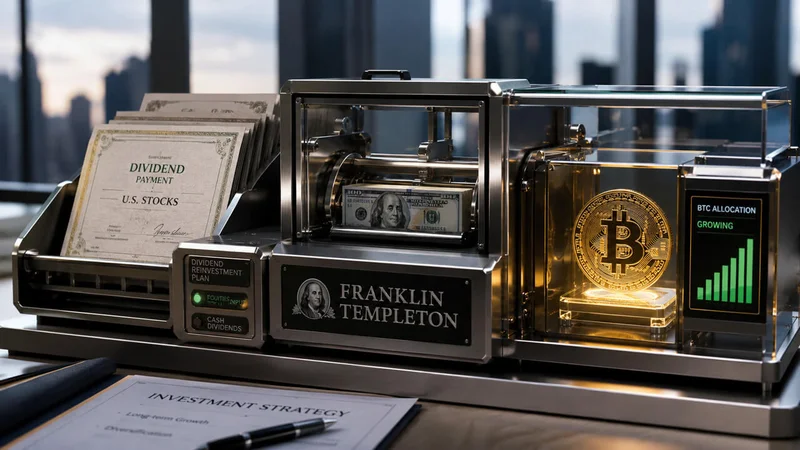
How does the conversion from dividends to Bitcoin actually work?
The technical core of these new ETFs lies in their departure from standard Dividend Reinvestment Plans (DRIPs). Traditionally, a DRIP allows an investor to automatically reinvest cash dividends back into additional shares of the same company that paid them. In the proposed Franklin Templeton structure, this mechanism is replaced by a programmed pipeline: as soon as a dividend is distributed from a participating U.S. corporation, it is instantly captured and converted into Bitcoin.
To achieve this at scale, the fund requires a robust technical infrastructure capable of real-time valuation. The system must determine the exact value of Bitcoin against the USD (or other relevant fiat currencies) at the precise moment of distribution to ensure accurate allocation. This creates a "hybrid" investment vehicle where the primary holding is a basket of dividend-paying equities, but the secondary growth engine—the yield—is captured and converted into digital assets. By automating this process, the fund removes the friction of manual trading, making it an appealing option for investors who are comfortable with blue-chip stocks but may be hesitant to navigate the complexities of direct crypto exchanges.
Why is this a game changer for institutional portfolios?
The inclusion of these funds marks a shift from "speculative" crypto investment toward "systemic" integration. For many institutions, the primary concern is risk profile; however, by wrapping Bitcoin exposure within an ETF that yields a dividend stream, the perceived risk profile is significantly lowered. The capital isn't being "gambled" on spot movements in the traditional sense; rather, it is being redirected from an existing equity yield into a non-correlated asset to hedge against fiat currency debasement and inflation.
Furthermore, this creates a consistent, non-speculative demand for Bitcoin. Unlike retail trading cycles which are often driven by "hype" and sentiment, an automated pipeline fueled by corporate dividends produces a steady flow of buy orders. This type of programmatic acquisition is highly attractive to the broader crypto ecosystem as it provides a more stable price floor through consistent accumulation. It essentially turns the dividend market into a fueling station for Bitcoin's institutional adoption.
Key Facts
- Franklin Templeton manages approximately $1.78 trillion in assets under management (AUM).
- Two new ETFs were filed with the SEC specifically designed to convert corporate dividends into Bitcoin exposure.
- The mechanism replaces traditional Dividend Reinvestment Plans (DRIPs) which typically reinvest dividends back into the original stock.
- Real-time valuation of Bitcoin against fiat currencies is required at the moment of dividend distribution.
- The primary goal is to serve "mass affluent" and institutional investors who face restrictions on direct crypto holdings.
- These funds represent a shift toward "hybridized" financial products where automated rules manage multi-asset transformations.
How does this impact the broader cryptocurrency market?
The introduction of these vehicles signals that the SEC is becoming increasingly comfortable with complex, integrated structures rather than just simple spot ETFs. It indicates a maturation of the regulatory environment where the complexity of the underlying "bridge" technology is seen as a valid way to provide safety for conservative investors. By offering a pathway for capital that was previously "locked out" due to compliance hurdles, Franklin Templeton is effectively expanding the total addressable market for Bitcoin among institutional players.
Furthermore, this sets a new precedent for how traditional wealth management firms can integrate digital assets into their core offerings. Instead of asking institutions to hold Bitcoin directly, they are providing a way for them to own "equity-backed" exposure. This move positions Franklin Templeton as a pioneer in bridge technologies, potentially establishing a new standard for the next generation of investment vehicles that blend traditional equity markets with decentralized finance infrastructure.
Expert Commentary
From a trader’s perspective, this is a masterclass in "engineering around" institutional constraints. The market has long known that the real wealth is locked in pension funds and private equity; however, those entities are often legally barred from holding "volatile" assets like BTC on their primary books. By utilizing dividends as the currency of conversion, Franklin Templeton creates a "synthetic" exposure that satisfies the compliance department's need for stability while satisfying the portfolio manager's need for non-correlated growth.
The most significant implication here is the shift toward "non-speculative demand." When you have an automated pipeline moving capital from blue-chip dividends into Bitcoin, you are removing the human emotion from the trade. This creates a consistent floor of demand that doesn't care about daily headlines or social media trends. It turns Bitcoin into a standard component of the "yield" portfolio. For those watching the long-term macro landscape, this is just one more step in the evolution of Bitcoin as a systemic reserve asset—it’s no longer just an alternative to gold; it's becoming an automated destination for equity yield.
About the Author
Fintech Monster
Fintech Monster is run by a solo editor with over 20 years of experience in the IT industry. A long-time tech blogger and active trader, the editor brings a combination of deep technical expertise and extended trading experience to analyze the latest fintech startups, market moves, and crypto trends.