Capital Rotation Deep Dive: Why Institutional Money is Flying from BTC ETFs to Altcoins Like SOL and XRP
Key Takeaways
Institutional capital is selectively rotating, pulling funds from Bitcoin ETFs and flowing into utility-focused altcoins like Solana and XRP, signaling a shift from broad market bets to high-utility, high-growth assets.
The crypto capital landscape is undergoing a structural recalibration, characterized by a distinct and accelerating divergence of investment flows. Recent market data reveals sustained, pronounced outflows from various Bitcoin-linked Exchange Traded Funds (ETFs)—with figures citing temporary drains exceeding $1 billion—while simultaneously demonstrating consistent and dedicated net inflows into specific utility-focused altcoins, notably Solana (SOL) and XRP. This movement is far more than mere market noise; it signals a significant tactical shift in how institutional capital is allocating risk, moving away from the 'buy-and-hold' benchmark of Bitcoin and towards assets perceived to offer superior growth potential or unique structural safeguards.
For years, Bitcoin has been synonymous with the primary crypto investment thesis. However, the current pattern suggests that sophisticated capital is no longer treating BTC simply as a generic store of value. Instead, they are employing a highly selective, sophisticated strategy that demands deep due diligence on network mechanics, developer adoption rates, and established real-world use cases. This institutional rotation points toward a belief that the next major wave of capital appreciation ('alpha') will be concentrated not at the Bitcoin layer, but in the highly functional, next-generation altcoin infrastructure.
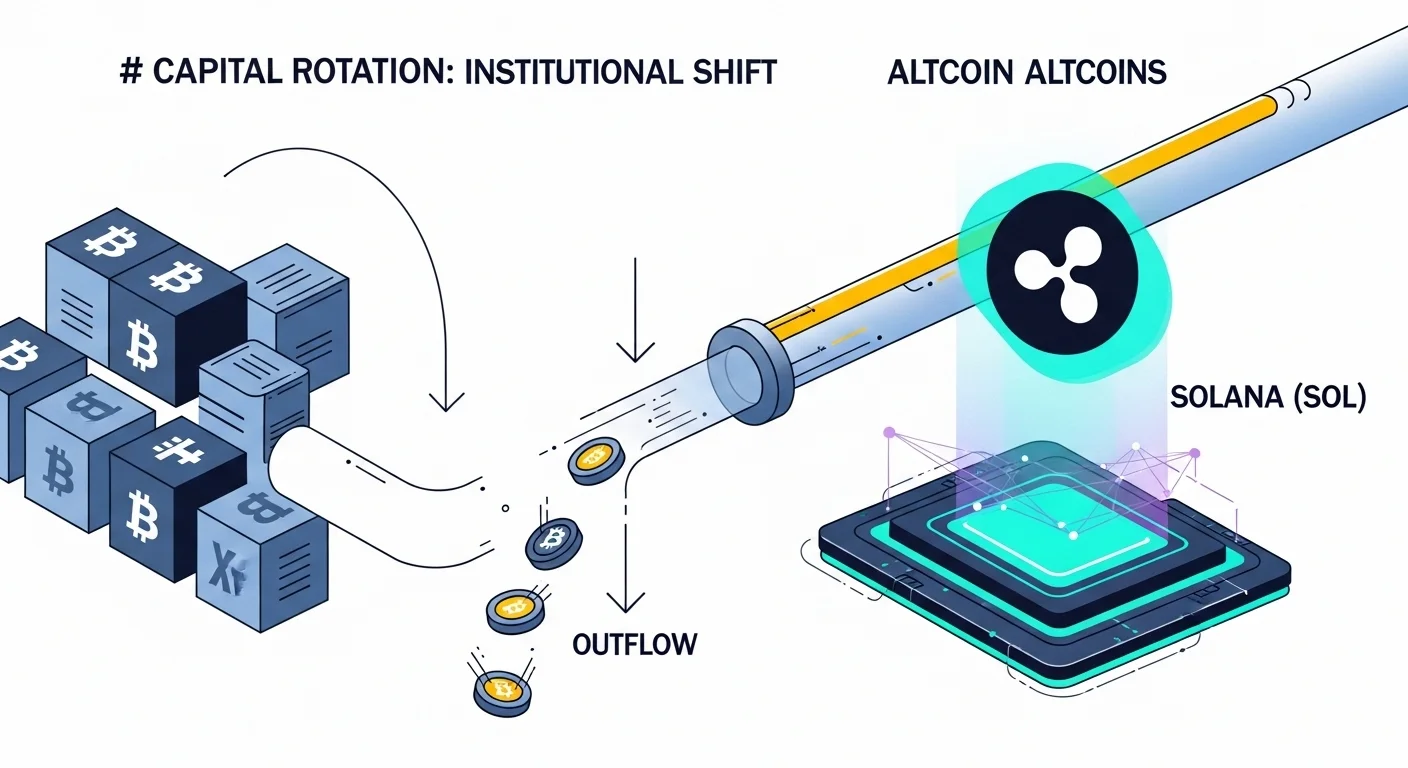
Why Is Institutional Capital Suddenly Prioritizing Utility Over Market Cap Dominance?
The consistent capital migration visible across the market—with even major assets like Ethereum seeing periods of net outflows—suggests that institutional investors are engaged in deep, multi-asset reallocation rather than simply following Bitcoin’s price action. They are executing a 'beta-alt' strategy.
This strategy fundamentally rejects the notion of uniform risk across all digital assets. Instead, it dictates that capital should flow to assets solving tangible, persistent problems. For Solana, this translates to its industry-leading throughput and low transaction costs, making it incredibly appealing for complex decentralized applications (dApps) that require high speed and scalability. For XRP, the appeal is inherently tied to its established, cross-border utility model, providing a clear regulatory value proposition in traditional finance (TradFi) corridors.
The sheer scale of the outflows from BTC ETFs, while sometimes dramatic, underscores a temporary loss of confidence in Bitcoin's immediate near-term trajectory, causing capital managers to seek relative safety or superior yield elsewhere in the ecosystem. The capital, therefore, isn't disappearing; it's migrating to areas where its potential return is perceived to be disproportionately higher relative to the risk taken.
Unpacking the ‘Beta-Alt’ Thesis: Risk-Adjusted Growth Plays
The 'beta-alt' strategy essentially seeks high-growth potential (alpha) by investing in assets that are undervalued relative to their underlying utility and technological adoption. It’s a granular approach that requires analyzing network health metrics—such as total value locked (TVL) on associated DeFi protocols, daily active developers, and successful enterprise partnerships—rather than merely observing price charts.
When a fund shows a sustained net inflow into a Solana-based decentralized exchange (DEX), it is a direct vote of confidence in Solana's technical architecture, signaling that the capital believes the network's utility will reliably outpace the broader market’s temporary concerns. Similarly, the sustained institutional interest in XRP validates its role as a crucial bridge asset, particularly for financial institutions looking to minimize SWIFT-style correspondent banking friction.
This indicates a maturing market structure, one that has moved past the early hype cycle. The sophisticated investor is now viewing the crypto ecosystem not as a single asset class, but as a decentralized array of specialized, competing technological networks.
The Systemic Implications of Divergent Capital Flows
The persistent divergence is not a fleeting trend; it reflects a fundamental shift in market structure. If BTC’s ETFs continue to experience temporary pressure, the market could signal a phase of consolidation for the foundational layer, prompting institutions to solidify their positions in the high-throughput, specialized altcoin layers.
From a macro perspective, this capital rotation is highly predictable for specialized funds. Instead of allocating a monolithic percentage to Bitcoin, they are instead implementing a portfolio strategy that hedges across different technological utility vectors: one part exposure to the established store-of-value asset (BTC), and another part exposure to emerging utility platforms (SOL, etc.).
This differentiation requires advanced due diligence, separating true utility and network effect from speculative hype, marking a maturation point for institutional money flow.
Key Takeaways for Investors:
- Focus on Utility: Analyze the tangible use cases and network effects rather than just market capitalization.
- Differentiate Risk: Recognize that while BTC represents a store of value, other altcoins represent utility plays with potentially higher reward/risk profiles.
- Monitor Inflow Vectors: The consistent inflow into utility-focused altcoins (like SOL) suggests sustained institutional belief in their operational necessity.
Disclaimer: This content is for informational purposes only and does not constitute financial advice. Cryptocurrency investments carry significant risks. Please conduct your own thorough research and consult with a certified financial advisor before making any investment decisions.
Google Search Preference
Add Fintech Monster to your preferred sources
Never miss deep, analytical fintech insights. Prioritize our stories in your Google Search, Discover feed, and AI Overviews with one click.
About the Author
Fintech Monster
Fintech Monster is run by a solo editor with over 20 years of experience in the IT industry. A long-time tech blogger and active trader, the editor brings a combination of deep technical expertise and extended trading experience to analyze the latest fintech startups, market moves, and crypto trends.