Decoding the Surge: How Quantum Computing and Autonomous Vehicles Are Driving Qualcomm's Valuation
Key Takeaways
Qualcomm's recent stock surge reflects deep market confidence in its dual position as a core enabler for both the multi-trillion dollar autonomous vehicle sector and the long-term exponential growth promised by quantum computing infrastructure.
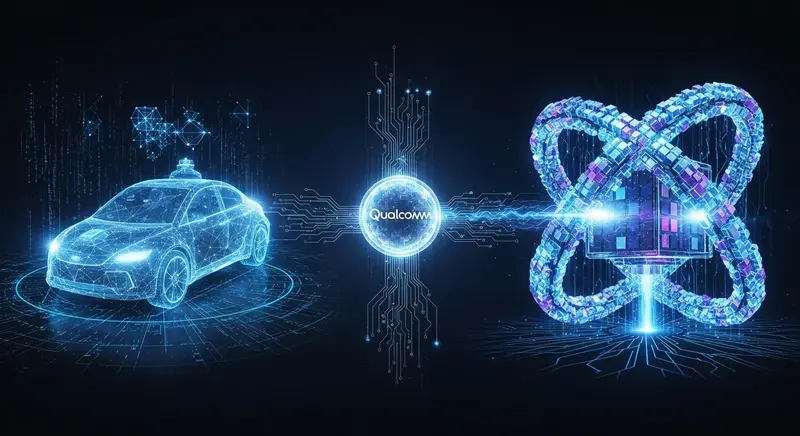
The significant appreciation in semiconductor giants' valuations, epitomized by the recent surge in Qualcomm’s stock, is not merely a reaction to quarterly earnings; it is a foundational re-pricing of the company's structural role in the next generation of computing. Market participants are assigning a premium value to the ability of specialized silicon architectures to manage two fundamentally distinct, yet equally transformative, technological vectors: the immediate, deep-scale connectivity demands of autonomous vehicles, and the long-horizon, exponential computational power promised by quantum processing. This deep-tech convergence narrative is fundamentally changing how investors perceive the value of a chip manufacturer—transforming them from component suppliers into critical, irreplaceable digital infrastructure architects.
The semiconductor industry has long been viewed as the bedrock of the digital economy. However, the current market cycle is defining a crucial inflection point. The demand is shifting away from generalized, purpose-built compute (the era of pure CPUs and GPUs) toward highly specialized, integrated edge processing platforms. Whether it’s the real-time sensor fusion required for a Level 4 self-driving system, or the complex error correction protocols needed for quantum state observation, the modern computing challenge requires unprecedented levels of integration, low latency, and power efficiency—all of which are hallmarks of sophisticated semiconductor design and the integrated platform approach championed by leaders like Qualcomm.
How the Auto Industry is Redefining the Chip Landscape
The automotive sector represents the most immediate and tangible source of capital inflow driving semiconductor valuations. The transition from combustion engines to electric, connected, and autonomous platforms is not an incremental upgrade; it is a complete architectural overhaul that renders legacy hardware obsolete. The vehicle itself is rapidly evolving from a mechanical object into a highly sophisticated, rolling computer platform, and this transformation necessitates a complete silicon rethinking.
Qualcomm’s strategic advantage lies in its capacity to move beyond simply supplying connectivity modules. Through platforms like the Snapdragon Digital Chassis, the company is facilitating a complete system-on-a-chip (SoC) solution. This platform must manage multiple, demanding tasks simultaneously: running advanced infotainment, processing high-definition sensor streams from LiDAR and radar, maintaining seamless 5G/6G connectivity, and executing the complex machine learning inference required for decision-making in an autonomous stack. This deep integration into the vehicle's core software and hardware architecture ensures not only reliable revenue streams but also a deep, structural dependency from major global automakers who cannot build next-generation vehicles without such comprehensive digital support.
Beyond the Chipset: Positioning for the Quantum Leap
While the automotive segment provides the robust, near-term revenue stability—the 'today' money—the narrative of quantum computing provides the necessary long-term, high-beta growth catalyst—the 'tomorrow' money. Quantum computation, based on principles like superposition and entanglement, promises computational power far exceeding the capability of even the most advanced classical supercomputers.
For the mainstream market, quantum technology remains challenging due to its extreme operational requirements (e.g., near-absolute zero temperatures, perfect isolation). However, the market value is currently being driven by the enabling technologies—the cryo-electronics, the error correction coding hardware, and the classical processors needed to run the sophisticated control systems surrounding the quantum core. Companies that can demonstrate mastery over the interface between classical computing and nascent quantum hardware are deemed crucial gatekeepers to future computational wealth. This positioning allows companies like Qualcomm to monetize their core strengths in advanced RF, signal processing, and chip architecture, adapting them for the unique challenges of quantum networking and control systems.
The Synergistic Growth Engine: Why Both Markets Matter
The greatest value proposition currently being priced into semiconductor stocks is the ability to manage the simultaneous demands of these two disparate fields. Autonomous vehicles require massive, sustained, parallel processing capability in a rugged, energy-constrained environment. Quantum computing requires precise, highly specialized, and exotic processing capability in a highly controlled environment.
The confluence suggests a deeper trend: the semiconductor industry is evolving into an orchestrator of diverse computing paradigms. The current investment narrative posits that the semiconductor company that can not only power the connected car but also prove technological relevance in the quantum control stack, will solidify its position as a monopolistic, essential infrastructure provider. This dual revenue stream—near-term stability from the auto market, and long-term exponential upside from quantum—is what investors are pricing into the company's valuation.
Deep Dive: Why This Combination is Disruptive
- From Brute Force to Intelligence: Automotive systems are moving beyond simple electronic controls. They are becoming mobile, real-time AI processing centers. This requires specialized edge computing power, demanding chips that can handle immense, immediate data streams while remaining highly efficient.
- The Data Density Problem: Autonomous vehicles generate petabytes of data per day. Managing this data flow, transmitting it, and processing it locally (at the "edge") is the next great hardware bottleneck—a bottleneck that only specialized, integrated hardware platforms can solve.
- Future-Proofing Through Protocol: By investing heavily in both auto-AI and quantum-ready chips, the company is effectively future-proofing its core IP. It ensures that its architecture remains relevant whether the next major breakthrough comes from a global V2X network upgrade or a breakthrough in qubit stability.
Google Search Preference
Add Fintech Monster to your preferred sources
Never miss deep, analytical fintech insights. Prioritize our stories in your Google Search, Discover feed, and AI Overviews with one click.
About the Author
Fintech Monster
Fintech Monster is run by a solo editor with over 20 years of experience in the IT industry. A long-time tech blogger and active trader, the editor brings a combination of deep technical expertise and extended trading experience to analyze the latest fintech startups, market moves, and crypto trends.