DTCC and Stellar Signal Digitalization of Global Capital with Tokenized Assets
Key Takeaways
Major financial infrastructure players are fundamentally reshaping capital markets by leveraging Stellar and DLT to tokenize illiquid assets, promising faster, cheaper, and more transparent settlement for global securities.
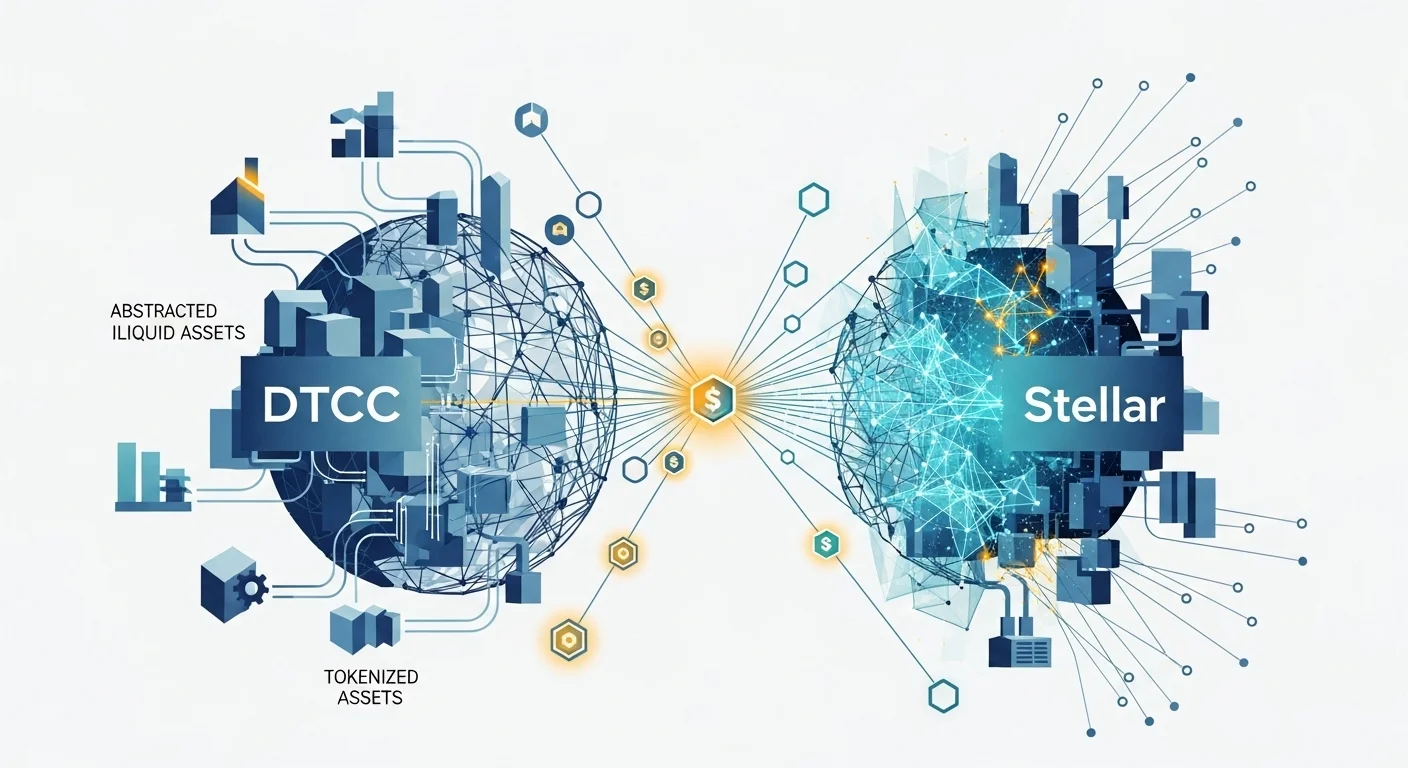
The collaboration between the Depository Trust & Clearing Corporation (DTCC), a foundational pillar of global securities settlement, and the Stellar network represents a pivotal moment in the history of finance. This move signals the accelerated, inevitable fusion of traditional finance (TradFi) giants with cutting-edge distributed ledger technology (DLT). By committing to the tokenization of deeply established asset classes—particularly government securities and high-value bonds—the industry is moving beyond simple blockchain experiments and into the systemic modernization of core financial plumbing. This shift is not merely a technological upgrade; it is a fundamental redesign of how ownership, liquidity, and settlement are managed across global markets.
For decades, the process of clearing and settling securities has relied on intricate, time-intensive, and often siloed legacy systems. Assets are held in book-entry form, meaning the ownership record exists on proprietary ledgers, creating friction points such as multi-day settlement cycles (T+2 or T+3), high counterparty risk exposure, and restricted access to fractional ownership. The promise of tokenization, underpinned by robust infrastructure like Stellar, is to resolve these systemic bottlenecks. By wrapping legal rights to real-world assets into digital tokens—digital representations of value that move on a permissioned ledger—the entire infrastructure gains immediate, unprecedented efficiency, moving settlement from slow, manual processes to near-instant, programmatically governed transactions.
Why is Tokenization the Linchpin for Global Finance Modernization?
The primary inefficiency in legacy financial markets is the disconnect between the instantaneous speed of digital information and the slow, batch-processed reality of physical asset settlement. Tokenization fundamentally bridges this gap. Instead of merely representing a concept on a blockchain, these digital assets are engineered to maintain the legal integrity and economic protections of their underlying traditional assets (the securities), while simultaneously inheriting the programmatic efficiency of DLT.
For the bond market, which constitutes trillions of dollars of global capital, this transformation is game-changing. Before tokenization, selling a large block of fixed-income assets meant navigating intricate custodial arrangements and correspondent banking relationships. With tokens, ownership becomes a single, auditable, and globally traceable entry on the ledger. This allows for the creation of secondary market liquidity pathways that were previously non-existent or prohibitively complex, effectively creating a 24/7 market that operates outside of traditional banking hours and geopolitical limitations.
How Does Stellar Specifically Enable This Complex Transition?
The choice of Stellar as the underlying network is highly strategic. Stellar is known for its speed, low transaction costs, and ability to facilitate programmable, cross-border transfers of value. Unlike some early blockchain attempts that focus solely on cryptocurrency transfers, Stellar's architecture is well-suited for 'asset-centric' use cases.
In the context of DTCC, the implementation suggests a highly sophisticated, permissioned environment. This means that while the technology is open and robust, participation is restricted to verified, regulated institutions—a crucial step for any core financial infrastructure play. This selective approach allows the systemic stability and regulatory compliance necessary for sovereign debt markets to engage with blockchain technology, thereby de-risking the adoption process for the broader institutional investment community. The technology handles the how (the plumbing), while the existing legal framework handled by DTCC ensures the what (the asset's underlying legal standing) remains protected.
What Are the Operational Implications of Tokenized Bonds?
The deepest implications lie in market operations. Currently, if an investment fund wishes to diversify its holdings across different types of sovereign debt, it must execute multiple transactions, each involving clearing fees, operational lags, and distinct institutional workflows.
Tokenization enables 'atomic' settlements—meaning the transfer of cash and the transfer of the asset happen simultaneously and irrevocably in a single, smart-contract-governed action. This minimizes the time assets are "in flight," dramatically reduces counterparty risk (the risk that the other party defaults before settlement), and drastically lowers operational costs associated with reconciliation. Furthermore, the ability to fractionalize these tokens means that traditionally reserved large-cap institutional investments become accessible to a wider spectrum of investors, bolstering secondary liquidity and deepening the overall market.
Key Facts
Key Facts
- Core Mechanism: Tokenization converts the legal claim and ownership rights of traditional, illiquid assets (e.g., US Treasury bonds) into secure, programmable digital tokens.
- Infrastructure Upgrade: The adoption of DLT by clearing houses like DTCC signals a shift from proprietary, siloed book-entry systems to a unified, shared ledger infrastructure.
- Efficiency Gains: Expected improvements include near-instantaneous settlement, reduced counterparty risk, and the enablement of 24/7 global trading access.
- Role of Stellar: Stellar provides the high-throughput, low-cost cross-border payment rail necessary to execute these atomic, global asset transfers efficiently.
Expert Commentary
The collaboration between DTCC and Stellar is less about 'crypto hype' and more about profound, necessary financial plumbing maintenance. History shows that every major iteration of global finance—from the introduction of SWIFT to the move to digitized ledgers—was driven by the unbearable cost of inefficiency. Today, that cost is in settlement lag, operational friction, and geographical limitations.
Tokenization, in this context, is simply the ultimate middleware solution. It is the mechanism that allows a legacy asset class (the bond) to adopt a modern, global settlement standard (DLT). The challenge for market participants now shifts from merely understanding the underlying technology to understanding the evolving regulatory structure that governs the tokens themselves. Will these tokens be classified as securities, commodities, or something entirely new? The answers to these questions will define the entire landscape of digital finance.
For institutional players, the takeaway must be that the margin for delay is closing. Firms that view blockchain technology merely as a speculative digital asset class are missing the point. It is fundamentally a systemic infrastructure upgrade. The move towards distributed, immutable record-keeping promises not just faster payments, but the foundational trust layer needed to build the next generation of global finance, making the current centralized rails increasingly vulnerable to disruption. This is not a niche technology; it is an overhaul of the plumbing of global capital movement.
Google Search Preference
Add Fintech Monster to your preferred sources
Never miss deep, analytical fintech insights. Prioritize our stories in your Google Search, Discover feed, and AI Overviews with one click.
About the Author
Fintech Monster
Fintech Monster is run by a solo editor with over 20 years of experience in the IT industry. A long-time tech blogger and active trader, the editor brings a combination of deep technical expertise and extended trading experience to analyze the latest fintech startups, market moves, and crypto trends.