From Passive Video to Active Coaching: Synthesia’s Pivot into Interactive AI Roleplay
Key Takeaways
Synthesia is pivoting from passive video generation to interactive AI roleplay, providing measurable training in high-stakes sectors like finance and defense.
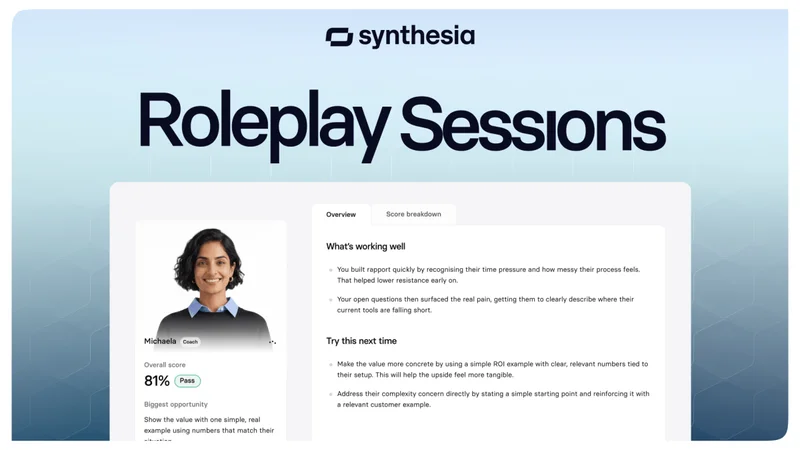
The landscape of synthetic media is undergoing a fundamental transformation, moving away from the mere creation of "talking heads" toward active, participatory intelligence. Synthesia, a leader in the generative video space, has signaled this shift by pivoting its core technology toward AI Roleplay Sessions. This evolution marks a critical transition for enterprise training: instead of employees passively watching a pre-recorded video to learn compliance or sales techniques, they are now engaging with dynamic, high-fidelity simulations that react in real-time. This move addresses a massive gap in the corporate market—the need for interactive, scalable coaching environments where learners can fail safely before facing real-world consequences.
This evolution is particularly significant for industries governed by strict regulatory frameworks and high-stakes consequences, such as healthcare, defense contracting, and global finance. In these sectors, "getting it right" isn't just a matter of company culture; it is often a legal requirement. By moving beyond static content, Synthesia is positioning its technology as a sophisticated infrastructure for human capital management. The shift reflects a broader trend in the AI sector where the value proposition is moving from "content creation" (low moat) to "functional application" (high moat), providing organizations with measurable evidence of employee competency rather than just proof of attendance at a training seminar.
Why is interactive roleplay better for high-stakes training?
Traditional corporate training often suffers from a "knowledge retention gap" where employees watch a video, pass a multiple-choice quiz, and then immediately forget the nuances of the material when faced with an actual client or regulator. Synthesia’s shift into AI Roleplay addresses this by creating a "safe sandbox." For example, in defense contracting or healthcare, personnel can practice complex protocols in a simulated environment where the AI acts as a dynamic counterparty. The AI isn't just reading a script; it is powered by Large Language Models (LLMs) that maintain contextual coherence and adapt their responses based on the user’s input. This allows the learner to experience "resistance"—the unpredictable nature of human conversation—without the risk of a multi-million dollar mistake in a live environment.
How does the platform turn soft skills into measurable data?
One of the greatest hurdles for HR and L&D departments has been the inability to quantify "soft skills." Skills like negotiation, conflict resolution, and complex client onboarding are historically difficult to measure because they involve nuances in tone, timing, and empathy. Synthesia’s AI integration changes this calculus by providing a granular analytics suite. The system doesn't just flag if a user completed a module; it analyzes the interaction qualitatively. It identifies hesitation points, detects filler words (like "um" or "uh"), and tracks emotional tone through vocal inflection analysis. By comparing these data points against predefined behavioral models, companies can now assign a tangible competency score to what was previously considered an abstract human skill.
How do financial institutions use this for compliance?
For financial institutions, the move toward AI roleplay offers a powerful defense in the face of regulatory scrutiny. Compliance departments are often required to prove that staff are proficient in Know Your Customer (KYC) protocols and sanctions screening. By utilizing automated roleplay sessions, firms can generate an auditable trail of competence. Every time an employee practices identifying red flags or navigating a suspicious transaction dialogue with an AI agent, the system logs their performance metrics. This creates a verifiable record that the institution is proactively training its staff to meet stringent regulatory standards, potentially reducing the risk of heavy fines and ensuring high-level adherence to compliance scripts.
What is the technical infrastructure behind these simulations?
The efficacy of the platform relies on sophisticated multi-modal AI capabilities. To create a convincing experience, the system must process several data streams simultaneously: voice tone (to detect confidence or hesitation), body language (if integrated with webcam inputs), and the conversational context provided by the underlying LLM. This tri-factor analysis allows for a much more immersive coaching experience than standard text-based chatbots. By synthesizing these elements, the technology moves from being a mere "tool" to becoming an automated coach capable of providing personalized feedback. Furthermore, this infrastructure can be tailored to specific corporate needs, allowing companies to swap out "personas"—ranging from an angry customer to a skeptical regulator—to test various training scenarios.
Key Facts
- Core Pivot: Transitioned from passive synthetic media generation to active AI Roleplay Sessions for interactive coaching.
- Target Sectors: High-stakes industries including finance, healthcare, and defense contracting.
- Measurable Metrics: Includes conversational flow analysis, filler word detection, emotional tone detection, and script adherence scores.
- Soft Skill Quantification: Enables measurement of negotiation, conflict resolution, and client onboarding capabilities.
- Compliance Application: Provides auditable logs for KYC (Know Your Customer) and sanctions screening training.
- Multimodal Tech: Integrates voice processing, body language analysis, and contextual LLM logic simultaneously.
Expert Commentary
From a market analysis perspective, Synthesia’s pivot is a textbook example of moving up the value chain in the AI economy. While "Generative AI" as a broad category often focuses on the novelty of creation—making an image or a video—the real enterprise value lies in "Applied AI." By focusing on roleplay, Synthesia is addressing a massive pain point in corporate L&D: the scalability of human-led coaching.
In the high-frequency and highly regulated world of finance, there is a significant "trust premium" associated with systems that can automate compliance. The ability to turn "soft skills" into hard data points is a profound shift for risk management departments. By providing a quantifiable metric for how an employee handles a difficult interaction, these platforms reduce the human error factor which often leads to regulatory scrutiny. We are seeing the transition of synthetic media from a marketing and content tool into a core infrastructure piece for corporate training and personnel validation. For investors and stakeholders in the tech space, this shift suggests that the next wave of "winners" in the AI space will be those who can wrap complex models into specific, measurable outcomes for enterprise clients.
Google Search Preference
Add Fintech Monster to your preferred sources
Never miss deep, analytical fintech insights. Prioritize our stories in your Google Search, Discover feed, and AI Overviews with one click.
About the Author
Fintech Monster
Fintech Monster is run by a solo editor with over 20 years of experience in the IT industry. A long-time tech blogger and active trader, the editor brings a combination of deep technical expertise and extended trading experience to analyze the latest fintech startups, market moves, and crypto trends.