From Scripting to Summoning: How Roblox’s "Build" Tab Redefines Digital Creation
Key Takeaways
By integrating LLMs and procedural generation into a mobile interface, Roblox's "Build" tool transforms users from manual developers into creative directors, radically lowering the barriers to entry for game creation.
The era of digital construction is undergoing a fundamental paradigm shift, moving away from laborious manual assembly toward a model of instantaneous manifestation. With the official introduction of the "Build" feature within its mobile application, Roblox has signaled a profound transformation in how interactive environments are conceived and deployed. By leveraging advanced generative artificial intelligence, the platform now allows users to bypass traditional technical hurdles, transforming simple natural language prompts into fully functional, playable games. This move doesn't just simplify the creation process; it fundamentally alters the economics of digital content by shifting the value proposition from technical mastery to creative direction, effectively ushering in an age where digital worlds are "conjured" rather than meticulously "built."
Historically, the barrier to entry for creating high-quality experiences on platforms like Roblox was substantial. Creators were required to master complex 3D modeling software and navigate the nuances of Luau scripting—a learning curve that often sidelined creative individuals who lacked formal technical training. While this created a moat for professional developers, it also limited the sheer volume of content available to the masses. By moving these creation tools from a desktop-centric environment (Roblox Studio) into a mobile-first interface, Roblox is targeting a much broader demographic: the casual creator whose primary skill lies in imagination and narrative rather than code architecture. This transition marks a critical milestone in the evolution of the metaverse, where the speed of iteration and the accessibility of tools become the primary drivers of ecosystem growth.
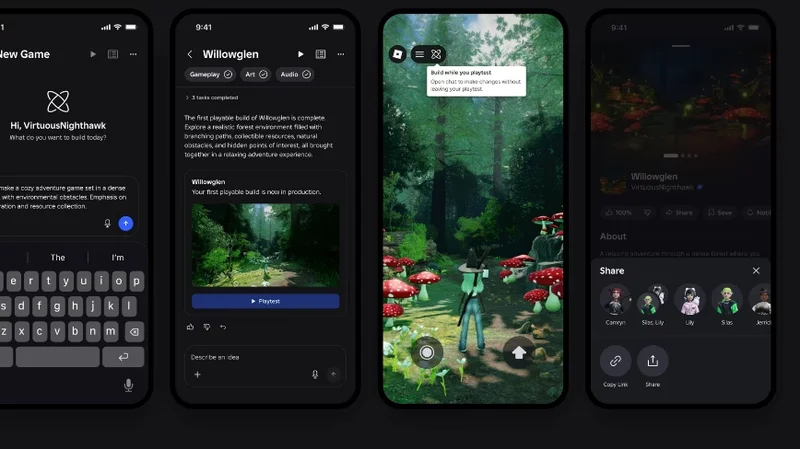
How does the Build feature actually turn text into playable games?
The "Build" tab is not merely a simplified interface; it is a sophisticated orchestration of Large Language Models (LLMs) and generative procedural systems. When a user inputs a prompt—such as "a neon-lit cyberpunk city with interactive hoverbikes"—the underlying system performs three distinct operations simultaneously. First, the Environment Generation engine interprets the aesthetic descriptors to populate the 3D space with assets that match the intended atmosphere. Second, instead of requiring a human to write lines of code for physics and interaction, the AI translates "actions" into functional scripts. This means if a user requests a mechanic like a "double-jump," the system automatically injects the necessary logic to make it work on mobile devices. Finally, the tool handles complex environmental interactions without manual configuration, ensuring that the resulting world is playable immediately upon generation.
Why is this move toward mobile-first creation so significant?
By prioritizing a mobile interface, Roblox is positioning itself as the leader in "instant" digital worlds. The shift from desktop-centric development to mobile-centric "direction" democratizes the production pipeline. In this new ecosystem, the creator acts more like a film director than a construction worker; they define the vision, and the AI handles the heavy lifting of asset placement and logic coding. This leads to an explosion in "rapid prototyping," where creators can test dozens of ideas in minutes rather than months. Furthermore, it paves the way for a surge in hyper-specific, niche content. When the cost (in time and technical skill) of creating a game drops toward zero, the opportunity for highly specialized experiences—designed for tiny but passionate communities—increases exponentially.
What happens to the creator economy when coding is no longer required?
The most profound impact of the "Build" tab lies in the migration of value within the ecosystem. As the technical labor of building becomes automated, the premium on unique creative concepts and sophisticated prompt engineering rises. We are seeing a pivot where the "moat" for a successful creator is no longer their ability to code complex scripts, but rather their ability to curate high-quality prompts that generate distinct, engaging experiences. This transition suggests a future where content can be deployed at a scale previously unimaginable by human developers alone. The integration of Build signifies a move toward a dynamic metaverse where environments are not static products, but ephemeral spaces that can be generated on the fly by any user with an idea.
Key Facts
- Instant Conversion: Users can turn natural language text into functional games immediately.
- Technical Removal: The feature removes the need for 3D modeling software knowledge or Luau scripting skills.
- AI Architecture: The system relies on a combination of Large Language Models (LLMs) and generative procedural systems.
- Automatic Logic: AI translates user intentions into functional scripts for mechanics like collisions and interactive triggers.
- Mobile-First Strategy: Moves the creation hub from desktop environments to mobile devices to broaden the creator base.
- Economic Shift: Value is migrating from "building" (labor) to "directing" (concept and prompt engineering).
Expert Commentary
From a market perspective, Roblox’s integration of "Build" is a classic example of the "de-skilling" of production as a means to scale. In traditional software cycles, high barriers to entry were used to maintain quality control; however, in the attention economy of the metaverse, volume and diversity often trump technical polish. By removing the friction of coding, Roblox is essentially creating an infinite content pipeline. We should expect to see a massive influx of "micro-experiences"—short-lived, highly specific interactive environments that cater to immediate trends. For investors and stakeholders, the key metric to watch isn't just the number of new games created, but the growth in "retention" within these AI-generated spaces. As human creativity is paired with machine execution, the primary value will reside in the proprietary data and intellectual property of the "prompts"—the unique creative DNA that makes one generated world stand out from another in a crowded marketplace.
Google Search Preference
Add Fintech Monster to your preferred sources
Never miss deep, analytical fintech insights. Prioritize our stories in your Google Search, Discover feed, and AI Overviews with one click.
About the Author
Fintech Monster
Fintech Monster is run by a solo editor with over 20 years of experience in the IT industry. A long-time tech blogger and active trader, the editor brings a combination of deep technical expertise and extended trading experience to analyze the latest fintech startups, market moves, and crypto trends.