How Somalia Leapfrogged Brick-and-Mortar Banking via Mobile Money
Key Takeaways
Somalia has successfully bypassed traditional banking infrastructure by building a resilient mobile money ecosystem that serves as the primary engine for financial inclusion and economic activity.
While many nations spent decades constructing massive brick-and-mortar banking infrastructures, Somalia provided a masterclass in technological leapfrogging by skipping those hurdles entirely to build a robust digital finance ecosystem. In an environment where physical infrastructure was often compromised by instability, mobile money platforms did not just supplement the economy; they became the foundational bedrock of modern commerce. This evolution provides critical evidence for how "lite" technology—specifically those leveraging cellular connectivity over complex banking protocols—can create rapid financial inclusion in emerging markets that lack traditional institutional support.
Historically, Somalia’s economic landscape was dominated by informal systems, most notably the Hawala networks. These were built on deep community trust and localized knowledge to facilitate remittances and trade in a region where formal banks were scarce or non-existent. When mobile telecommunications began to penetrate the region, they provided a fertile ground for Mobile Money Operators (MMOs) to digitize these trusted practices. By moving from paper records and physical cash movements to mobile-based transactions, Somalia managed to preserve cultural trust while adding layers of speed, traceability, and broader scale.
Why did Somalia bypass traditional banking?
The decision—or rather, the necessity—to favor mobile money over standard banking is rooted in infrastructure resilience. In regions with inconsistent power grids or fractured regulatory oversight, a physical bank branch represents a high overhead and high risk. Conversely, a mobile network provides an immediate, scalable touchpoint for any user with a handset.
The core of this success lies in the use of USSD (Unstructured Supplementary Service Data) protocols. Unlike modern banking apps that require 4G/5G connectivity and expensive smartphones, USSD works on basic "feature phones" over low-bandwidth networks. This choice allowed for nearly universal accessibility, ensuring that even those at the furthest fringes of the economy could participate in digital payments.
How do local merchants become the backbone of the system?
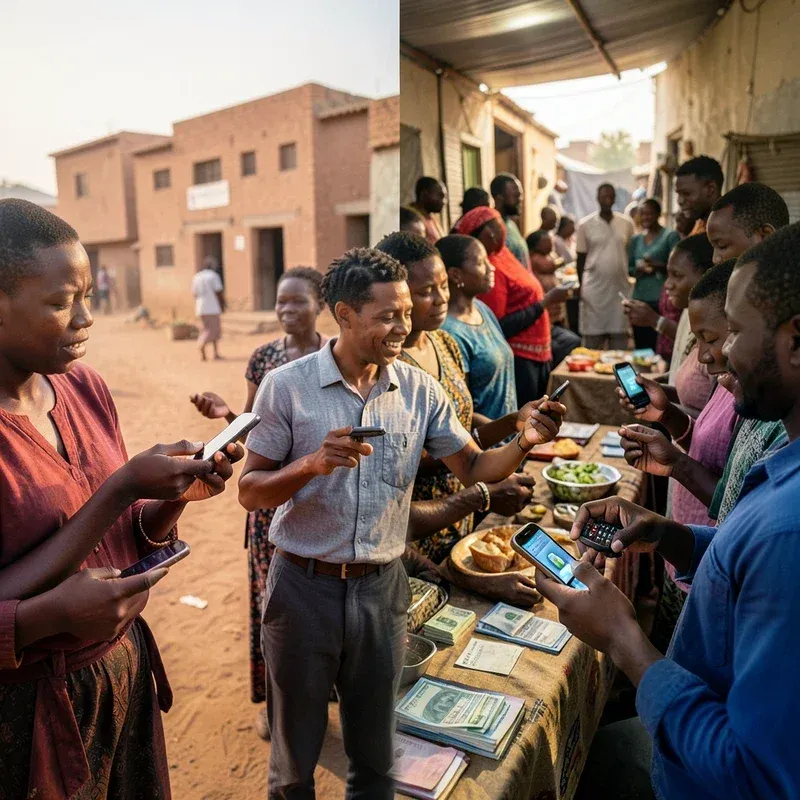
A critical component often overlooked by Western analysts is the role of the Agent Network Model. In Somalia, the "branch" is not a marble-floored office; it is a small shop, a roadside stall, or a family business. These merchant agents serve as the physical nexus where digital money enters and exits the ecosystem:
- Cash-in/Cash-out: Local residents can visit an agent to convert physical cash into mobile credit or withdraw funds for local trade.
- Geographic Reach: By partnering with existing micro-entrepreneurs, MMOs created a dense, decentralized network that is far more efficient than building and staffing remote bank branches.
- Trust Integration: These agents are often well-known members of the community, effectively merging the old "Hawala" trust model with modern digital verification.
Key Facts
- USSD Technology: The primary backbone for transactions, ensuring functionality on basic handsets without internet requirements.
- Empowerment Metrics: High adoption rates among women and micro-entrepreneurs who use the platforms to manage household finances and trade independently.
- Remittance Efficiency: Lower transaction costs compared to international wire transfers, which is vital for the large Somali diaspora.
- Data Trail Growth: Every mobile transaction creates a digital footprint, forming the groundwork for future credit scoring and formal financial identification.
What are the implications of this "skip" for global fintech?
The Somali model demonstrates that high-tech doesn't always mean "complex." For investors looking at emerging markets, the takeaway is clear: the most successful innovations often solve for accessibility first. By focusing on mobile-first infrastructure, these platforms have formalized an economy previously relegated to the shadows of informal systems. Furthermore, by providing a way to receive and manage funds securely, mobile money acts as a shock absorber against local volatility, allowing commerce to continue even when physical logistics are disrupted.
The transition from "cash-only" to "mobile-first" has also catalyzed a new wave of economic agency. Small businesses can now accept payments instantly, and women entrepreneurs can gain access to capital by demonstrating consistent transaction volumes—data that was previously impossible to capture in a cash-based economy. This data is the cornerstone for the next phase of evolution: integrated credit scoring and localized micro-lending.
| Feature | Traditional Banking Model | Mobile Money (Somalia) |
|---|---|---|
| Infrastructure | High-cost physical branches | Low-cost cellular network |
| User Access | Requires smartphone/internet | Accessible via basic USSD |
| Speed of Adoption | Decades to build trust | Rapid, built on existing networks |
| Primary Use Case | Savings & Institutional Credit | Remittance, P2P, Merchant Pay |
Expert Commentary
From a trading and market-analysis perspective, the Somali case study is a masterclass in "Infrastructure Arbitrage." By recognizing that the bottleneck for growth was not a lack of desire for banking, but the high cost of physical infrastructure, these systems optimized for volume over luxury.
For those watching emerging markets, we should take note: when a region skips a generation of technology (like credit cards or desktop-based banking) to go straight to mobile-first solutions, they create a "sticky" ecosystem that is very difficult for late-coming traditional banks to disrupt. The barrier to entry for new competitors isn't just the tech; it's the established network of local agents and the cultural habit formed by decades of reliable digital transactions. Investors should look toward these "leapfrog" markets as fertile ground for high-growth fintech platforms that prioritize scalability and low-barrier access over premium feature sets. The future is not always in the newest app, but in the most accessible way to move value from point A to point B.
Google Search Preference
Add Fintech Monster to your preferred sources
Never miss deep, analytical fintech insights. Prioritize our stories in your Google Search, Discover feed, and AI Overviews with one click.
About the Author
Fintech Monster
Fintech Monster is run by a solo editor with over 20 years of experience in the IT industry. A long-time tech blogger and active trader, the editor brings a combination of deep technical expertise and extended trading experience to analyze the latest fintech startups, market moves, and crypto trends.