Kraken's Bitcoin Vault: How Central Exchanges Are Mastering Decentralized Yield?
Key Takeaways
Kraken’s Bitcoin Vault introduces a simplified, non-custodial way for BTC holders to generate passive yield by wrapping their Bitcoin into kBTC, enabling deep exposure to on-chain lending markets without complexity.
The introduction of the Bitcoin Vault product by Kraken is not merely a new feature; it represents a pivotal technological and financial engineering achievement that fundamentally alters the relationship between centralized exchange utility and decentralized finance mechanisms. By offering a structured way for users to generate passive yield on their Bitcoin holdings, Kraken has strategically addressed a core pain point for institutional and long-term retail investors: the desire for passive income on BTC without the steep technical overhead, complex collateralization, or perceived custodial risks associated with direct interaction with multiple DeFi protocols. This product solidifies Kraken's positioning as a comprehensive financial utility, bridging the operational gap between traditional centralized custody and advanced on-chain yield generation.
Historically, the yield generation ecosystem was defined by a choice: either accepting the simplicity and safety of a centralized exchange—but for lower yields—or pursuing the theoretically higher APYs found in DeFi, which demanded deep knowledge of smart contract risk, liquidity pools, and impermanent loss. Kraken’s Vault resolves this tension by implementing a sophisticated wrapper mechanism that abstracts away the complexities of lending while preserving the user's fundamental, non-diluted exposure to the underlying Bitcoin asset price. This structural innovation—the ability to generate yield while maintaining full price parity—is the product's greatest technical triumph and its most significant market signal.
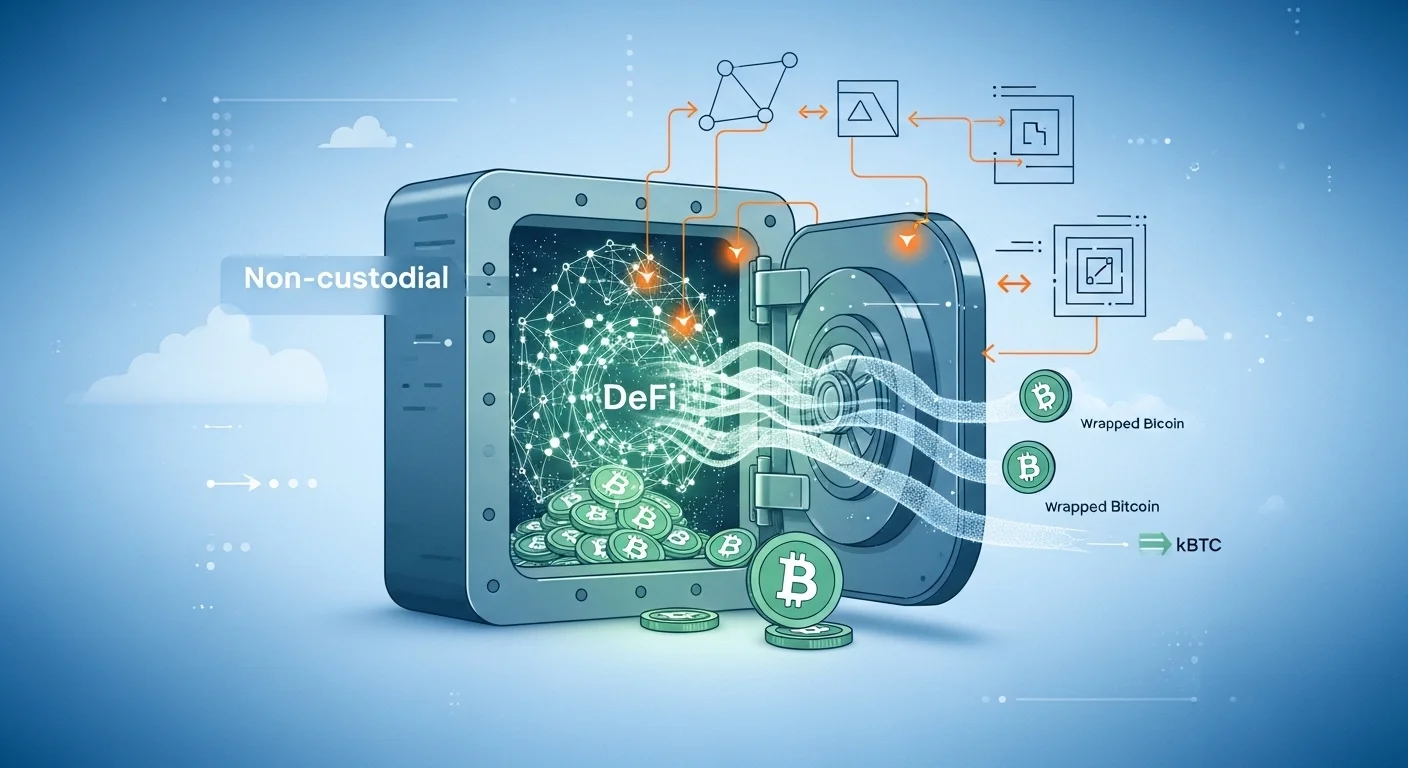
How Does the Bitcoin Vault Mechanism Actually Work?
Understanding the core innovation requires diving into the technical mechanics of the wrapped token, kBTC. When a user deposits BTC into the Vault, the asset undergoes a highly technical, but user-friendly, wrapping process. The native BTC is tokenized into kBTC and transferred to an embedded, non-custodial wallet structure on the Ink network. This tokenization is the critical enabler. It allows Kraken, the custodian platform, to treat the underlying BTC collateral as liquid, fungible collateral that can then be deployed across established, external on-chain lending markets to generate yield.
Crucially, the system is engineered to mitigate basis risk. Unlike some yield products that might require significant collateral overhead or suffer from price divergence between the wrapped token and the underlying asset, the Vault is designed to manage the entire lifecycle: lending -> reward accrual -> unwrapping. Once the yield-generating cycle is complete, the kBTC is systematically unwrapped back into native BTC and credited to the user's primary Kraken account. The complexity—the constant cycle of wrapping, lending, and unwrapping—is entirely managed behind the scenes, presenting the user with a single, seamless allocation function.
Why is Maintaining Full Price Exposure So Important for BTC Investors?
For Bitcoin conviction holders, the single most important factor is price exposure. They are not merely looking for the highest possible yield; they are looking for yield on Bitcoin. If a yield product forces investors to accept a structural discount, or if the collateral mechanism introduces significant basis risk, the perceived risk often outweighs the potential gain. Kraken’s explicit focus on full price exposure directly addresses this deep-seated market skepticism.
By ensuring the user’s BTC retains its full market price exposure throughout the cycle, the product appeals deeply to the institutional class and the long-term retail investor. This contrasts sharply with other structured products that might yield higher APYs but require the user to accept a theoretical pricing gap. The simplicity of the commitment—allocate BTC, earn yield, withdraw BTC—reinforces the product’s suitability for the Bitcoin Maximalist crowd who prioritize asset fidelity. This strategic product placement also signals a maturing maturity of the decentralized finance sector, where risk management and accessibility are gaining equal importance alongside raw APY numbers.
Is This Model Sustainable for Central Exchanges?
The success of the Bitcoin Vault marks a significant strategic pivot for centralized exchanges like Kraken. Historically, many CEXs were viewed as necessary but inherently limited intermediaries—tools for on/off-ramping fiat. Now, by deeply integrating specialized DeFi mechanisms, they are evolving into multi-utility financial infrastructure providers.
This strategy allows them to capture value-added services that previously required users to interact directly with complex, sometimes unpredictable, DeFi protocols. By providing a managed, regulated, and user-friendly interface, the platform reduces friction, increases adoption, and builds deeper customer lock-in. The resulting revenue streams are not just transactional; they are based on providing infrastructural trust and accessibility, making the platform indispensable to the crypto user journey.
Furthermore, the operational robustness of centralized players provides a critical safety net that raw DeFi protocols often lack, making the product highly attractive to institutional capital that demands robust risk mitigation.
The Future Implications for Crypto Finance
The rollout of products like this has profound implications for the entire crypto financial landscape:
- The Convergence of TradFi and DeFi: Products that wrap complex DeFi yield generation into a regulated, easily accessible wrapper are the clearest indicator of TradFi adoption. The product acts as a bridge, allowing traditional financial protocols to gain trust in the underlying mechanisms of decentralized finance.
- Yield Product Standardization: This push for high-quality, understandable yield products will force the DeFi sector itself to improve its interfaces and risk transparency, ultimately benefiting all participants.
- Capital Efficiency: For users, it represents a massive leap in capital efficiency, allowing capital to work harder by generating yield without requiring the user to become an expert in impermanent loss, liquidation risk, or complex smart contract interactions.
If you are looking to generate reliable yield without navigating complex DeFi mechanics, products like this provide an elegant, regulated solution.
Disclaimer: This content is for informational purposes only and does not constitute financial, legal, or investment advice. Always conduct your own thorough research.
Google Search Preference
Add Fintech Monster to your preferred sources
Never miss deep, analytical fintech insights. Prioritize our stories in your Google Search, Discover feed, and AI Overviews with one click.
About the Author
Fintech Monster
Fintech Monster is run by a solo editor with over 20 years of experience in the IT industry. A long-time tech blogger and active trader, the editor brings a combination of deep technical expertise and extended trading experience to analyze the latest fintech startups, market moves, and crypto trends.