MoonPay Launches MoonPay Trade: How Institutional Finance is Being Wired to the Multi-Chain DeFi Frontier
Key Takeaways
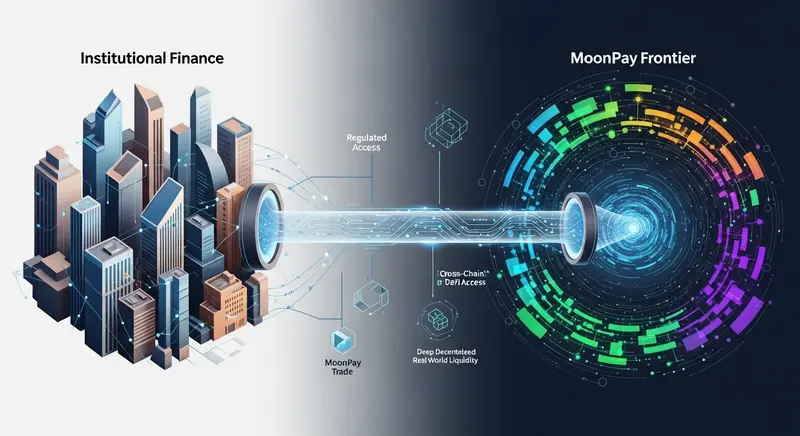
MoonPay’s new institutional platform, MoonPay Trade, solves key structural problems for major banks by providing regulated, cross-chain access to deep decentralized liquidity, tokenized real-world assets (RWAs), and diverse DeFi protocols.
Table of Contents
The recent unveiling of MoonPay’s institutional offering, MoonPay Trade, signals a definitive and highly strategic pivot: the transformation of the platform from a popular retail crypto on-ramp into critical financial plumbing for major global banks and institutional investment funds. This move is far more than an expansion of user base; it is the establishment of an integrated, regulated access point designed specifically to bridge the deeply entrenched silos of traditional finance (TradFi) with the vast, programmable complexity of the decentralized finance (DeFi) ecosystem. For years, the primary hurdle for major financial players has been systemic fragmentation, and MoonPay Trade positions itself as the single, unified solution to this monumental technical and structural challenge.
For the institutional sector, accessing digital assets previously required specialized, costly, and fragmented infrastructure. Banks and asset managers cannot simply open a retail crypto account; they require secure, regulated custody, reliable liquidity, and guaranteed interoperability across dozens of disparate blockchain environments. MoonPay addresses this by positioning itself not as a simple exchange, but as a comprehensive liquidity aggregator and transaction processing layer. Its core function revolves around enabling seamless access to tokenized real-world assets (RWAs) and deep liquidity pools across over 200 different blockchains—a capability previously thought to require proprietary, bespoke banking solutions. This institutional focus acknowledges the undeniable macro-economic shift: the necessity for traditional capital to locate yield generation and operational efficiency within the tokenized economy.
Why is MoonPay Trade the Key to Institutional DeFi Adoption?
The institutional reluctance to embrace digital assets stems largely from complexity, operational risk, and regulatory uncertainty. A global bank operates on the principle of minimizing counterparty risk across multi-jurisdictional transactions. Traditional DeFi, while offering immense opportunity, has historically lacked this standardization. MoonPay Trade tackles this head-on by building a highly structured access layer that integrates established financial workflows—like fiat on-ramping—with cutting-edge decentralized technology.
Decoding the Technical Plumbing: From Fiat to Cross-Chain Asset
The platform's architecture is revolutionary because it standardizes the multi-step process inherent in DeFi. A typical institutional transaction might involve converting fiat currency, which then needs to be converted into a stablecoin (such as USDC), and finally swapped into the target asset (e.g., governance tokens or RWA shares). MoonPay streamlines this with a clear, three-stage process.
First, the platform utilizes its regulated fiat gateway to initiate the capital flow. Second, the stablecoin acts as the critical unit of account, ensuring stability and mitigating volatility risk during the early stages of the transaction. Third, and most critically, MoonPay leverages specialized technology, including the interoperability backbone provided by acquisitions like Decent.xyz. This ensures that the stablecoin and the subsequent asset swap can occur reliably across diverse, disparate blockchain networks—a feat that was once considered impractical for institutional scale.
This seamless connectivity is what de-risks the entire process, making complex, multi-chain strategies accessible to large financial players who require absolute reliability and auditability.
The Shift to Tokenized Real-World Assets (RWAs)
The underlying driver compelling institutions to adopt this framework is the surging interest in tokenized real-world assets (RWAs). These are assets like real estate, bonds, and commodities, whose ownership rights are digitized and represented on a blockchain. For MoonPay’s institutional clients, the platform isn't just about asset transfer; it’s about accessing liquidity and yielding returns from asset classes that were previously difficult to fractionalize or trade globally.
By providing a direct gateway, MoonPay positions itself not merely as an exchange, but as a crucial infrastructure layer facilitating the migration of trillions of dollars from traditional finance (TradFi) into the decentralized finance (DeFi) ecosystem.
Key Implications for Institutional Finance
The launch marks several fundamental shifts in how institutional capital will operate:
- Fractionalization at Scale: Institutional investors can now participate in fractional ownership of high-value assets previously reserved for sovereign wealth funds.
- Speed and Efficiency: Settlement times that once measured days are now measured in minutes, radically improving capital velocity.
- Global Access: Geographic barriers to investing in emerging markets or specialized assets are significantly reduced.
This consolidation of specialized services—from on/off-ramping fiat to managing multi-chain RWA liquidity—solidifies MoonPay's role as a critical market enabler, signaling a definitive move toward crypto integration in the global financial mainstream.
Key Takeaways for Investors:
- Infrastructure Focus: The value proposition is no longer the asset itself, but the underlying secure, scalable infrastructure connecting traditional finance to blockchain rails.
- RWA Dominance: The primary investment narrative is shifting from pure speculation (altcoins) to tangible, tokenized assets (RWAs).
- Interoperability is King: The ability to move capital seamlessly between different blockchain ecosystems (multi-chain capability) is the defining technological advantage.
Google Search Preference
Add Fintech Monster to your preferred sources
Never miss deep, analytical fintech insights. Prioritize our stories in your Google Search, Discover feed, and AI Overviews with one click.
About the Author
Fintech Monster
Fintech Monster is run by a solo editor with over 20 years of experience in the IT industry. A long-time tech blogger and active trader, the editor brings a combination of deep technical expertise and extended trading experience to analyze the latest fintech startups, market moves, and crypto trends.
Related Articles
Recommended
Chainlink's Institutional Validation: Why Bottomline's Integration Changes Cross-Border Payments Forever
Bottomline's integration of Chainlink with its global network validates decentralized infrastructure as a core complement to traditional correspondent banking systems, signaling the maturation of institutional crypto adoption beyond mere speculation.

How Asset-Backed Lending Is Reshaping European Institutional Finance
Fuels Capital addresses Europe's institutional financing gap by securitizing diverse revenue streams into specialized Asset-Backed Lending (ABL) solutions, optimizing capital access outside traditional banking constraints.

AMC CEO vs. Robinhood: Why Institutional Leaders Are Shutting Down Stock Tokens
The conflict between AMC leadership and Robinhood signals a fundamental industry pivot, suggesting that traditional brokerage models are rejecting the immediate deployment of pure tokenized equity due to profound regulatory risk regarding securities classification.

South Korea Maps Out Definitive Roadmap for Tokenizing Real-World Assets
South Korea’s three-phase regulatory roadmap aims to establish a definitive legal and technical framework for tokenizing traditional securities, positioning the nation as a global leader in compliant digital asset markets by 2027.

South Korea’s Blueprint for Digital Assets: Decoding the Tokenized Securities Revolution by 2027
South Korea plans a full rollout of tokenized securities by February 2027, establishing a highly regulated digital asset framework that aims to reduce counterparty risk and facilitate 24/7 cross-border capital flows for traditional assets.