Project Aura: How Google and XREAL Are Redefining Reality with the Gemini-Powered Spatial Computer
Key Takeaways
Project Aura marks a crucial inflection point in consumer computing, leveraging a split-compute architecture and Google's Gemini AI to deliver lightweight, highly functional mixed-reality experiences via advanced smart glasses.
The convergence of advanced AI, high-fidelity optics, and portable hardware has culminated in Project Aura, a device poised to redefine the boundaries of personal computing. Developed through a strategic alliance between XREAL and Google, this system is not merely an upgraded pair of smart glasses; it represents a foundational pillar for the next generation of spatial computing. Aura addresses the industry's most persistent challenge: making high-powered, immersive mixed-reality (MR) accessible and comfortable for the mass consumer market. By integrating the robust intelligence of Google’s Gemini AI with cutting-edge Android XR ecosystem standards, Project Aura positions itself to move the industry past bulky, dedicated hardware and into a seamless, wearable form factor that feels less like a gadget and more like an integrated extension of human sight.
Historically, attempts at truly mixed-reality computing have been bottlenecked by the 'power-weight paradox.' Achieving high-fidelity rendering, complex environmental mapping, and robust AI processing requires substantial thermal dissipation and battery capacity, which has long confined these devices to room-sized setups or uncomfortable headsets. Project Aura solves this fundamental ergonomic hurdle through a highly sophisticated architectural split. This strategy—moving the main processing unit and battery to a separate, tethered puck—allows the core visual component (the glasses) to remain incredibly lightweight while granting access to the computational muscle needed for real-time, context-aware interaction. This paradigm shift is crucial, signaling that the barrier to consumer adoption is no longer simply about screen quality, but about sustained, wearable usability.
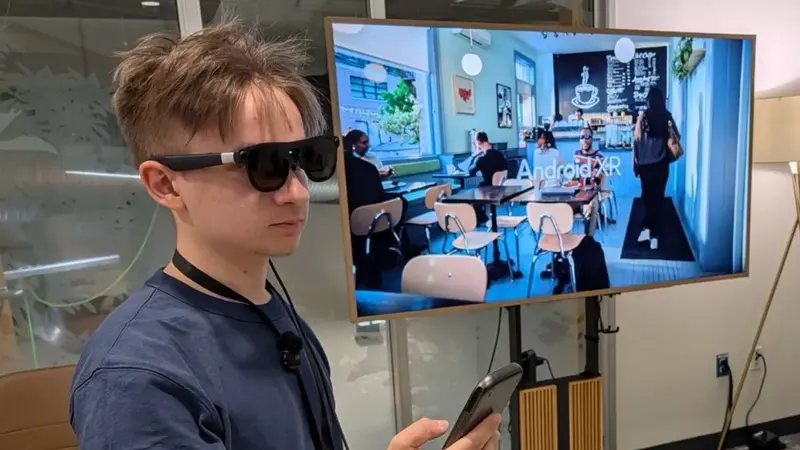
Why Is the Split-Compute Architecture a Game Changer for Wearable Tech?
The engineering choice to separate the high-power components is perhaps the most significant technical breakthrough detailed in Project Aura. By confining the battery and main processor (the puck) to a separate unit, XREAL and Google have fundamentally solved the core issue of thermal management and weight distribution in wearable electronics. Traditional AR/VR devices must carry all processing power and batteries on the head unit, leading to excessive bulk, heat buildup, and user fatigue.
The split-compute model reimagines the interaction, shifting the device from a single piece of headwear to an integrated personal computing hub. This design choice is not merely practical; it is predictive. It implies an infrastructure where computing resources are dynamically allocated, allowing the glasses to focus solely on optimal optics and display, while the puck manages the heavy lifting of AI computation, environmental mapping, and connectivity. This allows the glasses to achieve an impressive 70-degree Field of View (FOV)—a figure the developers note is critical for natural presence—without compromising the delicate balance required for comfortable all-day wear.
How Does Gemini AI Elevate a Smart Glass from a Display to an Assistant?
The inclusion of Gemini AI transforms Project Aura from a passive display device into an active, context-aware digital partner. Many early AR devices were constrained to displaying pre-rendered content or simple overlaid graphics. Gemini, however, implies a much deeper level of interaction: the ability to process and interpret the user’s real-time environment.
Consider a scenario: a user is in a kitchen. Instead of displaying a static recipe screen, the system uses Gemini's multimodal capabilities to recognize the physical items (a jar of cumin, a raw chicken breast) and overlay instructions directly onto the physical object—for instance, highlighting the correct spice drawer when needed. This deep environmental integration means the system is constantly running sophisticated perception algorithms: object recognition, spatial mapping, user intent analysis, and multimodal understanding (e.g., interpreting spoken instructions in relation to the observed environment). For developers, this is a massive opportunity, moving the use case beyond entertainment and squarely into enterprise productivity, advanced manufacturing, and professional training. The commitment to developing dev kits underscores the intent to build an open, adaptable platform for the ecosystem, not just a single consumer gadget.
The Ecosystem Advantage: Open Platforms for Innovation
The true revolutionary aspect of this technology is not the hardware itself, but the open platform it creates. By decoupling the processing power (the puck) from the visual interface (the glasses), the entire system becomes modular and scalable. This is critical for future developer investment.
A modular approach means that as computing power advances, the user only needs to upgrade the 'brain' (the puck) without needing to replace the display unit. Similarly, this architecture allows for rapid integration of new sensory inputs—such as advanced haptics, biometric readers, or specialized industrial sensors—streamlining the path for industrial adoption across fields like surgery, architecture, and logistics.
Market Implications and Future Outlook
The integration of advanced computing and display technology suggests that we are at the cusp of a major paradigm shift in human-computer interaction, moving away from the "screen" model we know today and toward a "layer" model—digitally augmenting reality rather than replacing it.
For industries, the implications are staggering. Imagine surgical trainees performing procedures with real-time overlaid arterial maps or engineers reviewing blueprints anchored directly onto a physical structure under construction. The value proposition moves from novelty to mission-critical efficiency, justifying high enterprise adoption rates.
This rapid evolution also mandates a focus on standards and interoperability. As more companies build their applications on this open platform, industry groups will play a critical role in defining common vocabularies and data exchanges, ensuring that investments made today are compatible with the technologies of tomorrow.
Key Takeaways:
- From Screen to Layer: The core shift is away from 2D screens toward real-time, spatial augmentation of the physical world.
- Modularity is Key: Separating the processing unit from the display unit enables iterative, cost-effective hardware upgrades.
- Enterprise Focus: Initial adoption will be driven by industrial sectors where augmented reality provides immediate, measurable gains in efficiency and safety.
The era of truly seamless, invisible computing is fast approaching, reshaping everything from how we work to how we learn, powered by the synergy between powerful computing and advanced optics.
Google Search Preference
Add Fintech Monster to your preferred sources
Never miss deep, analytical fintech insights. Prioritize our stories in your Google Search, Discover feed, and AI Overviews with one click.
About the Author
Fintech Monster
Fintech Monster is run by a solo editor with over 20 years of experience in the IT industry. A long-time tech blogger and active trader, the editor brings a combination of deep technical expertise and extended trading experience to analyze the latest fintech startups, market moves, and crypto trends.