SambaNova’s $11 Billion Leap: Why Specialized Silicon is Outpacing General-Purpose GPUs
Key Takeaways
SambaNova's $1 billion Series F funding and $11 billion valuation signal a massive market shift toward reconfigurable dataflow architectures to overcome the "memory wall" and provide more efficient inference than traditional GPU-based systems.
SambaNova has officially sparked a seismic shift in the semiconductor landscape by securing a massive $1 billion investment in its Series F funding round. This move catapults the company’s valuation to approximately $11 billion, establishing it as a dominant force in the specialized AI hardware sector. The surge is not just a win for SambaNova; it serves as a definitive market signal that investors are moving away from "one-size-fits-all" silicon in favor of highly specialized architectures designed specifically for the demands of large language models (LLMs).
The rapid ascent to an $11 billion valuation stands in stark contrast to industry rumors from only months ago, when it was reported that Intel was seeking to acquire SambaNova for roughly $1.6 billion. This significant discrepancy reveals a fascinating divergence in market perception: while a massive incumbent like Intel may have valued the company as a strategic acquisition to bolster its existing foundry capabilities, the broader venture capital and private equity markets are pricing SambaNova as an independent powerhouse capable of disrupting the established dominance of traditional high-performance computing (HPC) giants.
How did SambaNova reach an $11 billion valuation so quickly?
The jump from a rumored $1.6 billion acquisition price to an $11 billion standalone valuation highlights the "scarcity premium" currently assigned to viable alternatives to NVIDIA’s GPU dominance. Investors are increasingly looking for ways to optimize inference speeds while slashing power consumption—two critical metrics for companies deploying generative AI at scale. By focusing on "sovereign AI" capabilities, SambaNova appeals to enterprises and nations that require high-performance inference without the logistical and energetic overhead of massive GPU clusters.
This valuation suggests a pivot in investor sentiment toward "domain-specific architectures" (DSAs). While [previously noted trends in specialized silicon] showed a growing interest in niche hardware, the scale of this funding round indicates that market participants believe SambaNova’s architecture is ready for prime time as a primary infrastructure layer. It positions the company as a critical alternative for firms seeking to bypass the "GPU tax" while maintaining the high throughput required for modern transformer models.
What makes Reconfigurable Dataflow Architecture different?
To understand why SambaNova is commanding such a premium, one must look at the core architectural difference between their technology and standard Graphics Processing Units (GPUs). Most modern AI systems rely on the von Neumann architecture, which requires processors to fetch and decode instructions from memory before execution. This constant cycle creates significant "overhead"—time and energy spent on management rather than actual computation.
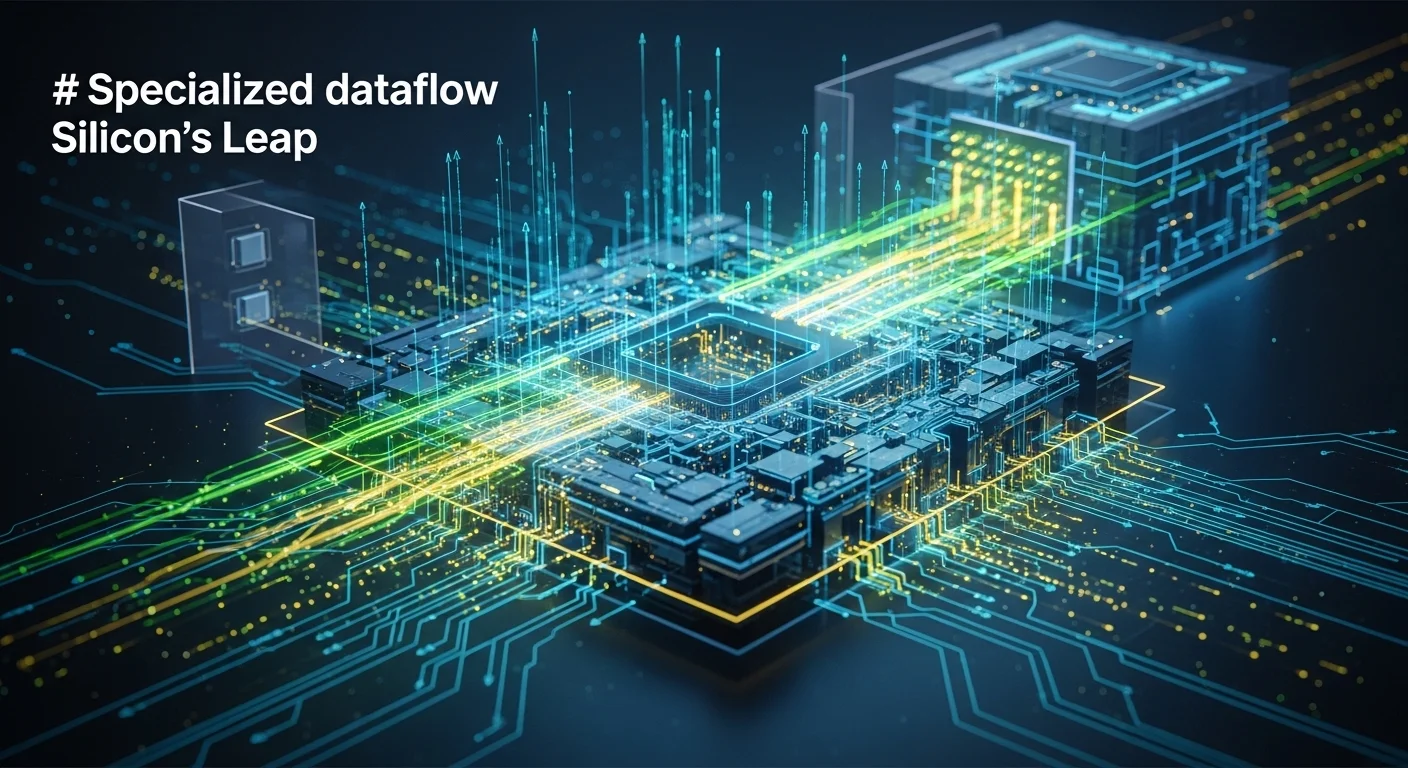
SambaNova’s Reconfigurable Dataflow Architecture eliminates much of this waste. Instead of following a standard instruction-fetch cycle, data moves through a pre-configured path of processing elements. By removing the need for continuous instruction decoding, more silicon space is dedicated to raw calculation. This allows the hardware to stay "in flight," where data flows through the chip in a streamlined manner that mimics the way neural networks are structured mathematically.
How does SambaNova address the "memory wall"?
One of the primary bottlenecks in modern AI—a hurdle often discussed in [technical reports on high-performance computing]—is known as the "memory wall." This refers to the disparity between the speed at which a processor can perform calculations and the speed at which data can be moved from memory into those processors. Because GPUs are general-purpose, they often spend significant energy moving data back and forth across long traces on the chip.
SambaNova’s architecture is specifically designed to minimize this movement. By keeping data "in flight" through processing elements, it significantly reduces latency for large-scale transformer models. This efficiency makes their chips particularly attractive for high-frequency inference tasks where every millisecond of delay translates into increased operational costs. Consequently, SambaNova sits in a unique strategic middle ground: it offers the flexibility of a GPU but performs with an efficiency closer to specialized ASICs (Application-Specific Integrated Circuits).
Key Facts
- SambaNova secured $1 billion in Series F funding at a valuation of approximately $11 billion.
- The company utilizes a "Reconfigurable Dataflow Architecture" to bypass von Neumann limitations.
- Valuation disparity: Rumors placed an Intel acquisition interest at ~$1.6B; private markets valued the firm at ~$11B.
- Core Technical Advantage: Reduction in instruction fetching/decoding overhead and minimized data movement (mitigating the "memory wall").
- Competitive Landscape: Primary competitors include high-growth firms like Groq and Cerebras.
- Strategic Focus: High valuation is driven by demand for sovereign AI capabilities and optimized inference speeds.
Expert Commentary
From a trading perspective, this investment cycle marks a transition from the "exploration" phase of AI infrastructure to the "optimization" phase. During 2023 and early 2024, capital flooded into any company that could facilitate even basic LLM training—a stage where NVIDIA’s brute force was the only viable path. We are now entering an era where "inference efficiency" is the primary metric for enterprise viability.
The massive delta between Intel's rumored offer and SambaNova's current valuation is a masterclass in how market perception shifts when specialized utility becomes a commodity. Intel would have valued the company as a strategic component to fix a specific gap in their portfolio; however, private equity sees it as a scalable replacement for the status quo. Investors are betting that the "memory wall" is the ultimate bottleneck of the current AI boom. By providing an architectural "detour" around these physical limitations, SambaNova isn't just selling chips—they are selling a way to scale AI without the unsustainable costs associated with general-purpose silicon. As companies look to move toward sovereign AI models where local deployment and power efficiency are paramount, SambaNova’s position as a middle ground between GPU flexibility and ASIC efficiency makes them a formidable gatekeeper in the next decade of high-performance computing.
Google Search Preference
Add Fintech Monster to your preferred sources
Never miss deep, analytical fintech insights. Prioritize our stories in your Google Search, Discover feed, and AI Overviews with one click.
About the Author
Fintech Monster
Fintech Monster is run by a solo editor with over 20 years of experience in the IT industry. A long-time tech blogger and active trader, the editor brings a combination of deep technical expertise and extended trading experience to analyze the latest fintech startups, market moves, and crypto trends.