Solving the 'Last Mile': How Markup AI is Shielding Enterprise Content from LLM Hallucinations
Key Takeaways
Markup AI addresses the critical "last mile" of content reliability by deploying automated Guardian Agents to filter out hallucinations in high-stakes environments like finance and legal reporting.
The leap from experimental artificial intelligence to production-ready enterprise solutions has hit a significant roadblock: the "last mile" of reliability. While large language models (LLMs) have demonstrated an unprecedented ability to generate coherent, human-like text at scale, the presence of subtle but catastrophic hallucinations makes their unmediated use in high-stakes environments like financial reporting and legal compliance nearly impossible. The emergence of Markup AI marks a pivotal shift in this landscape, moving the industry from "raw generation" toward a disciplined model of "verified production."
By introducing a suite of Content Guardian Agents, the platform addresses a specific, painful bottleneck for modern enterprises: the massive amount of human labor currently required to fact-check and correct automated outputs. For marketing teams, financial institutions, and legal firms, the risk profile of using raw AI output is too high to ignore. Markup AI functions as an essential intermediary—an automated editorial layer that ensures what leaves the system is not just plausible, but accurate. This transition is vital for maintaining public trust and regulatory compliance in sectors where a single incorrect figure or poorly phrased legal claim can result in significant financial and reputational damage.
Why is the "last mile" problem so critical for fintech?
In the world of high-stakes finance, there is no room for "mostly accurate." When financial institutions move toward automated customer interactions and real-time data reporting, the system's integrity becomes its primary product. Currently, many firms are stuck in a cycle where AI generates content that is 90% correct, but the remaining 10%—the "mind-blowingly wrong" errors—require extensive manual intervention from human experts to rectify.
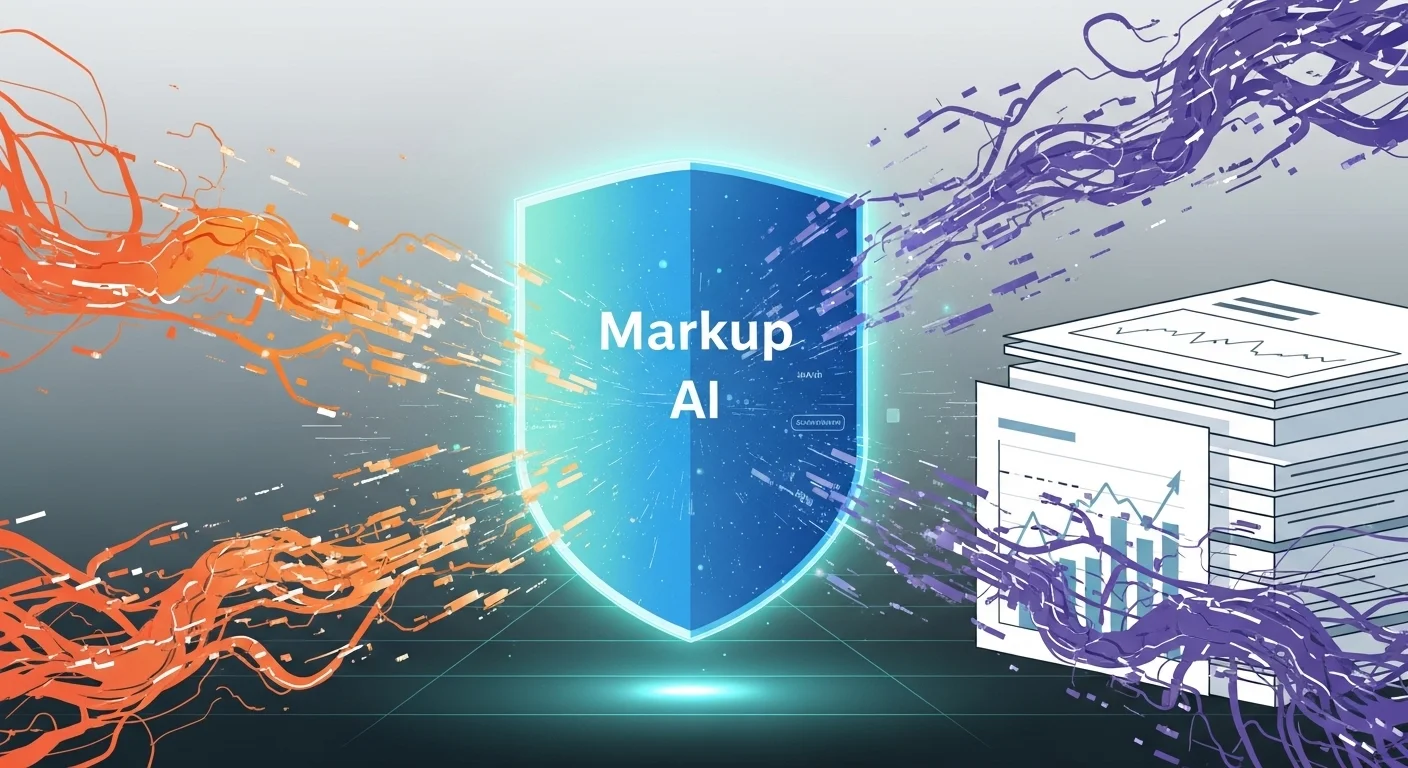
Markup AI addresses this by implementing specialized agents designed to intercept these errors before they reach the end-user. By automating the fact-checking and verification process, the platform allows organizations to scale their digital presence without proportionally increasing their need for human oversight. This is particularly relevant in B2C marketing, where a minor but critical error can go viral instantly, potentially devastating a brand's reputation overnight.
How does the "Markup" philosophy align with broader tech trends?
The methodology employed by Markup AI isn't just an isolated solution for text; it mirrors a broader architectural trend seen in software development and Web3 infrastructure. In both cases, the core strategy is to take a complex, raw system—whether it is the non-linear logic of an LLM or the intricate backend of a smart contract—and "mark it up" into manageable, abstracted layers for the end-user.
In the context of decentralized applications (dApps), "markup" philosophies are being utilized to lower the barrier to entry. By abstracting away the complexities of blockchain interactions and gas fees, these technologies allow developers without deep coding expertise to build sophisticated financial tools. Markup AI mirrors this by stripping away the complexities of prompt engineering and manual fact-checking, providing a streamlined workflow where the "raw" output of an LLM is refined into a production-ready asset.
The rise of the "Orchestrator" in the fintech workforce
The introduction of these automated guardrails signals a fundamental shift in the roles of professionals within the financial technology space. We are moving away from the era where developers had to manually code every logic gate and toward an era defined by the "orchestrator." In this new paradigm, professionals use high-level tools and managed layers to oversee multiple AI agents working in concert.
By providing a unified framework for verification, platforms like Markup AI empower these orchestrators to move faster. Instead of spending hours double-checking figures or correcting grammar, they can focus on strategy, portfolio management, and the development of new features. The democratization of technical processes—whether it is ensuring content accuracy or building decentralized protocols—is becoming a cornerstone of the next generation of financial technology. By removing the friction of verification, these technologies allow for faster deployment cycles and more robust systems that can survive the scrutiny of the modern digital economy.
Key Facts
- Targeting "Last Mile" Reliability: The platform specifically addresses the gap between raw AI output and verified content ready for public consumption.
- Mitigating Hall_ucinations: Markup AI claims to filter out the 10% of content that is statistically likely to be factually incorrect or "mind-blowingly wrong."
- Automated Editorial Layer: The system utilizes Content Guardian Agents to act as an automated gatekeeper for high-stakes sectors like legal and finance.
- Complexity Abstraction: Similar to how Web3 simplifies smart contract interactions, Markup AI abstracts the complexities of prompt engineering into a streamlined workflow.
- Efficiency Gains: By automating verification, companies can reduce the disproportionate amount of time spent on manual corrections by marketing and content teams.
Expert Commentary
From a risk management perspective, the rise of "guardrail" technology like Markup AI is not just a convenience; it is an institutional necessity. As we move deeper into an era where AI-generated content permeates every touchpoint of the customer journey, the cost of failure becomes exponential. We are seeing a pivot away from "wild west" AI experimentation toward structured, gated environments. The role of the human in this loop is changing—no longer are they the primary authors or the primary fact-checkers; they are becoming the architects of the systems that perform those tasks. For investors and stakeholders, the value lies in scalability. A company that can produce verified content at 10x the speed of a traditional firm, while maintaining a zero-tolerance policy for hallucination, holds a significant competitive advantage in the digital economy. We are moving into an era where the bottleneck is no longer generation; it is validation. Systems like Markup AI effectively turn "raw" data into "safe" assets, which is the only way to achieve mass adoption in regulated markets.
About the Author
Fintech Monster
Fintech Monster is run by a solo editor with over 20 years of experience in the IT industry. A long-time tech blogger and active trader, the editor brings a combination of deep technical expertise and extended trading experience to analyze the latest fintech startups, market moves, and crypto trends.