SpaceX’s $600 Billion Valuation Correction: The High Cost of AI Infrastructure
Key Takeaways
SpaceX experienced a massive $600 billion market valuation drop—nearly half of Bitcoin's total market capitalization—in just three days following its first bond sale to fund critical artificial intelligence infrastructure.
The rapid erosion of nearly $600 billion in market valuation for SpaceX within a mere 72-hour window marks one of the most significant correction events in the high-growth technology sector this year. This staggering decline was not merely a fluctuation; it was a sharp market reaction to the scale of capital requirements involved in transitioning from aerospace exploration to integrated artificial intelligence systems. The sheer magnitude of this shift—equaling nearly half of Bitcoin’s entire market capitalization at the time—highlights the immense volatility inherent in infrastructure-heavy pivots within the current AI boom.
This volatility followed the announcement of a major bond sale aimed at raising at least $20 billion. This move was not just about funding rockets; it was specifically designed to build out the massive high-performance computing (HPC) clusters required for large-scale AI model training and operation. Since the acquisition of Elon Musk’s xAI in February, SpaceX has fundamentally shifted its strategic focus toward the integration of advanced computational capabilities into its core operations. This transition from a space exploration firm to an aerospace-and-computing powerhouse has introduced a new level of scrutiny regarding how investors value "compute" as a physical asset.
Why did the market react so harshly to the bond sale?
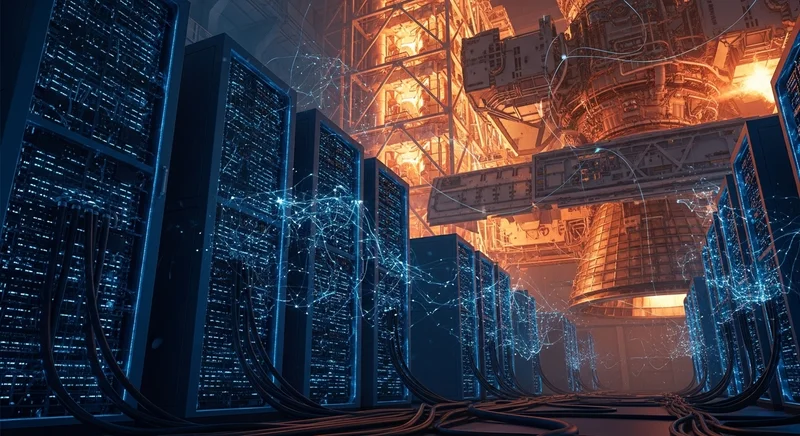
The market’s reaction to the $600 billion plunge serves as a stark reminder of the "infrastructure tax" currently impacting high-tech valuations. When SpaceX chose to issue bonds rather than pursue traditional equity rounds, it signaled a commitment to heavy capital expenditure (CapEx) for physical infrastructure—including specialized hardware, massive power generation systems, and advanced cooling technologies.
Investors are increasingly cognizant that building out a dominant position in AI is no longer just a software game; it is an industrial-scale undertaking. The sharp decline of approximately 23% in valuation over three days reflects the market’s reaction to the complexities of debt servicing and the sheer scale of investment required for infrastructure projects. While the bond sale was intended to provide the necessary liquidity for xAI's integration, the rapid correction suggests that investors are pricing in the high risk associated with large-scale physical resource procurement during a period of macroeconomic uncertainty.
How does this compare to "store of value" assets like Bitcoin?
The contrast between SpaceX and Bitcoin during this three-day window provides a fascinating case study in market psychology and asset classification. While both entities are often viewed as leaders in their respective categories, their fundamental roles differ: * Bitcoin remained remarkably stable, fluctuating by less than 1% and holding steady near the $63,600 mark. This reflects its current role as a "store of value" asset, which is perceived as a hedge against macroeconomic instability. * SpaceX, however, acts as an "infrastructure-heavy growth" entity. Its valuation is tied to tangible, high-risk infrastructure projects. Because its value is tethered to the logistics of heavy manufacturing and energy distribution for AI, it remains highly sensitive to news regarding debt, capital requirements, and project scope.
The fact that SpaceX lost nearly half of Bitcoin's market capitalization in just three days underscores how volatile companies become when they move from R&D-focused models toward industrial-scale infrastructure deployment. For investors, the "capitalization curve" for AI means that as a company builds out physical compute capabilities, its valuation becomes inextricably tied to the feasibility of scaling those technologies across massive amounts of land and power.
Key Facts
- SpaceX's market valuation plummeted by approximately $600 billion in a three-day window following its first bond sale.
- The $600 billion drop was equivalent to nearly half of Bitcoin's total market capitalization at that time.
- During this same period, Bitcoin remained stable with less than 1% fluctuation, holding near the $63,600 mark.
- SpaceX’s valuation fell by approximately 23% during the three-day window.
- The bond sale was structured to raise a minimum of $20 billion specifically for artificial intelligence infrastructure.
- Following the acquisition of xAI in February, SpaceX pivoted toward integrating advanced computational capabilities into its core operations.
The broader implications for the "AI Arms Race"
This event signals a shift in how the market evaluates aerospace and defense firms that are moving into the AI space. We are witnessing the convergence of orbital mechanics and neural network infrastructure. As these sectors merge, they bring with them the complexities of heavy industrial finance.
The volatility surrounding SpaceX’s valuation indicates that the market is still trying to calibrate how to value hybrid entities that require both high-tech innovation and massive physical capital. The $600 billion swing serves as a warning for investors: in the era of AI, "compute" is a scarce resource, but building the infrastructure to house it requires a level of investment that can cause significant market shocks during the transition from private R&D to industrial-scale deployment.
Expert Commentary
From a trading perspective, this scenario highlights a fundamental divergence between "speculative growth" and "industrial utility." Bitcoin's stability suggests it has successfully decoupled from immediate infrastructure hurdles, establishing itself as a macro-hedge. In contrast, SpaceX’s volatility is the classic symptom of an industrial transition. When a firm moves into a heavy CapEx phase—like building out HPC clusters for AI—the market becomes hyper-sensitive to debt structures and the sheer scale of the project. The $600 billion correction isn't just about the cost of chips; it’s about the risk of the energy grid, the logistics of cooling systems, and the reality of high-cost infrastructure in a high-interest environment. Investors aren't just buying a dream of space travel anymore; they are pricing the physical plumbing required to run the AI revolution.
About the Author
Fintech Monster
Fintech Monster is run by a solo editor with over 20 years of experience in the IT industry. A long-time tech blogger and active trader, the editor brings a combination of deep technical expertise and extended trading experience to analyze the latest fintech startups, market moves, and crypto trends.