The Architecture of Trust: How EdVisorly’s Series A Signals a Shift in Automated Data Normalization
Key Takeaways
EdVisorly’s $13.3 million Series A investment highlights the massive market potential for AI-driven data normalization, providing a technical blueprint for solving "messy" data problems in both education and cross-border financial compliance.
The recent announcement that EdVisorly has secured $13.3 million in Series A funding marks a significant milestone in the evolution of intelligent automation for complex administrative workflows. While the immediate application lies within the educational technology sector—specifically addressing the friction inherent in college credit transfers and university admissions—the underlying technological architecture suggests a much broader utility. By automating the reconciliation of non-standardized data, EdVisorly is tackling one of the most persistent hurdles in institutional processing: the conversion of "messy" raw inputs into structured, actionable intelligence.
Historically, educational institutions have struggled with a fragmented landscape of academic credentials. When students move between institutions or across borders, admissions officers are forced to manually interpret diverse grading systems and inconsistent course descriptions. This manual oversight is not only labor-intensive but also prone to human error, creating substantial bottlenecks for student mobility and operational efficiency. EdVisorly’s entry into this space is a direct response to the need for an algorithmic, rather than human-led, interpretation of academic data.
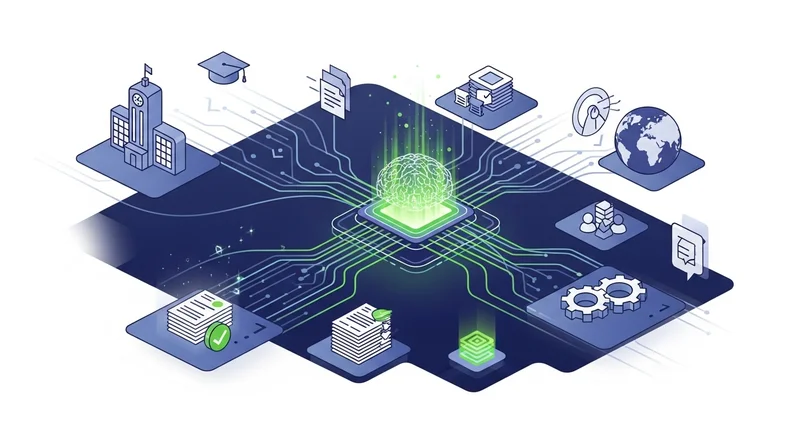
How does EdVisorly solve the "messy data" problem?
The core innovation of the EdVisorly platform lies in its ability to ingest unstructured data and transform it into a normalized format that can be compared against specific institutional requirements. The system utilizes advanced natural language processing (NLP) and machine learning to parse documents—such as transcripts or credit records—that vary wildly in formatting and terminology. By identifying equivalent courses and automatically calculating credit weights, the platform removes the ambiguity that typically plagues the admissions process.
The technical engine is built upon three critical pillars: Data Extraction & OCR, Entity Resolution and Normalization, and Rule-Based Logic Integration. The first layer ensures that physical or digital documents are converted into machine-readable text while maintaining contextual integrity. The second layer, perhaps the most vital for scalability, identifies functional equivalents between disparate entities—recognizing, for example, that "Intro to Macroeconomics" at one university serves the same pedagogical purpose as "ECON 101" at another. Finally, the system applies a layer of rule-based logic to ensure the final output complies with specific institutional mandates.
Key Facts
- EdVisorly secured $13.3 million in Series A funding to scale its AI-native platform.
- The core technology utilizes advanced NLP and machine learning for automated credential mapping.
- The system automates the conversion of unstructured data into standardized, actionable records.
- Technical pillars include OCR-based extraction, entity resolution, and rule-based logic integration.
- The solution aims to reduce administrative overhead and accelerate enrollment cycles.
Why is this a blueprint for FinTech compliance?
While EdVisorly's primary market is education, the underlying problem it solves—the translation of non-standardized data into a standardized framework—is structurally identical to the challenges faced in the financial sector, specifically within Know Your Customer (KYC) and Anti-Money Laundering (AML) protocols. In cross-border finance, institutions must often verify identity documents issued in various formats across different jurisdictions. Just as an admissions officer must "map" a foreign credit onto a local degree requirement, a compliance officer must map a foreign residency permit or government ID onto domestic regulatory standards.
By adopting a similar AI model to EdVisorly’s approach, financial institutions can automate the verification of these "messy" documents into unified trust scores or identity profiles. The transition from manual document review to algorithmic mapping allows for "Zero-Touch" verification in high-stakes environments. This shift is critical for scaling cross-border services; it allows firms to expand their reach geographically without a corresponding linear increase in compliance headcount. By removing human subjectivity from the initial screening layer, financial institutions can ensure that every customer is evaluated against a consistent, data-driven standard, thereby reducing the risk of regulatory fines and improving the speed of capital flow.
The shift toward "Zero-Touch" infrastructure
The investment in EdVisorly signals an increasing appetite for technologies that solve fundamental infrastructure bottlenecks. In both education and finance, the primary cost driver is often not the complexity of the rules themselves, but the labor required to interpret inconsistent data against those rules. By moving toward a model where AI performs the heavy lifting of data normalization, institutions in both sectors can achieve greater consistency.
The scalability offered by these models means that "friction costs"—the delays and overhead caused by manual verification—can be significantly minimized. For students, this means faster enrollment; for financial institutions, it means a more seamless path to global expansion. Ultimately, the success of EdVisorly highlights a broader trend: as AI becomes more sophisticated at handling nuance and unstructured text, the opportunity to automate high-friction compliance workflows grows exponentially.
Expert Commentary
From a market perspective, the investment in EdVisorly is a classic example of "infrastructure play" masquerading as a niche application. While the immediate headlines will focus on edtech, the real value lies in the mastery of data normalization. In my experience, the most valuable segments in fintech are often those that sit at the intersection of complex regulation and messy reality.
When you have an AI model that can successfully map academic credits—a process involving heavy nuance, translation, and rule-validation—you have a blueprint for solving high-stakes KYC/AML hurdles. We are moving toward an era where "human-in-the-loop" will be reserved only for the most extreme edge cases, while the bulk of cross-border verification is handled by these automated mapping layers. The reduction in friction cost here is immense; any firm that can automate the transition from "raw data" to "verified status" without increasing headcount gains a massive competitive advantage in scaling their global footprint. EdVisorly’s success suggests that the next wave of high-value startup acquisitions will be those that provide the plumbing for these automated trust layers.
Google Search Preference
Add Fintech Monster to your preferred sources
Never miss deep, analytical fintech insights. Prioritize our stories in your Google Search, Discover feed, and AI Overviews with one click.
About the Author
Fintech Monster
Fintech Monster is run by a solo editor with over 20 years of experience in the IT industry. A long-time tech blogger and active trader, the editor brings a combination of deep technical expertise and extended trading experience to analyze the latest fintech startups, market moves, and crypto trends.