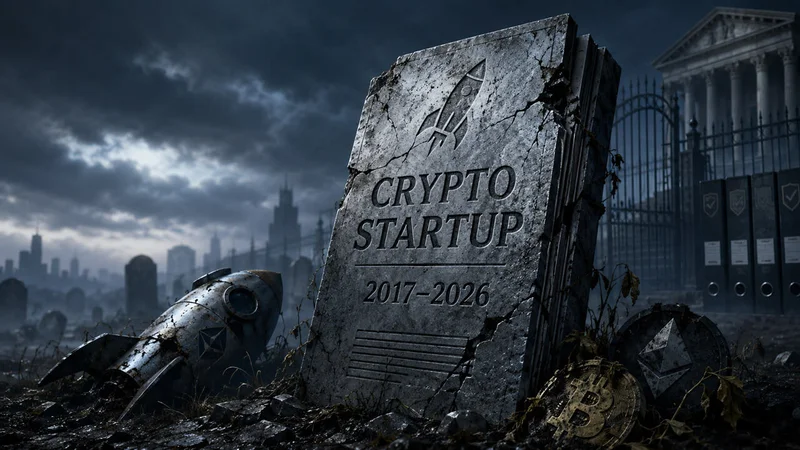
The Death of the Crypto Startup: Why the "Wild West" Era Ended in 2026
Key Takeaways
The transition from 2017's deregulated ICO boom to the current high-barrier institutional era marks a fundamental shift toward stable, compliant, and scalable financial systems.
The era of "permissionless" growth in the cryptocurrency space has effectively reached its conclusion, replaced by a rigorous infrastructure designed for longevity rather than just hype. While the headlines in 2017 were dominated by grass-roots projects exploding into multi-billion dollar valuations overnight, the landscape of 2026 is defined by institutional integration and strict regulatory guardrails. This shift represents a fundamental maturation: the industry is moving away from seeking retail "mania" and toward becoming an indispensable backbone for global finance.
To understand why the "easy" path to market has vanished, one must look at the structural differences between the early 2010s and the current decade. In the late 2010s, a compelling whitepaper and a vocal community were often enough to bypass traditional financial gatekeepers. This period of rapid experimentation allowed for immense innovation but simultaneously fostered a "Wild West" environment where lack of oversight led to frequent collapses and systemic vulnerabilities. Today, those gaps are being filled by heavy-duty compliance frameworks that prioritize security over speed of deployment.
Why did the "Wild West" of 2017 vanish so quickly?
The primary catalyst for this evolution was the realization that for crypto to achieve mass adoption, it had to be safe enough for pension funds and major banks. The "rug pulls" and exchange collapses of previous years served as a harsh education for regulators. Between 2021 and 2026, legislative milestones like the implementation of MiCA in Europe and intensified enforcement by the SEC in the United States created a high-barrier environment. This transition essentially priced out many small, nomadic developer teams who lacked the capital to hire specialized legal counsel or implement complex internal auditing systems from day one.
How do modern regulations change the game for new developers?
For a startup to survive today, "moving fast and breaking things" is no longer a viable mantra. Modern crypto ventures must bake Know Your Customer (KYC) and Anti-Money Laundering (AML) protocols into their core architecture from inception. This isn't just an optional feature; it is a requirement for interacting with the traditional banking rails that provide liquidity. The cost of entry has skyrocketed, meaning that modern startups are often larger organizations at their starting point—equipped with formal governance structures and dedicated security teams to ensure they meet the rigorous standards required by institutional investors.
What is replacing the speculative hype cycle?
As the easy money from retail speculation dries up, the focus has shifted toward high-utility infrastructure. We are seeing a massive pivot toward Real-World Assets (RWA), where physical property, commodities, and government bonds are being tokenized to provide fractional ownership and increased liquidity. Furthermore, stablecoins have moved into the spotlight as a primary vehicle for cross-border payments. Because of their role in global trade, these assets now face intense scrutiny regarding reserve transparency and minting processes. The goal is no longer to find the next meme-coin, but to build a reliable settlement layer that can compete with—and eventually improve upon—legacy systems like SWIFT.
Key Facts
- Transition from speculative retail focus to institutional-grade infrastructure.
- Implementation of MiCA and SEC scrutiny creating significant entry barriers for small teams.
- Mandatory KYC/AML compliance as a baseline requirement for all modern startups.
- Growing shift toward Real-World Assets (RMAs) and tokenized commodities.
- Requirement for third-party security audits and formal governance to attract institutional capital.
Expert Commentary
From the perspective of a seasoned market participant, the "death" of the early crypto startup model isn't actually a tragedy; it is an evolution of maturity. We are witnessing the transition from a speculative casino to a sophisticated financial utility. While some purists lament the loss of the 2017 "anarchy," that era was unsustainable for a global economy. The current constraints—regulatory moats, audit requirements, and compliance hurdles—actually provide a much more stable floor for the next decade of growth. By purging the low-quality actors who could only survive on fumes and hype, the market is clearing space for projects with deep integration capabilities. We aren't losing innovation; we are trading high-volatility "hype cycles" for lower-volatility, high-utility infrastructure that can actually be integrated into the global economy without constant fear of a regulatory shutdown. The era of the amateur may be over, but the age of the institution has just begun.
Google Search Preference
Add Fintech Monster to your preferred sources
Never miss deep, analytical fintech insights. Prioritize our stories in your Google Search, Discover feed, and AI Overviews with one click.
About the Author
Fintech Monster
Fintech Monster is run by a solo editor with over 20 years of experience in the IT industry. A long-time tech blogger and active trader, the editor brings a combination of deep technical expertise and extended trading experience to analyze the latest fintech startups, market moves, and crypto trends.