The Evolution of Global Finance: Why Asset Tokenization is Wall Street’s Next Frontier
Key Takeaways
The transition from speculative cryptocurrency trading to the tokenization of Real World Assets (RWAs) represents a fundamental overhaul of financial plumbing, providing institutions with atomic settlement and programmable compliance.
Table of Contents
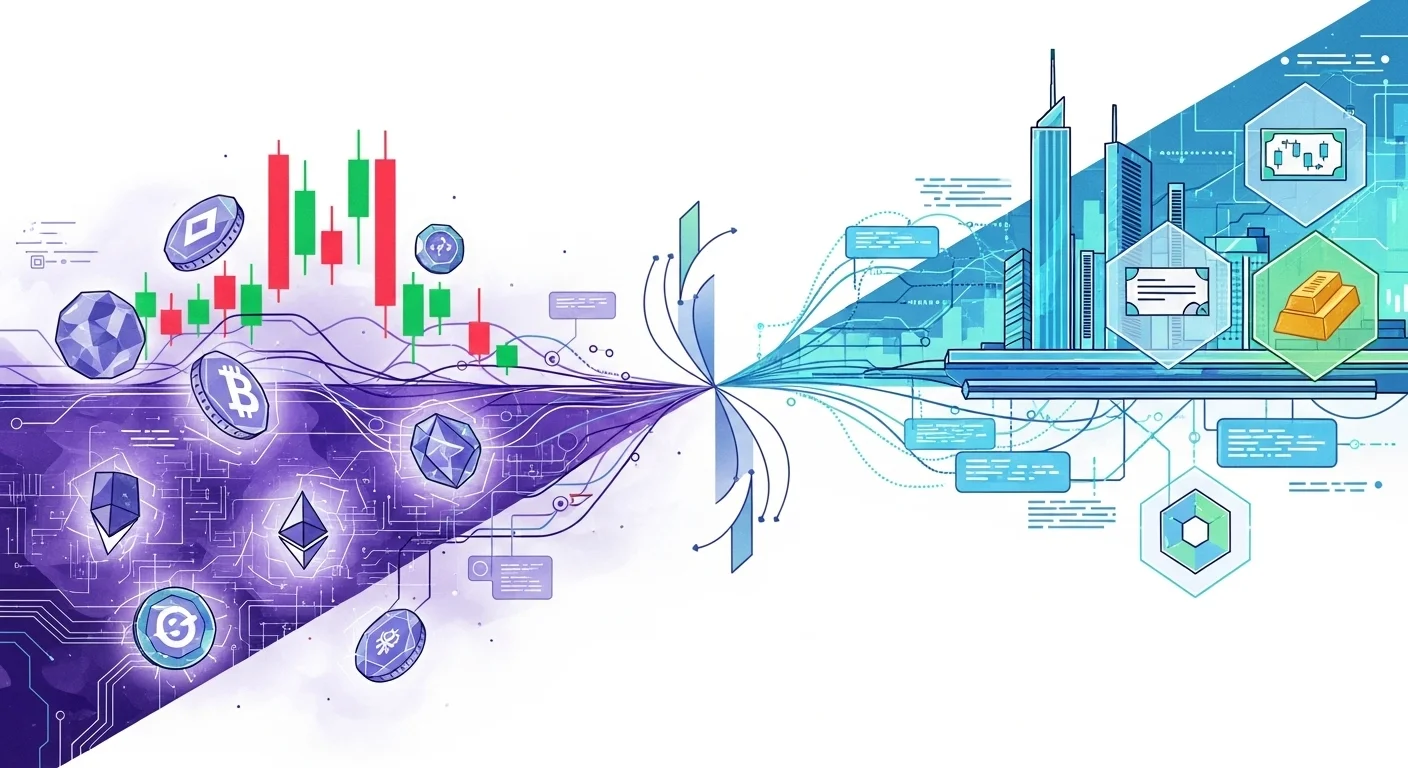
Blockchain is increasingly becoming the foundational infrastructure for global capital markets, rather than just a vehicle for speculative assets. As institutional players move away from volatile "crypto-native" assets, they are gravitating toward the underlying technology that enables the seamless movement of value. This transition represents a maturation of the sector, where the focus is shifting from the asset class itself to the plumbing—the mechanisms of ownership, settlement, and custody—that power the entire financial system.
This is driven by the emergence of Real World Assets (RWAs). By translating physical or traditional financial instruments into digital tokens on a distributed ledger, institutions can bypass several layers of antiquated middle-man processes. It reimagines how value flows through global markets. For Wall Street, the primary allure lies in the ability to bring "lumpy," illiquid assets—such as private equity or real estate—into a modernized framework where they can be managed with the same speed and precision as digital information.
Why is "atomic settlement" the holy grail for institutional investors?
One of the most significant hurdles in modern finance is the delay in trade finality. Traditionally, markets operate on T+1 or T+2 settlement cycles, requiring a complex web of intermediaries to verify and reconcile transactions between different ledgers. This lag creates counterparty risk and necessitates massive amounts of capital held in reserve during the "waiting period."
Tokenization introduces the concept of atomic settlement, where the exchange of an asset and the corresponding payment happen simultaneously and instantly. By utilizing smart contracts, the transaction is only finalized when all conditions are met. For a large-scale financial institution, this eliminates the need for manual reconciliation and significantly reduces the operational costs associated with cross-border trades or complex multi-asset portfolios. It transforms settlement from a background process that takes days into an immediate confirmation, mirroring the speed of digital commerce while maintaining full regulatory integrity.
How does tokenization solve the liquidity problem in private markets?
Right now, many high-value assets like private equity and commercial real estate are hard to trade because they are "lumpy"—they require massive minimum investments and have slow turnover. This creates a barrier for smaller institutions and reduces overall liquidity. By turning these assets into digital tokens, the market can finally enable fractional ownership.
When an apartment complex or private equity stake is tokenized, it can be broken down into millions of tiny units. This lets investors buy and sell small portions, creating a secondary market for assets that used to be locked away. For pension funds and insurance companies, this "democratization" means better diversification and liquidity without sacrificing the stability of traditional assets. It effectively bridges the gap between private equity returns and the liquidity usually found only in public markets.
Can smart contracts actually enforce regulatory compliance automatically?
For Wall Street, compliance isn't a luxury; it's a mandate. One of the biggest advantages of blockchain is its ability to bake programmable logic directly into the asset itself. In traditional finance, ensuring an investor has been properly vetted (KYC) or that a trade complies with local rules requires manual post-trade auditing.
In a tokenized ecosystem, these requirements can be coded straight into the smart contract. A token for a government bond or private equity stake can be programmed to only transfer if the recipient's digital identity meets pre-defined compliance rules. This shifts the burden of enforcement from human auditors to the protocol itself. By baking compliance directly into the architecture, institutions can trade with more confidence and less risk, knowing the asset literally cannot move unless it follows the rules.
Google Search Preference
Add Fintech Monster to your preferred sources
Never miss deep, analytical fintech insights. Prioritize our stories in your Google Search, Discover feed, and AI Overviews with one click.
About the Author
Fintech Monster
Fintech Monster is run by a solo editor with over 20 years of experience in the IT industry. A long-time tech blogger and active trader, the editor brings a combination of deep technical expertise and extended trading experience to analyze the latest fintech startups, market moves, and crypto trends.
Related Articles
Recommended
Why are Bitcoin’s $2B+ Corporate Treasuries a Ticking Bomb of Conditional Supply Risk?
Complex derivatives like options and secured loans are transforming large corporate Bitcoin holdings from passive assets into conditional liabilities, introducing systemic sell-side risk that regulators must address.

Solana Transactions Hit Record 4.2B Amid $4 Billion RWA Inflow—A Systemic Shift for Global Finance
Solana's massive increase in transaction volume validates its capacity as the preferred digital rail for institutional Real-World Asset (RWA) tokenization, signaling a permanent integration of traditional finance into decentralized systems.

The $500M Digital Divide: Why Crypto Custody Firm Copper's Valuation Sparks M&A Debate
The valuation gap between Copper's high asking price and low institutional bids reveals structural market friction, suggesting that despite advanced technology, global regulators still perceive significant operational and adoption risk in specialized digital custody services.

Decoding Parent-Controlled Supply: Inside the Solana Reinsurance Sale Mechanics
Oxbridge’s dominant role in the Solana reinsurance sale highlights systemic risks associated with parent-controlled supply allocation rather than broad market conviction.

Chainlink's Institutional Validation: Why Bottomline's Integration Changes Cross-Border Payments Forever
Bottomline's integration of Chainlink with its global network validates decentralized infrastructure as a core complement to traditional correspondent banking systems, signaling the maturation of institutional crypto adoption beyond mere speculation.