The Great Rotation: Why AI Infrastructure is Siphoning Liquidity from Digital Assets
Key Takeaways
The global financial landscape is undergoing a structural shift as capital migrates from speculative digital assets into tangible artificial intelligence infrastructure and software ecosystems.
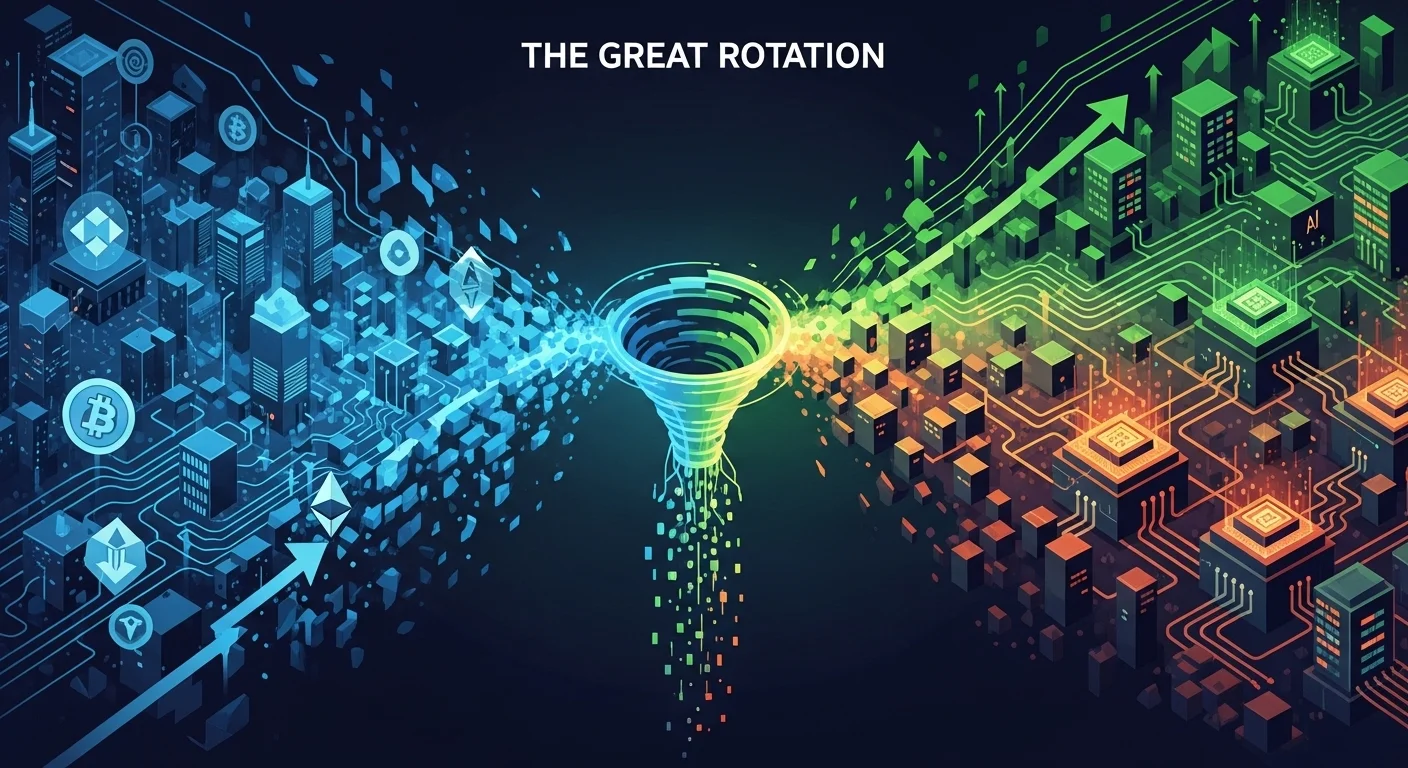
The global financial landscape is currently navigating a profound structural transformation where institutional and retail capital is migrating away from decentralized digital assets in favor of the core infrastructure powering artificial intelligence (AI). This "Great Rotation" signifies a transition in investor psychology, moving away from speculative "store of value" narratives toward "productive technology" models. As the market matures, investors are increasingly prioritizing tangible utility and scalable industrial applications over the high-variance volatility typical of the cryptocurrency markets of the last decade.
This shift is not merely a temporary trend but a strategic pivot in how global portfolios manage risk in an era of rapid technological acceleration. While cryptocurrency served as a primary vehicle for speculative liquidity during previous cycles, AI has emerged as the definitive infrastructure play of the current decade. The migration is fueled by an urgent demand for high-performance computing (HPC) capabilities, leading to a massive concentration of capital into semiconductor manufacturing, cloud service providers, and data center operations—the bedrock upon which modern intelligence is built.
Why are investors gravitating toward AI infrastructure over digital assets?
The core distinction driving this capital migration lies in the difference between speculative growth and infrastructure-led growth. Investors are increasingly drawn to the "pick and shovel" providers of the AI revolution. While cryptocurrency projects often seek value through network effects and community adoption, AI companies provide foundational layers that immediately integrate into corporate workflows to improve efficiency, enhance customer service, and accelerate R&D cycles.
This preference is underscored by a critical shortage in high-performance computing capabilities. The sheer scale required to train large language models (LLMs) and maintain complex neural networks has created a massive opportunity for companies involved in the hardware ecosystem. Consequently, capital that previously sought growth in digital assets—often characterized by "wait and see" utility—is now flowing into AI-centric equities that offer measurable improvements in industrial output.
How are macroeconomics influencing this market shift?
Macroeconomic factors, specifically fluctuations in the "risk-free" rate and persistent inflation concerns, have played a pivotal role in this transition. In environments where central bank policies create volatility, non-yielding assets like many cryptocurrencies become less attractive compared to high-growth technology stocks that offer clear paths to profitability. AI provides a tangible roadmap for investors; it offers immediate integration into the global economy, making it a safer bet for institutional portfolios that are mandated to prioritize growth backed by physical and operational infrastructure.
| Feature | Cryptocurrency Assets | AI Infrastructure Stocks |
|---|---|---|
| Primary Narrative | Store of Value / Decentralization | Productive Technology / Automation |
| Market Role | Speculative Liquidity | Industrial Utility & Efficiency |
| Infrastructure Need | Distributed Networks | High-Performance Computing (HPC) |
| Capital Cycle | Volatile/Speculative | Long-term Growth/Expansion |
| Corporate Adoption | Secondary Layer / Niche | Primary Infrastructure / Core |
What does this mean for the future of the crypto space?
The "theft" of billions in liquidity from the digital asset sector toward AI isn't necessarily a death knell for cryptocurrency, but it is a forced evolution. To remain relevant, the crypto market must pivot toward Real World Assets (RWA) and decentralized physical infrastructure (DePIN). By aligning itself with tangible assets and real-world utility, the crypto space can carve out a niche as a secondary layer of the global financial system, focusing on settlement and verification rather than being the primary vehicle for speculative growth.
The capital concentration in the AI sector also suggests a period of consolidation. Because the CapEx required to build next-generation training clusters is so immense, power is likely to concentrate among a few dominant technology giants. This creates a "winner-takes-most" environment for hardware and cloud infrastructure. Meanwhile, the cryptocurrency space must reinvent its value proposition to survive this shift, moving away from speculative sentiment and toward integration into global logistics, identity, and physical asset management.
Key Facts
- The "Great Rotation" marks a transition from store of value narratives to productive technology models.
- Capital is migrating into hardware ecosystems, specifically semiconductors, cloud providers, and data center operators.
- AI offers measurable improvements in corporate efficiency, making it more attractive to institutional investors than non-yielding digital assets.
- The crypto sector must pivot toward Real World Assets (RWA) and dePIN to maintain relevance as a secondary layer of the financial system.
- Investment in AI is projected to dominate the capital cycle for the next decade due to high CapEx requirements for training clusters.
Expert Commentary
From a trading perspective, we are witnessing a fundamental re-pricing of "certainty." For the last several years, investors were willing to tolerate the volatility of digital assets because the narrative of "digital gold" was enough to sustain growth. However, in the current macro climate, the market is demanding tangible utility. AI isn't just a new technology; it is the engine of the next industrial revolution.
When you look at the capital flow into semiconductor firms and specialized data centers, you see investors moving toward "moats." These are companies with massive physical footprints and essential roles in the global supply chain. Cryptocurrency, while still technologically significant, currently lacks the same level of immediate, high-scale integration into corporate R&D and production pipelines. The "Great Rotation" is a move toward assets that can be quantified by their ability to automate human labor and optimize industrial output. For the crypto space to survive this decade, it must stop trying to compete with AI for the "innovation spotlight" and instead focus on becoming the invisible infrastructure layer—handling RWA tokenization and decentralized data management—while AI takes the lead on the primary capital cycle.
About the Author
Fintech Monster
Fintech Monster is run by a solo editor with over 20 years of experience in the IT industry. A long-time tech blogger and active trader, the editor brings a combination of deep technical expertise and extended trading experience to analyze the latest fintech startups, market moves, and crypto trends.