The Quantum Shield: Securing Ethereum’s Future Against the Rise of Q-Day
Key Takeaways
As quantum computing milestones accelerate the timeline for "Q-Day," Ethereum core researchers and cryptography startups are engineering post-quantum cryptographic schemes to protect validator consensus and user keys.
Table of Contents
The cryptographic foundation of the global digital economy is facing a looming existential threat: the arrival of "Q-Day"—the theoretical point at which a fault-tolerant quantum computer achieves sufficient qubit capacity to break modern public-key cryptography. For Ethereum, which secures hundreds of billions of dollars in decentralized capital, decentralized finance smart contracts, and sovereign tokenized assets, preparing for the post-quantum era is not a distant academic thought experiment; it is the most critical infrastructure upgrade in the history of distributed ledger technology.
The vulnerability stems from the core mathematical primitives that power modern blockchain architectures. Ethereum, like Bitcoin and the vast majority of traditional banking networks, relies on the Elliptic Curve Digital Signature Algorithm (specifically the secp256k1 curve) to generate public-private key pairs, and the BLS (Boneh-Lynn-Shacham) signature scheme for proof-of-stake validator aggregation. If a sufficiently powerful quantum computer running Shor’s algorithm is deployed, it could compute private keys from public keys in a matter of seconds, enabling malicious actors to drain user wallets and forge consensus signatures at will.
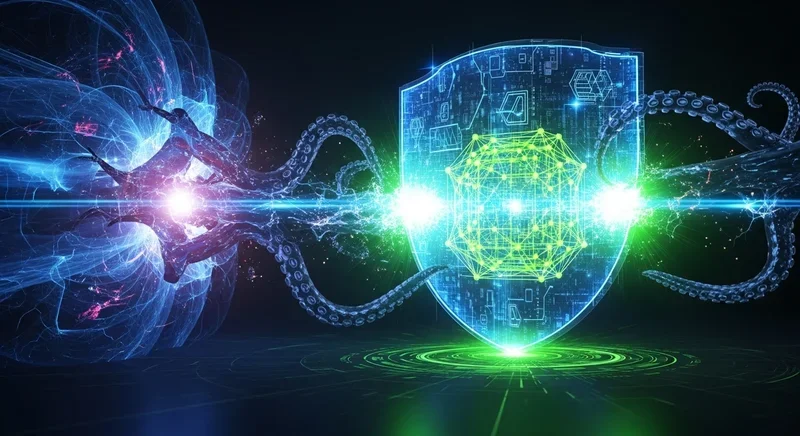
How are Ethereum core researchers and cryptography startups engineering post-quantum resilience?
The engineering roadmap to secure Ethereum against quantum adversaries centers on migrating the entire network to lattice-based cryptography, hash-based signatures, and quantum-resistant zero-knowledge STARKs (Scalable Transparent Arguments of Knowledge). Unlike elliptic curve cryptography, lattice-based problems (such as Learning With Errors, or LWE) and cryptographic hash functions (such as Keccak-256) are mathematically believed to be impervious to both classical and quantum algorithmic shortcuts.
To protect end-user accounts without requiring a chaotic, emergency network hard fork, researchers are leveraging Account Abstraction (ERC-4337 and native RIP-7560 proposals). Account abstraction enables user wallets to be programmed as smart contracts capable of executing arbitrary signature verification logic. Instead of being hard-coded to secp256k1, accounts can seamlessly upgrade their verification algorithms to post-quantum signature schemes—such as CRYSTALS-Dilithium, Falcon, or SPHINCS+—standardized by the U.S. National Institute of Standards and Technology (NIST).
Key Facts
- Vulnerability Target: Elliptic Curve Digital Signature Algorithm (secp256k1) and BLS signature aggregation susceptible to Shor's quantum algorithm.
- Post-Quantum Solutions: Lattice-based cryptography (CRYSTALS-Dilithium, Falcon), hash-based signatures (Winternitz/SPHINCS+), and STARK-based ZK rollups.
- Upgrade Mechanism: Account abstraction (ERC-4337) allows modular signature scheme swaps at the application layer while consensus layers prepare for a hard-fork state migration.
What are the performance and scalability trade-offs of post-quantum cryptographic schemes?
While post-quantum cryptography provides mathematically robust security against quantum adversaries, it introduces severe engineering bottlenecks regarding computational overhead and blockchain data bloat. Post-quantum public keys and signatures are substantially larger than their classical elliptic curve counterparts; for instance, a Dilithium signature requires several kilobytes of data, compared to just 64 bytes for a standard ECDSA signature.
In a high-throughput blockchain environment where block space and gas costs are fiercely constrained, transmitting and validating multi-kilobyte signatures for millions of transactions would severely degrade network throughput and skyrocket transaction fees. To mitigate this data explosion, cryptographic engineers are designing recursive STARK aggregation layers. By aggregating thousands of post-quantum user signatures into a single, compact zero-knowledge proof verified on-chain in constant time, Ethereum can achieve quantum immunity without sacrificing network performance or decentralization.
Expert Commentary
Having monitored cryptography, enterprise security architectures, and distributed systems for more than twenty years, the blockchain industry’s proactive stance on quantum security is a masterclass in risk management. While traditional banking systems and government agencies remain paralyzed by the colossal cost of upgrading legacy COBOL mainframes, the open-source Ethereum ecosystem is already testing post-quantum primitives in live testnet environments.
The danger of quantum computing is not that it will arrive tomorrow morning without warning; the danger is the "Harvest Now, Decrypt Later" strategy currently employed by state-sponsored cyber espionage units. Sophisticated adversaries are actively recording encrypted blockchain transactions and public key disclosures today, waiting for the hardware breakthroughs that will allow them to crack historical private keys retroactively.
Looking forward, the transition to post-quantum cryptography will be the ultimate trial of Ethereum’s modular architecture. The networks that survive and capture global institutional capital will be those that engineer seamless cryptographic agility into their core protocols. Ethereum is constructing a formidable quantum shield, ensuring that decentralized finance remains unassailable for the next century of computing.
Google Search Preference
Add Fintech Monster to your preferred sources
Never miss deep, analytical fintech insights. Prioritize our stories in your Google Search, Discover feed, and AI Overviews with one click.
About the Author
Fintech Monster
Fintech Monster is run by a solo editor with over 20 years of experience in the IT industry. A long-time tech blogger and active trader, the editor brings a combination of deep technical expertise and extended trading experience to analyze the latest fintech startups, market moves, and crypto trends.
Related Articles
Recommended
Ethereum's Quantum Leap: Why PQC Migration by 2029 Is the Next Infrastructure Frontier
To neutralize the existential threat posed by quantum computing to current elliptic curve cryptography (ECC), Ethereum is mandating a hard fork upgrade to adopt Post-Quantum Cryptography (PQC) standards by 2029.

Quantum Crisis Looms Over Staking Security: How Ethereum Developers Plan Crypto-Proofing
Ethereum developers are proposing a foundational migration to Post-Quantum Cryptography (PQC) using hybrid signatures to protect staking mechanisms from future computational attacks by quantum computers.

How Has Crypto Forensics Transformed from AML Monitoring to National Security Tooling?
The use of advanced forensic tools and cooperation between major centralized exchanges has shifted crypto tracing from routine Anti-Money Laundering monitoring to a powerful, actionable tool for federal law enforcement investigations.

The $36 Million Liquidation Cascade: How 3% Volatility Exposed DeFi’s Systemic Fragility
A minor 3% adverse token price swing triggered $36 million in cascading liquidations across major Ethereum DeFi protocols, revealing critical structural flaws related to oracle latency and execution slippage risk.

The $9M Black Hole: Deconstructing the Tectonic Exploit on Cronos Network
The exploit exposed critical systemic vulnerabilities in cross-chain bridge mechanisms, proving that standard ledger rollbacks are insufficient to guarantee asset recovery when pre-consensus funds are drained via protocol flaws.