The Siege of Silicon: How Etched’s $5B Valuation Signals the Dawn of the Inference Era
Key Takeaways
Etched’s $5 billion valuation and $1 billion in booked contracts signal a critical shift from general-purpose GPUs to domain-specific ASICs for LLM inference.
The semiconductor landscape is currently undergoing a profound structural transformation as the era of "general-purpose" dominance faces its most significant challenge yet. The recent achievement of a $5 billion valuation by Etched, coupled with approximately $1 billion in booked contracts for its specialized inference systems, marks a pivotal moment in the hardware lifecycle. This isn't merely a new startup making waves; it is a clear signal that the market is pivoting away from the broad-spectrum utility of Nvidia’s H100 and B200 series toward domain-specific architectures optimized specifically for Large Language Models (LLMs) and Transformer-based neural networks.
For years, Nvidia has enjoyed a near-monopoly by providing the "Swiss Army Knife" of chips—versatile enough to power everything from graphic rendering to complex scientific simulations. However, as artificial intelligence matures from experimental research into production-grade enterprise infrastructure, the "Nvidia tax"—the cost of high power consumption and lower efficiency resulting from general-purpose logic—is becoming a burden for large-scale operations. The industry is moving toward Application-Specific Integrated Circuits (ASICs). These chips are engineered to perform one primary task with extreme efficiency: the massive matrix multiplications that underpin today's most advanced AI models.
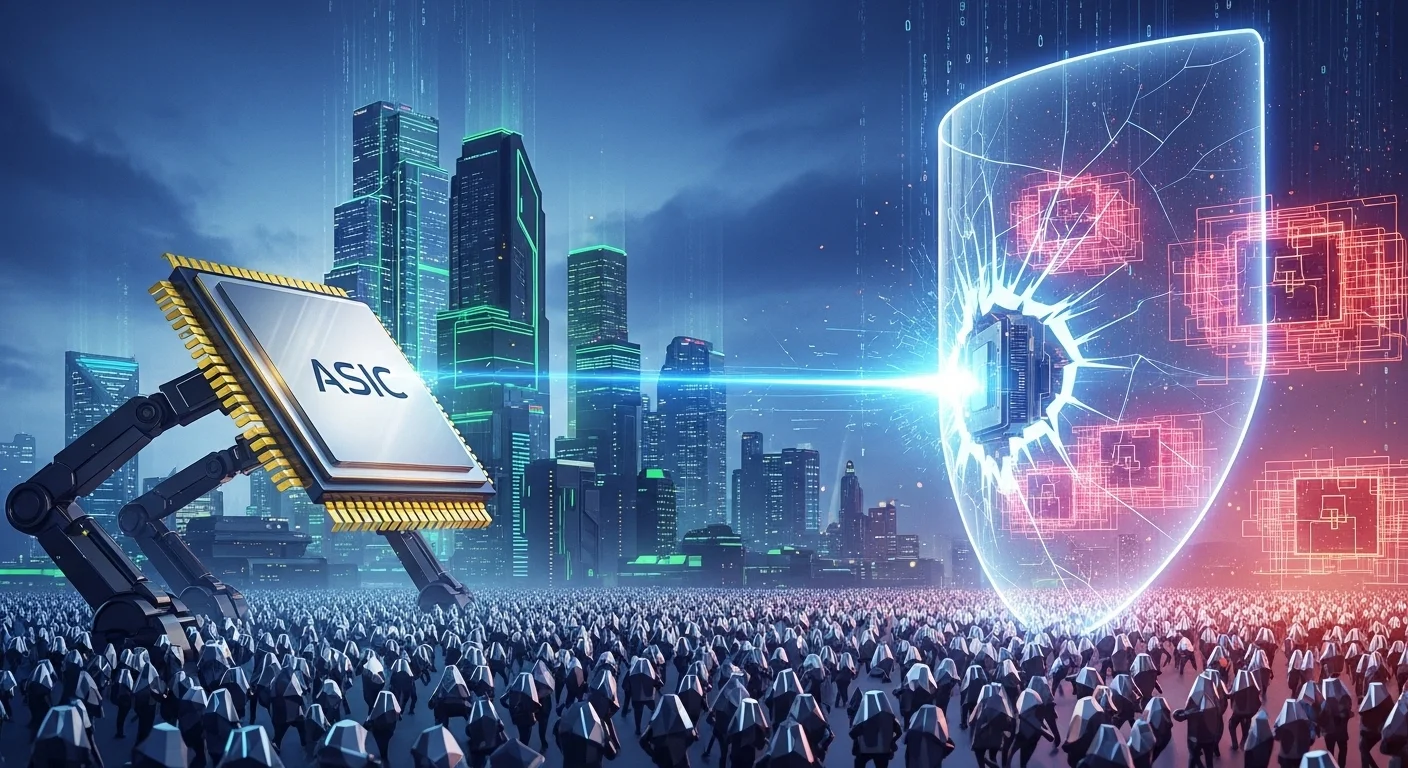
What makes Etched’s architecture different from standard GPUs?
To understand why Etched is capturing such significant investor interest, one must look at the technical "overhead" inherent in modern GPU design. While Nvidia's chips are impressive, they carry a vast amount of logic designed to support thousands of different use cases. When these chips are used solely for inference—the process of running a pre-trained model to generate outputs—that extra logic becomes wasted energy and physical space.
Etched’s architecture strips away this unnecessary complexity. By focusing exclusively on the mathematical requirements of Transformer models, their silicon can achieve higher throughput and significantly lower power consumption during the inference phase. For large-scale enterprises, this translates directly into a superior Return on Investment (ROI). In the world of high-stakes technology, where every watt of electricity and every square inch of rack space in a data center has a literal price tag, the ability to do more with less physical hardware is a massive competitive advantage.
Why are financial institutions specifically pivoting toward specialized silicon?
The impact of this shift is perhaps most visible in the fintech sector, particularly within high-frequency trading (HFT) and complex risk modeling environments. For these firms, the transition from "training" models to "deploying" them in live markets changes the hardware requirements entirely. While a general-purpose GPU might be sufficient for training an algorithm once every six months, it is often inadequate for the millisecond-sensitive demands of active trading.
One of the primary drivers for this shift is the reduction in Total Cost of Ownership (TCO). By utilizing specialized ASICs like those from Etched, financial institutions can run larger, more sophisticated models on fewer physical units. This allows firms to scale their operations—such as real-time fraud detection or automated sentiment analysis—without a linear increase in infrastructure costs.
Furthermore, "deterministic performance" is the holy grail of high-frequency trading. General-purpose GPUs can sometimes introduce latency jitter because of their complex scheduling of varied tasks. In contrast, an ASIC designed specifically for inference provides a consistent, predictable execution path. In a market where microseconds equate to millions of dollars in profit or loss, the ability to eliminate "noise" from the hardware layer allows firms to execute trades at speeds that are physically impossible on standard, multi-purpose architectures.
How does this shift change the competitive landscape for AI infrastructure?
The $5 billion valuation of Etched is a direct reflection of investor confidence in a fragmented inference market. While Nvidia remains the titan of the "training" phase—where models are first built and refined—the "inference" market, which accounts for the vast majority of ongoing enterprise spending, is opening up to specialized players.
By moving toward these bespoke solutions, financial institutions can reduce their dependency on a single-source ecosystem (like Nvidia’s CUDA). This diversification creates a more resilient infrastructure where the hardware is specifically tuned for the production goals of the firm. We are witnessing the birth of a bifurcated market: general-purpose chips will remain the standard for R&D and experimental science, while specialized ASICs will become the backbone of the high-scale AI operations that power modern global finance.
Key Facts
- Etched recently reached a $5 billion valuation as an emerging leader in AI silicon.
- The company has reported approximately $1 billion in booked contracts for its inference systems.
- Unlike general-purpose GPUs, Etched’s architecture is optimized specifically for matrix multiplications in Transformer models.
- Specialized ASICs allow financial institutions to lower their Total Cost of Ownership (TCO) by running larger models on fewer units.
- For high-frequency trading (HFT), specialized hardware provides more deterministic performance and lower latency compared to general-purpose chips.
- The shift toward ASICs helps firms move away from a single-source dependency on the Nvidia CUDA ecosystem.
Expert Commentary
From a market perspective, we are seeing the "de-layering" of the AI stack. In the early stages of the AI boom, it didn't matter how inefficient the hardware was as long as it could perform the task at all. We were in the "exploration phase." Now, we have entered the "industrialization phase."
In industrial operations—particularly in high-volume financial environments—efficiency is the only metric that scales. Investors are betting on Etched because they recognize that the next trillion dollars of AI spending won't go toward making models "smarter" in a vacuum; it will go toward making them cheaper and faster to run in production. The "Nvidia tax" was high because of the lack of alternatives, but as inference becomes the dominant use case for global enterprises, the hardware moat is eroding. For the smart money in fintech, the move toward specialized ASICs isn't just a technical upgrade; it’s a strategic move to decouple from single-source dependencies and optimize the profit margins of their AI deployments.
Google Search Preference
Add Fintech Monster to your preferred sources
Never miss deep, analytical fintech insights. Prioritize our stories in your Google Search, Discover feed, and AI Overviews with one click.
About the Author
Fintech Monster
Fintech Monster is run by a solo editor with over 20 years of experience in the IT industry. A long-time tech blogger and active trader, the editor brings a combination of deep technical expertise and extended trading experience to analyze the latest fintech startups, market moves, and crypto trends.