Upvest Secures $125M To Rebuild European Investment Infrastructure
Key Takeaways
Upvest raised $125 million, led by Sapphire Ventures and Tencent, to replace legacy banking infrastructure with API-first investment technology.
Key Facts on Upvest's Blockbuster Funding:
- Amount Raised: $125 Million ($90M equity, $35M debt)
- Lead Investors: Sapphire Ventures, Tencent Holdings
- Valuation: €640 Million
- Product: API-first investment infrastructure replacing legacy banking systems.
Berlin based financial technology company Upvest has finalized a $125 million funding round. The financing includes $90 million in equity, led by Sapphire Ventures and Tencent Holdings, alongside a $35 million debt facility. This capitalization, arriving twelve months after a $115 million Series C, values the API infrastructure provider at €640 million. The company intends to accelerate the deployment of institutional investment products, including complex tax wrappers and AI driven advisory features, across European markets.
This development matters because it highlights a structural exhaustion within European banking. Legacy financial institutions operate on rigid, outdated backend systems. Upvest replaces these legacy cores with modern, API based infrastructure. This transition enables massive banks and emerging wealth managers to deploy complex investment products rapidly, bypassing years of internal development friction.
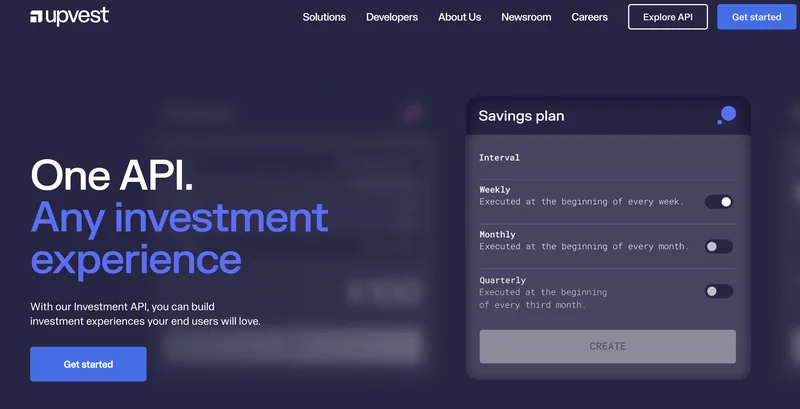 Upvest provides the API infrastructure powering modern European retail investment networks.
What Are the Mechanisms of Infrastructure Replacement?
The financial industry functions upon layers of accumulated technical debt. Banks traditionally built and maintained proprietary execution systems, custody ledgers, and brokerage software. This architecture is stable but highly inflexible. Modifying a legacy banking core to support fractional shares or new pension products often requires immense capital and time.
Upvest addresses this bottleneck through abstracting the complexity of financial plumbing. The company provides a unified Application Programming Interface (API) that manages trade execution, custody, and settlement. When digital banks like N26 or Revolut decide to offer retail trading, they do not build brokerage software from scratch. They integrate Upvest’s API. This model transforms extreme regulatory and operational friction into a modular software integration. By processing over 100 million client orders annually across more than 30 institutions, Upvest demonstrates that banks are increasingly willing to rent infrastructure rather than own it.
How Will Upvest Drive European Expansion?
The injection of $125 million signals an aggressive geographic and product expansion. The European investment landscape is highly fragmented. Each jurisdiction maintains distinct regulatory frameworks and tax advantaged structures. A unified trading platform in Germany requires different compliance mechanics than a pension product in the United Kingdom.
Upvest explicitly intends to channel the new capital into localizing its infrastructure. The roadmap includes support for specialized vehicles, such as the Altersvorsorgedepot in Germany and Self Invested Personal Pensions (SIPPs) in the UK. This localization is technically difficult. By building a unified interface that naturally handles regional complexities, Upvest positions itself as the default conduit for any financial institution seeking pan-European distribution. Furthermore, the planned integration of AI capabilities aims to automate retail advisory services, shifting the company's value from pure execution to personalized wealth management at scale.
Are We Seeing the Commoditization of Financial Pipes?
The trajectory of Upvest reflects a broader historical pattern in technology markets. When an industry digitizes, foundational layers eventually commoditize. Amazon Web Services commoditized server hosting. Stripe commoditized payment processing. Upvest attempts to commoditize the highly regulated backend of retail investment.
The participation of heavyweights like Tencent, Sapphire Ventures, Bessemer Venture Partners, and BlackRock indicates institutional consensus. BlackRock's continued involvement is particularly significant. As the world's largest asset manager, BlackRock requires efficient distribution channels for its financial products. Investing in the infrastructure that powers retail trading apps ensures that their products can flow continuously to retail investors with minimal technical friction. The market is moving from closed, vertically integrated banks to open, horizontally integrated software platforms.
What Are the Systemic Implications of Rented Infrastructure?
The shift toward API based financial infrastructure alters the incentive structures of the banking sector. The primary mechanism of change is the drastic reduction in time to market for complex financial products. Banks no longer compete on the reliability of their internal ledgers. They compete purely on customer acquisition and user interface design.
This creates second order consequences. As the cost of offering investment products falls to near zero through providers like Upvest, wealth management capabilities will become a baseline expectation for any consumer app. Retail investors will access sophisticated trading tools through non-traditional interfaces. However, this reliance introduces systemic fragility. If multiple major European digital banks rely on a single API provider for trade execution and custody, an outage or compliance failure at the infrastructure layer propagates instantly across the entire ecosystem. The financial system gains velocity but concentrates operational risk.
Expert Commentary: How Do We Decipher the Noise?
We must separate the signaling of venture capital terminology from the structural reality of the financial market. The rhetoric surrounding large funding rounds often obscures actual mechanisms of value creation. The narrative emphasizes lightspeed deployment and best-in-class experiences. The reality is heavily weighted toward managing administrative inertia.
The variables that actually matter for Upvest’s future outcomes are not related to user interfaces or marketing velocity. The measurable risk lies in regulatory integration. The company's valuation of €640 million embeds massive expectations for seamless cross-border operation. Can their API architecture efficiently process the regulatory nuances of UK pensions while simultaneously satisfying the German tax authorities? This variable dictates their capacity to achieve dominance. The rest is noise.
Furthermore, we must identify the asymmetry in their business model. Upvest benefits from the proliferation of consumer fintech, but they do not assume the brutal customer acquisition costs. They collect rent on the infrastructure. However, they are entirely dependent on their institutional clients achieving sufficient transaction volume to drive their APIs. The future success of this model is unknown, as it assumes that retail trading demand remains robust through unpredictable market cycles.
Narratives of disrupting banking often distort the perception of risk. Upvest is not disrupting banks; it is becoming the invisible utility layer beneath them. This position offers immense leverage but demands extreme reliability. Any credible forecast of their trajectory requires measuring their failure rates, their compliance friction, and the switching costs for their institutional clients. Everything else is a story constructed to satisfy the mechanisms of venture capital.
Google Search Preference
Add Fintech Monster to your preferred sources
Never miss deep, analytical fintech insights. Prioritize our stories in your Google Search, Discover feed, and AI Overviews with one click.
About the Author
Fintech Monster
Fintech Monster is run by a solo editor with over 20 years of experience in the IT industry. A long-time tech blogger and active trader, the editor brings a combination of deep technical expertise and extended trading experience to analyze the latest fintech startups, market moves, and crypto trends.