Wall Street’s Tokenization Race Accelerates as Infrastructure Hits a Tipping Point
Key Takeaways
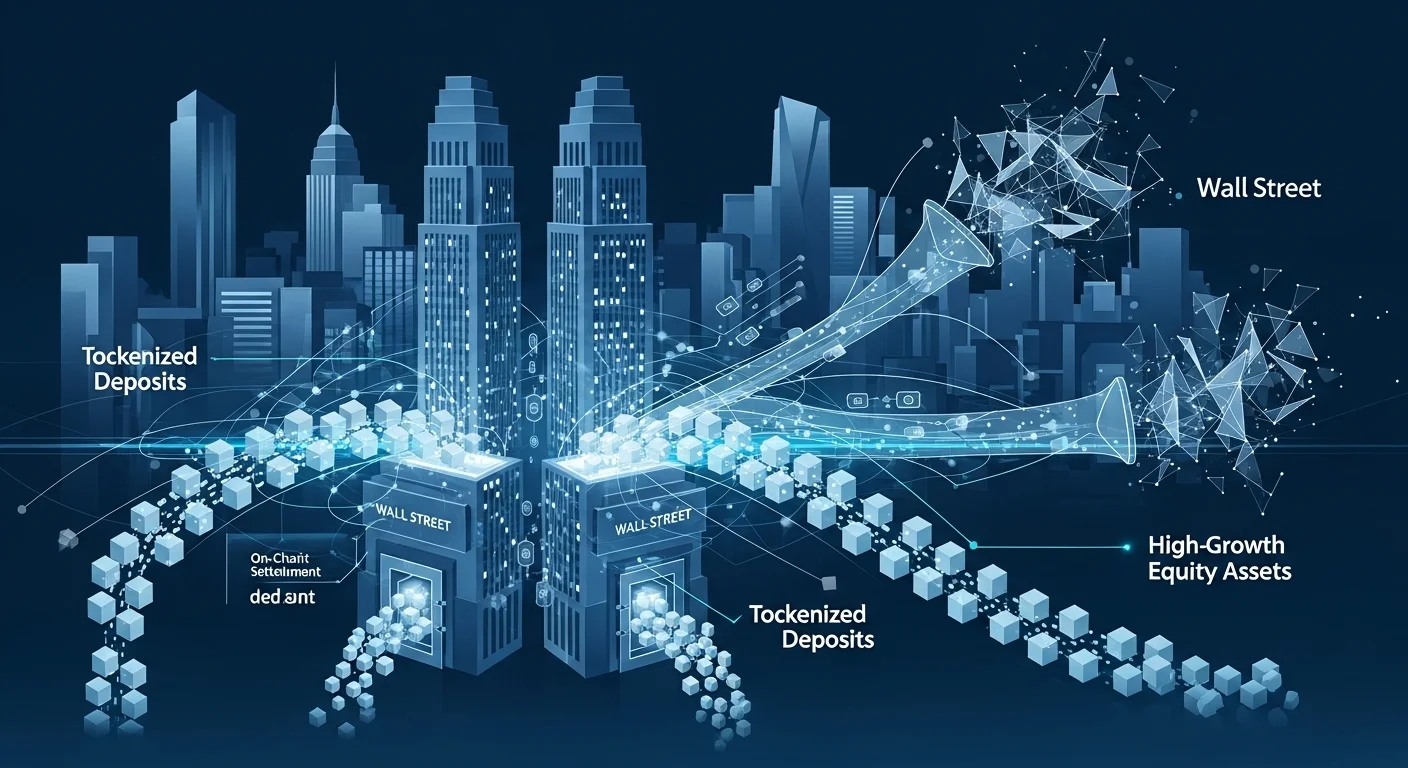
The transition from legacy T+2 settlement cycles to "atomic" on-chain settlement is transforming capital market plumbing through tokenized deposits and high-growth equity assets.
The landscape of institutional finance is undergoing a profound structural metamorphosis as the "experimental" era of blockchain technology gives way to the "foundational" era of infrastructure. This shift is most visible in the move away from legacy T+2 settlement cycles toward "atomic" settlement—a process where the exchange of assets and the corresponding payment occur simultaneously on-chain. This evolution isn't just a technical upgrade; it represents a massive push for capital efficiency, reduced counterparty risk, and the creation of liquid markets for traditionally illiquid assets. The sheer scale of this movement is evidenced by the explosion in tokenized stock volume, which has surged over 3,300% since the beginning of 2024, surpassing $1.5 billion in total value.
Historically, the friction inherent in traditional clearing and settlement systems has forced institutions to hold capital in reserve to mitigate risk during those two-day "waiting" periods. By integrating Distributed Ledger Technology (DLT) into the core plumbing of the financial system, these windows disappear. This transition is not just occurring on the fringes; it is being spearheaded by major U. founders and traditional gatekeepers. The integration of digital representations of fiat currency—known as tokenized deposits—on permissioned blockchains allows for the real-time movement of value between institutions. These assets serve as the foundational rails, ensuring that the settlement of equities and government bonds can happen instantly across borders without the delays inherent in contemporary correspondent banking networks.
Why is the industry moving toward "atomic" settlement?
The primary driver behind the move to atomicity is the elimination of the "settlement gap." In traditional systems, a trade is executed today, but the assets are only exchanged days later. This lag necessitates complex collateral management and exposes institutions to counterparty risk. By utilizing tokenized deposits on permissioned blockchains, banks can ensure that when an asset moves, the payment moves with it at the exact same moment.
This "unified ledger" model means that ownership records, movement of value, and contract execution happen on a single platform. For institutional players, this results in significantly lower costs for capital and reduced operational overhead. When transaction finality is instant, the need for manual reconciliation—which currently plagues much of the global banking infrastructure—is drastically minimized. This technological leap allows firms to manage liquidity with surgical precision, especially when dealing with cross-border payments where traditional systems often struggle with varying jurisdictions and delays.
How is the DTCC reshaping capital market plumbing?
The Depository Trust & Clearing Corporation (DTCC) serves as a cornerstone of U.S. market infrastructure, and its pivot toward DLT marks a major milestone for the industry. The organization has signaled significant moves to integrate tokenized equity and Treasury trades into its ecosystem. This is particularly revolutionary for U.S. Treasuries; because they are the bedrock of global liquidity, moving them onto an on-chain framework allows institutional investors to manage collateral and overnight lending with unprecedented efficiency.
DTCC's plan to launch a broader platform in October is designed specifically to accommodate these assets on-chain. By doing so, they are facilitating "fractional" ownership and enabling 24/7 trading cycles that were previously impossible under legacy systems. When the infrastructure used to settle Treasury trades becomes automated and instantaneous, it ripples through every other asset class, providing a more robust framework for everything from corporate bonds to complex derivatives.
What does the massive growth in tokenized stocks signal?
The statistics surrounding tokenized assets are no longer just interesting; they are alarming to those still operating on old-school models. The fact that tokenized stocks have surpassed $1.5 billion in total value—growing by over 3,300% in a very short window—indicates a massive migration of capital into "wrapped" assets. These aren't just speculative tokens; they are digital representations of traditional securities that provide deeper liquidity for niche assets and allow for more sophisticated automated market-making (AMM) strategies.
This growth is also driven by the capability of programmable smart contracts. Beyond simple ownership, these contracts can automate complex corporate actions such as dividend distributions or voting rights. For a corporation, this means less administrative friction; for an investor, it means they can interact with their holdings in real-time without waiting for manual updates from a middleman. This programmatic nature is what ultimately makes the asset more "useful" to an institutional portfolio manager than its non-tokenized counterpart.
How is the SEC responding to this rapid evolution?
The regulatory landscape is moving in tandem with these technical milestones. The Securities and Exchange Commission (SEC) is currently reviewing rules regarding the regulation of "security tokens." This is a critical phase where regulators are attempting to balance innovation with investor protection. The goal is to establish clear guidelines for how existing regulations—such as disclosure requirements and accredited investor status—apply specifically to blockchain-based assets.
The focus of these regulatory reviews is to ensure that while the technology is novel, the protections remain robust. By formalizing the rules for security tokens, the SEC provides a "safe harbor" for institutions to move their portfolios onto DLT platforms. This clarity is essential for the long-term adoption of tokenized assets as standard investment vehicles. The ultimate objective is a system where the legal framework recognizes the unique capabilities of smart contracts while ensuring that every transaction complies with federal securities laws, thereby cementing the role of blockchain in the future of global capital markets.
Key Facts
- Atomic Settlement: The transition from T+2 cycles to immediate "on-chain" settlement eliminates the window for counterparty risk.
- Tokenized Deposits: These are digital representations of fiat currency on permissioned blockchains, enabling real-time interbank value movement.
- DTCC Integration: A major platform launch in October aims to move tokenized equity and Treasury trades onto a unified DLT ecosystem.
- Market Growth: Tokenized stocks have seen over 3,300% growth since early 2024, exceeding $1.5 billion in total value.
- Automated Governance: Programmable smart contracts can automate dividends and corporate actions like voting.
- Regulatory Evolution: The SEC is currently reviewing frameworks to specifically address "security tokens."
Expert Commentary
From a trader’s perspective, the distinction here between "innovation" and "infrastructure" is everything. For years, the narrative around blockchain was dominated by retail speculation and volatile assets. However, the move toward tokenized deposits and the DTCC's pivot represent the "industrialization" of the technology. They aren't trying to replace money; they are trying to fix the plumbing that moves it.
When you consider the sheer cost and risk associated with T+2 settlement, the shift to atomic settlement is an inevitable evolution for institutional-grade finance. It removes a massive friction point in the capital stack. The growth in tokenized stocks isn't just a trend; it’s a signal that large-scale participants are beginning to prefer "wrapped" assets because they offer better liquidity and automated execution via smart contracts. We are moving toward a world where the distinction between "traditional" and "digital" assets blurs, as both eventually inhabit the same high-efficiency, on-chain infrastructure. The institution is no longer waiting for the market to adapt to blockchain; it is building the markets on blockchain.
About the Author
Fintech Monster
Fintech Monster is run by a solo editor with over 20 years of experience in the IT industry. A long-time tech blogger and active trader, the editor brings a combination of deep technical expertise and extended trading experience to analyze the latest fintech startups, market moves, and crypto trends.