Zcash Solidifies Privacy Integrity via AI-Enhanced Mythos Audit
Key Takeaways
Electric Coin Company's deployment of AI-enhanced formal verification tools via the Mythos audit protocol establishes zero-vulnerability proofs across Zcash's Orchard zero-knowledge circuit implementations.
Table of Contents
The cryptographic and cybersecurity standards governing decentralized privacy protocols have reached an unprecedented level of mathematical rigor. Electric Coin Company (ECC), the core engineering organization behind privacy-focused blockchain Zcash, has concluded a comprehensive security audit of its Orchard shielded pool architecture using the Mythos AI-enhanced formal verification suite. The audit certified zero critical vulnerabilities across Zcash’s zero-knowledge proving circuits, setting a new benchmark for automated mathematical proof verification in high-consequence Web3 infrastructure.
Securing zero-knowledge cryptography is one of the most complex challenges in modern computer science. Unlike standard smart contract codebases where logic flaws can often be spotted through manual line-by-line code reviews, zero-knowledge circuits rely on intricate constraint systems over algebraic finite fields. An under-constrained circuit can introduce silent "counterfeiting bugs"—subtle mathematical loopholes that allow malicious actors to mint unbacked tokens inside the shielded pool without breaking the cryptographic zero-knowledge anonymity veil.
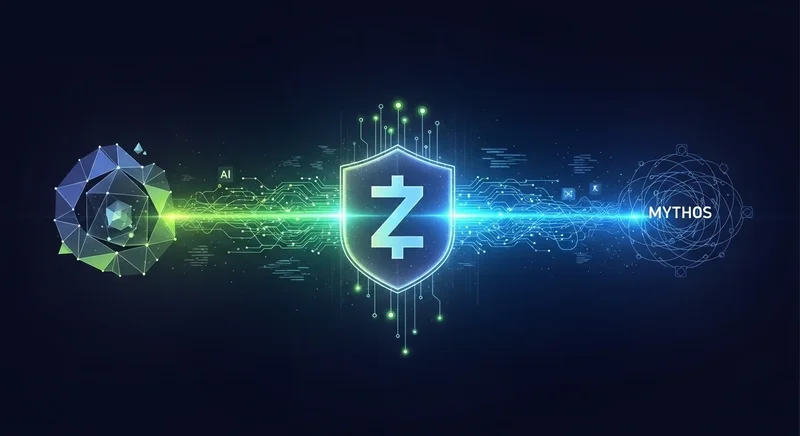
How does the Mythos AI audit engine achieve automated formal verification of zero-knowledge circuits?
The technological breakthrough powering the Mythos audit lies in combining formal symbolic theorem provers with specialized graph neural networks trained on zero-knowledge constraint systems. Rather than relying solely on statistical fuzzing or manual code audits, Mythos translates Zcash’s Orchard Halo 2 circuit definitions into mathematical formal logic representations.
The automated reasoning engine then evaluates millions of execution pathways simultaneously, testing edge-case polynomial boundaries and verifying that every witness variable is strictly constrained. Mythos proved that the Orchard circuit guarantees complete soundness—confirming that it is mathematically impossible to produce a valid proof without possessing the underlying private spending keys, while ensuring zero leakage of metadata regarding transaction values, sender identities, or recipient addresses.
Key Facts
- Audit Target: Zcash Orchard shielded pool protocol and Halo 2 zero-knowledge proving system.
- Methodology: Automated symbolic execution, AI-driven constraint fuzzing, and mathematical formal verification via the Mythos protocol.
- Audit Outcome: Zero critical, high, or medium severity vulnerabilities detected, confirming complete circuit constraint soundness.
What are the institutional and regulatory ramifications for compliant privacy networks?
The successful formal verification of Zcash’s core privacy layer comes at a pivotal juncture in global cryptocurrency regulation. As regulatory authorities worldwide enforce strict AML compliance mandates and scrutinize privacy protocols, the ability to mathematically prove circuit integrity and deterministic behavior provides a crucial defense against illicit exploitation.
Furthermore, Zcash’s Halo 2 proving architecture eliminates the need for a "trusted setup"—the historical vulnerability where initial cryptographic ceremony parameters had to be generated by human participants. By proving that privacy circuits are mathematically sound and free from trusted backdoors, Zcash is opening the door for institutional and enterprise adoption. Regulated financial institutions exploring privacy-preserving DeFi and confidential interbank settlement can utilize Zcash’s proving architecture to ensure transactional privacy while generating selective cryptographic audit proofs for tax authorities and financial regulators.
Expert Commentary
Having audited financial systems and cryptographic protocols for over twenty years, the deployment of AI-driven formal verification tools like Mythos represents a watershed moment for software security. Human auditors, no matter how brilliant, are fallible when evaluating multi-million-variable constraint systems. Mathematical theorem provers do not get tired, do not overlook edge cases, and do not make assumptions.
Zcash has consistently represented the gold standard in academic cryptography. By pioneering zero-knowledge proofs long before they became the dominant scaling narrative in Ethereum rollups, Electric Coin Company laid the groundwork for modern privacy technology.
Looking forward, I predict that AI-enhanced formal verification will become mandatory for all institutional-grade smart contracts and zero-knowledge protocols. The days of launching multi-billion-dollar protocols on manual PDF audit reports are over. In an era of autonomous cyber exploits and nation-state threat actors, mathematical proof is the only acceptable standard of trust.
Google Search Preference
Add Fintech Monster to your preferred sources
Never miss deep, analytical fintech insights. Prioritize our stories in your Google Search, Discover feed, and AI Overviews with one click.
About the Author
Fintech Monster
Fintech Monster is run by a solo editor with over 20 years of experience in the IT industry. A long-time tech blogger and active trader, the editor brings a combination of deep technical expertise and extended trading experience to analyze the latest fintech startups, market moves, and crypto trends.
Related Articles
Recommended
Engineering Trust into Autonomy: How FinTech Firms Are Governing AI Decision Engines
To deploy autonomous AI in finance, institutions must move beyond mere process automation by implementing verifiable control loops, Explainable AI (XAI), and robust Human-In-The-Loop (HITL) fail-safes to satisfy rigorous regulatory demands for auditability.
Vanguard's Strategic Acquisition of Altruist: How AI Will Rebuild Institutional Wealth Custody
Vanguard's purchase of Altruist signals an aggressive pivot to embedding advanced AI workflow engines into its core custody platform, revolutionizing personalized advisory services for the next generation of wealth managers.

Meta’s Open Weights Gamble: How Architectural Vulnerabilities Exposed $250M in FinTech Development
The $250M loss stemmed not from a conventional smart contract flaw, but from exploiting systemic architectural gaps created by integrating open-weights AI models (Glimmer) into mission-critical, closed financial pipelines (Muse Spark's infrastructure).

AI Agents Enter Institutional DeFi: Sygnum’s Blueprint for Regulated Digital Asset Transactions
Sygnum Bank demonstrated that advanced AI agents can execute complex, multi-step digital asset transactions on a live blockchain Mainnet using natural language commands, establishing a new standard for regulated financial automation.

AI Is Making Crypto Security Cheaper, Faster, and More Proactive
AI is revolutionizing cryptocurrency security by shifting the defense model from reactive manual monitoring to proactive, automated protection that detects threats like sandwich attacks and smart contract bugs in real-time.