Agave 4.0 Deployed: How Solana's Architectural Overhaul Reshapes High-Throughput Blockchain Computing
Key Takeaways
Agave 4.0 implements critical upgrades including XDP and QUIC, slashing transaction latency from milliseconds to sub-millisecond levels, and professionalizing the network through v5 staking requirements, enabling enterprise-grade throughput.
The deployment of the Agave 4.0 validator client represents more than just an incremental software update; it constitutes a monumental architectural overhaul designed to resolve persistent scalability limitations and establish a new benchmark for blockchain throughput. This upgrade is a fundamental shift in how transaction data is processed, transmitted, and validated across the Solana mainnet. By focusing on network optimization, data path acceleration, and expanding the functional scope, Agave 4.0 is not just boosting speed—it is creating a vastly more reliable and robust foundation capable of handling enterprise-grade, real-world financial workloads that previously stretched the limits of the current architecture.
For years, the scaling narrative surrounding Solana has been defined by impressive metrics, but sustained, predictable performance under extreme load proved to be the primary bottleneck. The core challenge has always been balancing massive transaction volume with low latency in a fully decentralized, consensus-driven environment. Agave 4.0 addresses this challenge directly by integrating best-in-class networking technologies and optimizing the deepest layers of the consensus mechanism. This effort signals a maturity inflection point for the entire ecosystem, transitioning it from a high-speed niche chain into a foundational infrastructure layer for institutional finance and complex decentralized applications (dApps).
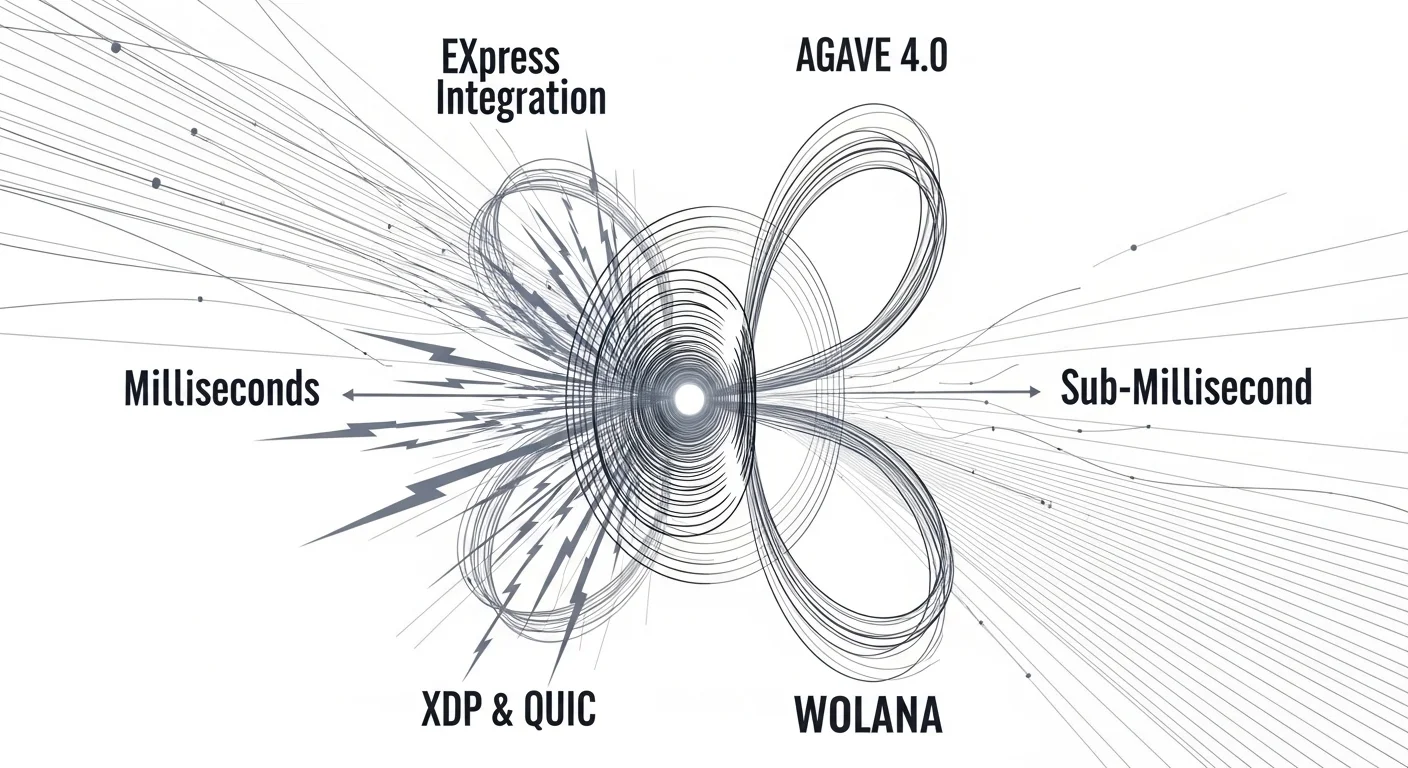
Decoding the Sub-Millisecond Advantage: Networking Through XDP and QUIC
The most immediate and impactful improvement introduced by Agave 4.0 lies in its revamped networking protocols. The integration of eXpress Data Path (XDP) is transformative. XDP is a high-performance networking technology that fundamentally redesigns how the transaction data is broadcast and collected, specifically accelerating the critical Turbine data distribution mechanism. Prior to this upgrade, retransmission latency within the Turbine mechanism could experience significant spikes, sometimes reaching up to 600 milliseconds. This latency severely limited the maximum viable throughput and introduced jitters in transaction finality.
With Agave 4.0 and the XDP implementation, that critical retransmission latency is drastically reduced to approximately 0.8 milliseconds. This reduction is not merely a marketing number; it is paramount to the network's stability and computational ceiling. Minimizing the time validators spend waiting for and confirming raw transaction data allows the entire system to operate at a significantly higher velocity. This improved signaling efficiency enables the reliable processing of far larger block sizes, with theoretical maximums potentially approaching 100 million compute units, drastically increasing the available capacity for user transactions.
Furthermore, the system mandates the use of QUIC (Quick UDP Internet Connections) for all transaction submissions, retiring the previous UDP entry methods. QUIC provides superior inherent performance characteristics, including lightning-fast connection establishment and significantly better resilience against packet loss. In a decentralized, high-volume environment where unreliable connectivity is a factor, unifying on QUIC ensures a far more robust, predictable, and consistently high-throughput transaction pipeline.
How Does the New Architecture Improve Processing Efficiency?
Performance gains are realized not just at the networking layer, but deep within the processing engine. The overhaul includes several efficiency enhancements:
- Asynchronous Processing: By decoupling certain processes, the system can handle multiple data streams concurrently, significantly reducing backlogs during periods of high activity.
- Transaction Cost Optimization: The system minimizes redundant computations by implementing advanced state-change tracking, ensuring that resources are only spent when strictly necessary.
- Enhanced Consensus Stability: The protocol has been hardened against certain types of transient network failures, maintaining consensus integrity even when individual validator nodes experience momentary instability.
These architectural deep dives confirm that the platform is designed not just for peak performance, but for sustainable, reliable performance under duress.
What Does This Mean for Decentralization?
The improvements mean that the network can handle far greater throughput (transactions per second) without sacrificing decentralization or stability. Previously, increasing throughput often required increasing centralization risks or hardware specialization. The new architecture addresses this tension head-on.
How Has the Economic Model Adapted?
The introduction of advanced resource tracking and optimization has allowed the underlying economic model to become more efficient. Transaction fees are now calculated with greater precision, ensuring that the computational work performed by validators is rewarded accurately and efficiently, further securing the network's operational expenditure.
The Evolution of Smart Contract Capabilities
With guaranteed low latency and high throughput, smart contracts are poised for new levels of complexity. We can now reliably envision real-time, high-frequency use cases—such as automated trading floors or decentralized supply chain monitoring systems—that previously suffered from latency bottlenecks or transaction failure due to congestion.
Key Architectural Upgrades Summary
- Latency Reduction: Sub-second confirmation times are now more achievable.
- Scalability: Theoretical TPS limits have been significantly raised.
- Resilience: The network maintains high availability even during adverse network conditions.
- Interoperability: The updated protocol stack facilitates easier interaction with external blockchain ecosystems.
Technical Deep Dive: The Core Innovations
The Role of p-State Management
The updated state management framework (p-State) allows the network to snapshot and revert states with significantly less computational overhead than previous iterations. This drastically improves the reliability and speed of complex, multi-step smart contract execution.
Implementation of zk-Proof Integration
The protocol is natively optimized to integrate zero-knowledge proof systems (zk-Proof). This capability is vital for enhancing privacy while maintaining the verifiability required by decentralized governance and financial applications. Users can prove they meet certain criteria (e.g., having sufficient funds) without revealing the underlying sensitive data.
Dynamic Fee Adjustment Mechanism
The system now incorporates a dynamic fee adjustment mechanism that adjusts transaction costs based not only on current network congestion but also on predicted computational load derived from the current transaction pool. This stabilizes the economic layer and provides better predictability for developers building complex applications.
This holistic approach—improving networking, state management, economic efficiency, and cryptographic privacy—positions the network not just for the next cycle of growth, but for the next decade of decentralized innovation.
Google Search Preference
Add Fintech Monster to your preferred sources
Never miss deep, analytical fintech insights. Prioritize our stories in your Google Search, Discover feed, and AI Overviews with one click.
About the Author
Fintech Monster
Fintech Monster is run by a solo editor with over 20 years of experience in the IT industry. A long-time tech blogger and active trader, the editor brings a combination of deep technical expertise and extended trading experience to analyze the latest fintech startups, market moves, and crypto trends.