BIS Piloted Protocols Signal the End of Traditional Cross-Border Banking Model
Key Takeaways
The Bank for International Settlements' advanced prototypes, including mBridge and BIS Agora, are establishing a new, real-time, multi-CBDC standard for international payments, signaling a structural shift away from legacy correspondent banking systems.
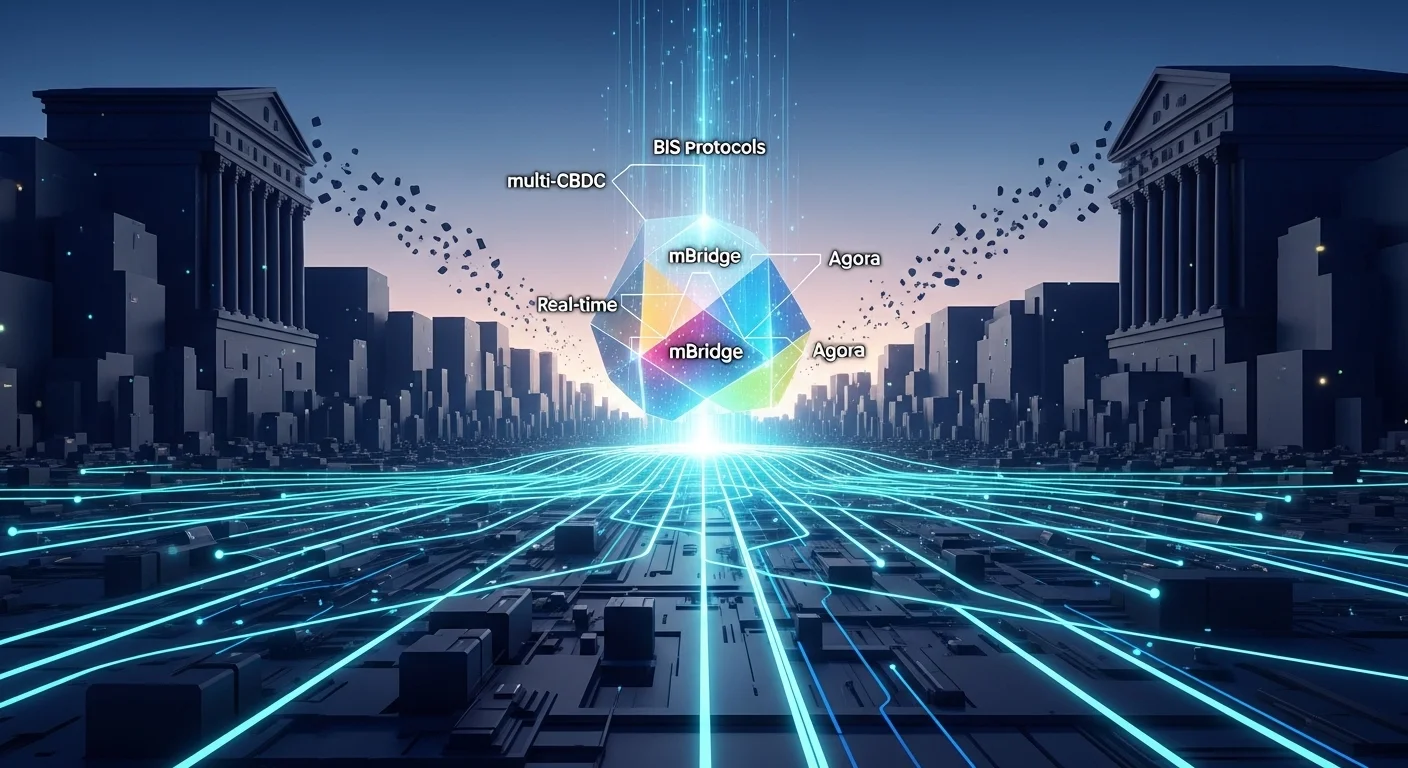
The whispers of a global financial overhaul have become a resounding technical mandate. The Bank for International Settlements (BIS) is aggressively piloting sophisticated new protocols—chief among them Project mBridge and BIS Agora—that promise to dismantle the multi-day friction and opaque settlement layers inherent in traditional cross-border payment systems. This initiative is far more than a mere upgrade of SWIFT’s infrastructure; it represents a fundamental, structural pivot toward real-time gross settlement (RTGS) enabled by multi-CBDC platforms and Distributed Ledger Technology (DLT). The core finding is that international finance is moving from a batch-processing, correspondent-bank model to a direct, digitized, and instantaneous peer-to-peer digital rail, dramatically optimizing global liquidity and efficiency.
Historically, moving capital across borders has been an exercise in delay, cost, and mistrust. The reliance on correspondent banking relationships meant that transactions often required multiple intermediaries (e.g., USD clearing through New York, then routing through London, etc.). This complexity inflated costs, introduced time zone delays, and created significant liquidity mismatches, forcing global commerce to operate under the latency of days. This structural inefficiency, coupled with escalating geopolitical fragmentation, created intense pressure on global financial bodies to find a technological panacea. The BIS, acting as the global coordinator for banking stability, has stepped into this void, deploying its research arm to prove that a shared, digitally native ledger can bypass these accumulated structural weaknesses entirely.
Why Is the Global Financial Infrastructure Getting a Digital Overhaul?
The need for change stems from a perfect storm of technical limitation and economic necessity. Legacy payment rails, while robust in their time, were not designed for the hyper-speed, interconnected, 24/7 global economy of the 21st century. The central problem was the "time-value decay" of money in transit: funds often sat in suspense accounts, awaiting verification, clearing, and reconciliation across multiple time zones.
The BIS prototypes tackle this decay head-on by focusing on the programmability of money. By utilizing DLT, they are not just transmitting a message; they are transmitting a tokenized, programmable claim on value. This allows participating central banks (the issuing authorities) to engage in real-time settlement of both funds and instructions simultaneously. The implications are vast: instantaneous settlement drastically reduces the need for banks to hold massive, expensive liquidity buffers—a massive boon to systemic efficiency. Furthermore, the multi-CBDC approach inherently builds into global standardization, creating shared technical rules that smooth regulatory friction points previously encountered at every national border.
How Do Multi-CBDC Platforms Actually Work?
The magic lies in the concept of the "Multi-CBDC." A single national digital currency (a CBDC) is not enough; the system requires several national digital currencies to interact seamlessly. These prototypes are building interoperable rails, meaning a digital dollar (or tokenized equivalent) can move directly into a digital yuan or a digital baht without needing to pass through a legacy correspondent bank’s manual reconciliation process.
This direct path is facilitated by a Shared Ledger Infrastructure (SLI). This SLI, provided by the DLT, acts as a single source of truth for all participating nodes. When a payment is initiated, it is not simply booked; it is validated instantaneously against the rules of the network, settled, and recorded on the immutable ledger. This structure mitigates counterparty risk—a major source of systemic failure in older models—because the participants are settling directly with the core system, not relying solely on the operational risk profile of an intermediary bank.
Project mBridge: The Proof-of-Concept Powerhouse
Project mBridge stands out as the most tangible and advanced demonstration of this theory. Its collaborative nature, involving major financial centers and diverse economies, signals strong international buy-in. The ability of the project to incorporate diverse participants—from established economies like the UAE to emerging financial hubs—demonstrates that the solution is protocol-agnostic and broadly scalable. The successful development of the Minimum Viable Product (MVP) validates that the complex interactions between different legal jurisdictions and currencies can indeed be harmonized into a singular, efficient digital protocol.
Key Facts
- Protocol Focus: The initiatives center on multi-CBDC rails, moving beyond simple token transfers to full, real-value, institutional settlements.
- Core Technologies: DLT provides the shared, immutable ledger; CBDCs provide the programmable, direct claim on value; and the multi-CBDC architecture provides the interoperability.
- Efficiency Gain: Settlement time is projected to drop from days (T+2) to minutes (real-time), minimizing liquidity needs.
- Global Scope: Initial participation highlights a commitment to bridging gap between traditional banking (Correspondent Banking) and modern digital rails.
Beyond Payments: Impact on Global Trade Finance and Remittances
While the immediate focus is on pure cross-border payments, the underlying infrastructure has far-reaching consequences for other global finance pillars.
Trade Finance: In global trade, payment settlement often occurs long after the physical goods have been shipped, creating significant time lag risk. By creating near-instantaneous, transparent settlement rails, these new digital systems can potentially link payment initiation directly to verifiable points in the supply chain (e.g., customs clearance, port docking). This reduces counterparty risk and allows for the implementation of novel trade finance products that were previously too cumbersome or slow to manage efficiently.
Remittances: For the billions of people relying on cross-border remittances, the current system often involves high fees and delays, particularly in connecting emerging economies. An integrated digital railway can dramatically slash the cost and time associated with moving funds, fundamentally reshaping the micro-finance landscape and empowering consumers in underserved regions.
In summary, these initiatives are not merely technical upgrades; they represent a foundational shift in global settlement architecture, promising greater transparency, reduced systemic risk, and unprecedented speed across the entire financial ecosystem.
Google Search Preference
Add Fintech Monster to your preferred sources
Never miss deep, analytical fintech insights. Prioritize our stories in your Google Search, Discover feed, and AI Overviews with one click.
About the Author
Fintech Monster
Fintech Monster is run by a solo editor with over 20 years of experience in the IT industry. A long-time tech blogger and active trader, the editor brings a combination of deep technical expertise and extended trading experience to analyze the latest fintech startups, market moves, and crypto trends.