Falcon Finance Launches fUSD: How OCC Regulation and Banking Partnerships Are Rewriting the Stablecoin Landscape
Key Takeaways
The launch of fUSD, backed by federally chartered Anchorage Digital Bank and governed by OCC compliance, marks a major structural shift, positioning stablecoins as bank-grade, yield-bearing instruments for institutional treasury management.
The artificial intelligence (AI) revolution has dramatically accelerated the convergence between traditional finance (TradFi) and decentralized digital assets. Nowhere is this intersection clearer than with the recent introduction of fUSD by Falcon Finance, in partnership with Anchorage Digital Bank. This stablecoin launch is not merely a product update; it represents a structural maturation of the digital asset class, signaling a decisive move toward institutional acceptance by wrapping the stablecoin mechanism in layers of federal regulatory compliance and sophisticated yield generation capabilities. This blend of private-sector innovation with federally chartered banking oversight fundamentally elevates fUSD from a speculative digital dollar replacement into a quasi-bank-grade financial utility.
Historically, the primary friction point for major institutional asset managers—from pension funds to sovereign wealth funds—has been regulatory uncertainty. These large entities require absolute legal certainty and predictable systemic risk management. By anchoring its reserve management and issuance process to the oversight of the Office of the Comptroller of the Currency (OCC), fUSD directly addresses the "trust deficit" that has plagued the stablecoin market. The collaboration with Anchorage, a pioneering federally chartered crypto bank, is key because it centralizes compliance under the robust federal umbrella, significantly mitigating the complex and patchwork legal risks associated with navigating disparate state-level regulations. This clarity provides the necessary legal safety net for traditional financial institutions to confidently utilize digital dollars for treasury management and asset-liability matching.
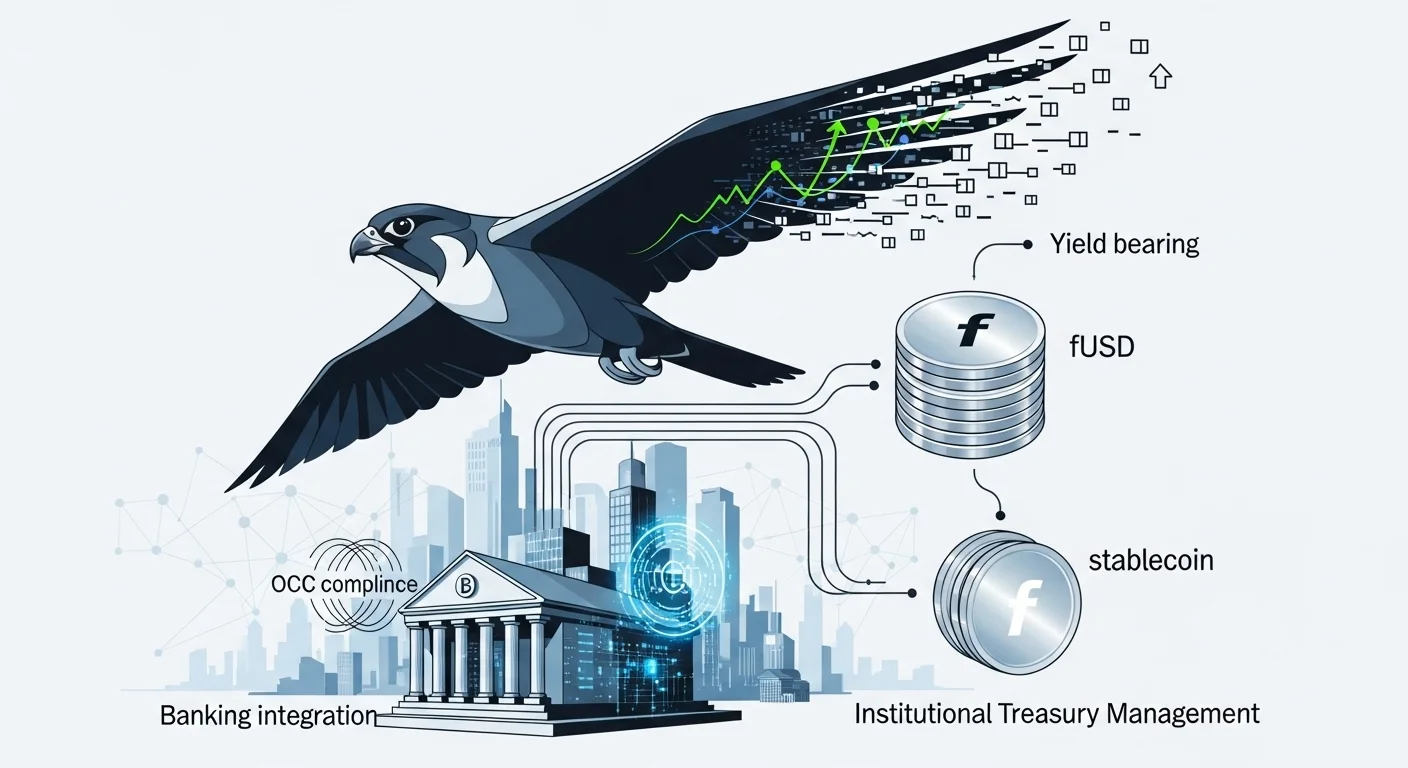
What Does OCC Compliance Mean for Crypto Adopters?
For large multinational financial institutions, compliance is non-negotiable. The OCC's involvement confirms that national banks can legally and operationally engage in stablecoin activities, establishing a predictable and legally sound framework. This legal certainty is paramount because it allows institutions to treat digital assets not as high-risk exotic investments, but as predictable, auditable components of their overall treasury portfolio.
The structure positions the stablecoin mechanism as an integral, regulated function, much like a commercial bank ledger. This systemic approach means that the stablecoin’s issuance and the management of its backing reserves are supervised by one of the strictest financial watchdogs in the United States. This single point of federal oversight drastically reduces the operational and legal complexity that previously required sophisticated and expensive bespoke legal counsel for every transaction or jurisdiction. For those exploring more regulated digital finance avenues, understanding the role of federally chartered banking becomes crucial, as previously major financial players were hesitant due to similar compliance risks.
How Does fUSD Achieve Institutional-Grade Transparency?
A major criticism of earlier stablecoins centered on opaque reserve backing—the "where did the money come from?" question. fUSD tackles this head-on by mandating rigorous, independent auditing mechanisms. The inclusion of global accounting firms, such as Deloitte, for mandatory monthly proof-of-reserve audits, establishes an unprecedented level of confidence.
This commitment to radical transparency means that institutional holders are provided with verifiable, real-time assurances that the stablecoin's reserves are fully collateralized and meticulously managed according to documented, conservative compliance standards. The operational model moves beyond simple blockchain tracking; it requires external validation of the underlying assets themselves. This two-pronged approach—supervisory oversight (OCC) plus external verification (Deloitte)—effectively raises the asset class from speculative digital currency to a true, quasi-bank-grade financial instrument fit for high-stakes capital deployment.
Key Facts
- OCC Oversight: Stablecoin reserve management and issuance are subject to the regulatory supervision of the Office of the Comptroller of the Currency, providing maximum legal predictability.
- Federally Chartered Banking: Anchorage Digital Bank's status provides the white-label, federally regulated infrastructure, mitigating fragmented state-level compliance risks.
- Mandatory Auditing: Reserves are subjected to mandatory, rigorous monthly proof-of-reserve audits by major accounting firms, ensuring deep financial transparency.
- Yield Mechanism: The stablecoin is designed to generate predictable, income-producing yields for eligible institutional holders from reserve operating profits.
Beyond Digital Dollars: Integrating Yield and Treasury Management
The most significant functional shift introduced by fUSD is the incorporation of a target annual yield for eligible institutional participants. This capability fundamentally alters the stablecoin's utility proposition. A stablecoin, traditionally viewed as a perfectly neutral, zero-yield digital dollar replacement, now becomes an income-generating asset.
For institutional treasuries, this changes the calculus entirely. The asset can now fulfill multiple critical functions simultaneously: (1) maintaining dollar parity for operational fungibility, (2) providing highly liquid collateral for rapid deployment, and (3) generating predictable yield on reserves. This tri-functionality makes fUSD invaluable within sophisticated asset-liability management (ALM) frameworks. Instead of having to allocate capital across multiple, non-correlated assets to achieve liquidity and yield, institutions can increasingly deploy funds into a single, auditable, regulated digital instrument. This feature is what accelerates the integration of digital assets into the core mechanics of traditional capital flow management, creating a fully digital, yet fully compliant, financial loop.
Furthermore, this integration signals the beginning of a critical shift in global payment architecture. As more banks and financial services providers adopt this regulated digital rails, cross-border payments, trade finance, and collateral management can become exponentially faster and cheaper than existing SWIFT-based systems, without compromising local banking regulatory standards. The regulated nature of fUSD ensures that the inherent efficiencies of blockchain technology do not conflict with the foundational principles of global financial stability.
Expert Commentary
From a seasoned institutional trader's perspective, the fUSD launch is not a market catalyst in the immediate sense; it is a structural settlement. What the market needs to realize is that regulated stablecoins are not competing with fiat currencies; they are competing with the operational overhead and illiquidity inherent in the legacy banking system. The fact that this model relies on a federally chartered institution (Anchorage) and an established regulatory body (OCC) means that the systemic risk profile is inherently lower and more predictable than competing decentralized models.
The yield component is the smoking gun. Previously, the narrative around stablecoins was purely about preservation of value—a digital parking spot for dollars. By introducing a measurable, auditable yield, the stablecoin is positioned as an active investment vehicle for treasuries. For any institutional investor watching this space, the key takeaway must be to track the correlation between fUSD's yield and short-term T-bill yields, as this will provide the clearest measure of its safety and utility relative to core cash instruments. We are seeing the final piece of the institutional puzzle click into place: a highly efficient, regulated, and income-generating digital dollar. This signals the definitive start of the 'Settlement Layer' being digitized, and the money flow will adapt rapidly to this superior infrastructure.
Google Search Preference
Add Fintech Monster to your preferred sources
Never miss deep, analytical fintech insights. Prioritize our stories in your Google Search, Discover feed, and AI Overviews with one click.
About the Author
Fintech Monster
Fintech Monster is run by a solo editor with over 20 years of experience in the IT industry. A long-time tech blogger and active trader, the editor brings a combination of deep technical expertise and extended trading experience to analyze the latest fintech startups, market moves, and crypto trends.