Geopolitical Shockwaves: Why Privacy Tokens Declined Amid US Strikes on Iran
Key Takeaways
Escalating geopolitical tensions, specifically US strikes on Iran, triggered a systemic risk-off event, forcing privacy tokens like Zcash and Monero to decline despite their anonymity focus, signaling crypto's deep correlation to global macro risk.
The cryptocurrency market demonstrated a profound susceptibility to real-world geopolitical shocks this week, culminating in a sharp decline for anonymity-focused assets like Zcash (ZEC) and Monero (XMR). The market sell-off was directly correlated with escalating tensions in the Middle East, particularly reports of US military strikes on Iran, confirming that even the most technologically advanced privacy coins cannot insulate themselves from systemic global panic. This movement signals a powerful paradigm shift in how institutional capital views crypto: not as a perfectly uncorrelated hedge, but as a highly speculative asset class deeply integrated into the global risk matrix.
Historically, proponents have long touted digital assets as a sanctuary from the volatility of national currencies and political conflicts. The underlying thesis was that decentralized digital finance would provide an ultimate layer of insulation. However, the recent market reaction challenged this core assumption. The selling pressure was not confined to single, vulnerable altcoins; it spread across the board, pulling down major players like Bitcoin (BTC) and Ethereum (ETH), indicating that the primary driver was a pervasive "risk-off" sentiment. This sentiment, fueled by concerns over global commodity prices (notably oil) and the subsequent fluctuating strength of the US Dollar, forced investors into profit-taking cycles that disproportionately affected high-risk, speculative tokens, placing pressure on assets that were previously seen as technological cornerstones of decentralized finance.
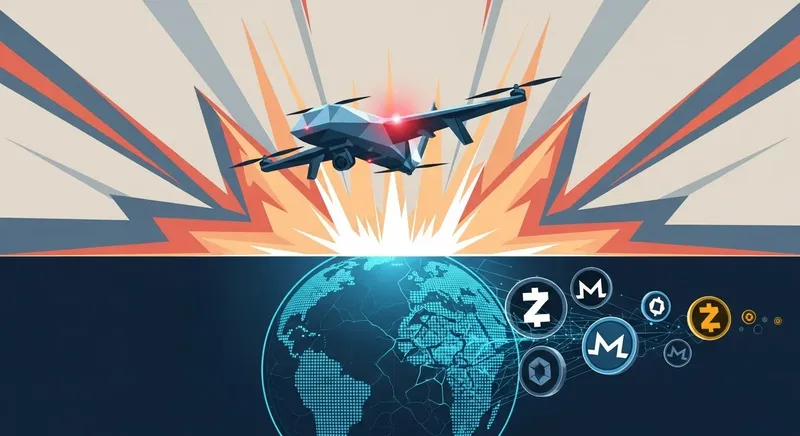
How Did Geopolitics Suddenly Impact Privacy Coins?
The collapse of ZEC and XMR defied their fundamental design principles. These tokens are architected precisely to resist surveillance and minimize on-chain traceability, making them ideal for environments of high political instability. The market's response, however, suggested that the fear associated with instability was far more powerful than the solution provided by privacy.
The primary mechanism at play was the classic risk-off dynamic. When major global powers clash, investors do not look for privacy; they look for capital preservation. Since crypto assets, particularly altcoins, are universally viewed as high-beta, speculative investments, they were among the first categories of assets liquidated to generate cash for safer, perceived havens. This wave of profit-taking meant that even sophisticated technology, such as Zcash's zk-SNARKs or Monero's Ring Signatures, failed to protect the market capitalization from the sheer weight of collective investor fear.
What Do the Core Technical Failures Suggest?
The decline exposed a critical technical vulnerability in the crypto investment thesis: the correlation to global macro-factors. The simultaneous downward movements across BTC, ETH, and specific altcoins like ZEC and XMR confirm that the market is treating crypto as a high-risk bet on global economic stability.
When the Fear and Greed Index fell into 'fear territory' amid heightened geopolitical risk, the capital flow shifted away from speculative growth bets. Institutional players, who often lead these speculative rallies, were likely executing coordinated risk-management sell orders. This institutional withdrawal, triggered by the US-Iran flashpoint, amplified the sell-off, confirming that the liquidity in the crypto ecosystem remains heavily dependent on perceived global calm and stable macro indicators.
Key Facts
- Correlation Evidence: The simultaneous decline across BTC, ETH, and privacy tokens (ZEC, XMR) demonstrates a high correlation with global risk sentiment, overriding perceived asset independence.
- Privacy Token Performance: Zcash (ZEC) experienced an approximate 5.2% drop, while Monero (XMR) saw a decline of around 4%, marking significant deviation from prior performance.
- Market Context: Bitcoin traded near the $76,500 mark, having fallen from previous highs, confirming a widespread risk-off appetite.
- Macro Driver: The primary catalyst was the escalation of geopolitical risk stemming from the US-Iran conflict, triggering global liquidity tightening.
Bitcoin's Position and the Search for Uncorrelated Assets
While the focus was on the privacy tokens, Bitcoin's movement was equally telling. Bitcoin's struggle to hold above key resistance levels ($80,000+) highlights that its perceived status as "digital gold" is not guaranteed in the face of military escalation. Traditionally, assets like gold or physical commodities are viewed as zero-correlation hedges against geopolitical shocks. The fact that BTC also fell suggests that the current fear is so pervasive it has downgraded all speculative digital assets, forcing a re-evaluation of what genuinely constitutes an uncorrelated safe haven.
The broader market sentiment has shifted into a consolidation phase, marked by caution. This is a necessary correction after periods of aggressive growth fuelled by institutional excitement around specific sectors, such as decentralized infrastructure and enhanced privacy. Traders are now assessing whether the fundamental utility of privacy tokens (maintaining anonymity for high-value transactions) can outweigh the systemic risk posed by state-level conflicts and their resulting global economic uncertainty.
Ultimately, the takeaway here is not about the technical failure of ZEC or XMR; it's about the profound correlation between technological finance and geopolitical reality. We must retire the notion that crypto is inherently decoupled from the physical world. In reality, it is deeply leveraged to global liquidity, commodity pricing, and, most critically, geopolitical stability.
This market cycle shows that "decentralization" cannot insulate an asset class from macroeconomic shocks or geopolitical tension. When governments, energy flows, and commodity markets become unpredictable—as seen in the tension between the US and Iran—the risk premium demanded by capital flows instantly increases, causing speculative assets to deflate regardless of their underlying technology.
Investors should temper the expectation of technological immunity. True portfolio resilience requires diversifying across geopolitical risk vectors, not just technological ones. The current environment suggests that macro-level risk, measured by geopolitical instability indices, will remain a dominant factor, demanding a more cautious approach and a shift in focus from pure technological innovation narratives to tangible, real-world infrastructure risk mitigation. The digital gold narrative is currently being overshadowed by the volatility of global power structures.
Google Search Preference
Add Fintech Monster to your preferred sources
Never miss deep, analytical fintech insights. Prioritize our stories in your Google Search, Discover feed, and AI Overviews with one click.
About the Author
Fintech Monster
Fintech Monster is run by a solo editor with over 20 years of experience in the IT industry. A long-time tech blogger and active trader, the editor brings a combination of deep technical expertise and extended trading experience to analyze the latest fintech startups, market moves, and crypto trends.