Sui Network Downtime: When 1,500 TPS Meets Systemic Risk
Key Takeaways
Sui's recent six-hour outage, attributed to a software bug during a major upgrade, shifted market focus from peak theoretical throughput to demonstrable, continuous uptime and core network reliability.
The recent operational instability experienced by the Sui blockchain network in late May 2026 represents a critical inflection point for the Layer-1 ecosystem. After achieving impressive peak performance metrics, the platform suffered a major, publicized network stall lasting approximately six hours. This incident immediately shifted the conversation among sophisticated institutional capital and seasoned developers, fundamentally altering the market's assessment of the platform's operational maturity. The core takeaway is stark: achieving record-breaking throughput (TPS) is academically impressive, but proving sustained, continuous uptime under real-world stress conditions is the true measure of infrastructure value.
This downturn was far from an isolated glitch; it was the second major system disruption within a compressed timeframe, directly tied to the deployment of a major network upgrade (version 1.72). When a core consensus mechanism fails, the entire distributed ledger halts, freezing all block production and transaction processing. The complexity of the failure, which necessitated a supermajority consensus fix among validators, provided an unparalleled, if alarming, case study in the failure modes of modern, high-speed distributed systems. For investors and enterprise adopters, the focus is no longer solely on the theoretical maximum capacity but on the Mean Time Between Failures (MTBF) and the speed of recovery.
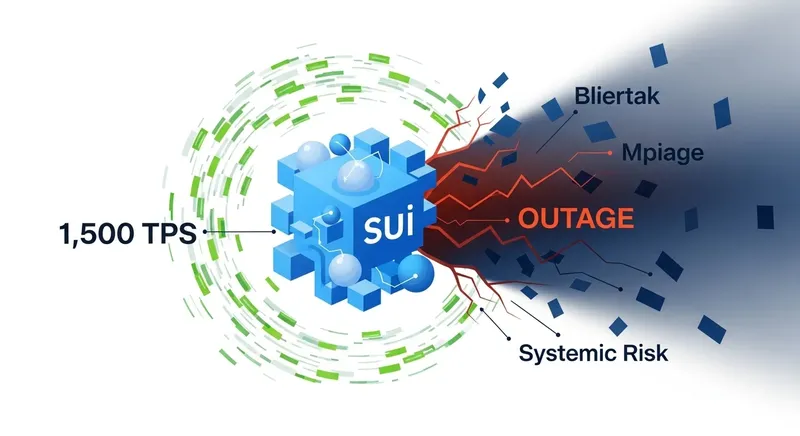
High throughput doesn't guarantee reliability
The narrative tension created by Sui is profound: how can a system capable of processing an astonishing 1,539 Transactions Per Second (TPS)—a metric designed to appeal to major institutional payment rails—also suffer a complete operational stall for six hours? The answer lies in the immense complexity and speed of the underlying distributed consensus mechanism. When developers push rapid, iterative upgrades, even minor bugs can introduce systemic weaknesses.
The incident was explicitly traced back to a flaw introduced during the 1.72 software upgrade. This bug did not merely slow the network; it corrupted the core mechanism by which validators agreed on the next block state. In a highly decentralized environment, when consensus fails, the default safety mechanism kicks in: the network halts to prevent the permanent divergence of the ledger. This safety feature, while critical for data integrity, immediately translates into a total loss of service. Understanding this failure mode is key to appreciating the true risk profile of advanced Layer-1 platforms.
The Economics of Operational Failure: Price Action and Reliability
The immediate market reaction proved the high correlation between infrastructure reliability and asset valuation. During the period of the six-hour stall, the native SUI token saw a significant, measurable decline in value, with reports citing drops between 6% and 8%. This immediate price reaction underscores that, for sophisticated investors and institutional players, uptime and predictable performance are monetized risks.
The failure demonstrates that theoretical throughput (TPS) is insufficient. The market is increasingly valuing reliable throughput—the consistent ability to process transactions without interruption.
Key Technical Takeaways from the Outage
- Consensus Vulnerability: The event highlighted the vulnerability inherent in complex, high-speed consensus mechanisms. Every upgrade introduces potential failure points that must be rigorously tested across heterogeneous network conditions.
- The Cost of Complexity: The drive for ever-higher throughput inevitably increases the complexity of the underlying code. This complexity, while desirable for scalability, multiplies the attack surface and the potential for catastrophic, system-wide failure.
- The Shift in Value: The market narrative is shifting from "What is the maximum potential throughput?" to "What is the guaranteed, sustained uptime?"
Crucial Lessons for the Next Generation of Blockchains
To move beyond mere theoretical capability, future blockchain infrastructure must prioritize resilience and predictable failure modes. The focus must shift to:
- Automated Regression Testing: Mandatory, exhaustive pre-release testing simulating real-world stresses and edge-case failures.
- Graceful Degradation: Designing the system so that if one component fails, the entire network does not crash. Instead, certain services should degrade gracefully, allowing core functionality (like transaction validation) to continue.
- Real-Time Health Monitoring: Implementing hyper-vigilant monitoring that detects deviations in performance metrics before they trigger a critical failure.
Google Search Preference
Add Fintech Monster to your preferred sources
Never miss deep, analytical fintech insights. Prioritize our stories in your Google Search, Discover feed, and AI Overviews with one click.
About the Author
Fintech Monster
Fintech Monster is run by a solo editor with over 20 years of experience in the IT industry. A long-time tech blogger and active trader, the editor brings a combination of deep technical expertise and extended trading experience to analyze the latest fintech startups, market moves, and crypto trends.